

(This is the last edition of a three-part series on Alexandria’s historic Wilkes Street Tunnel. Read PART I | Read PART II)
Matthew Eng, Offbeat NOVA
PART III: Out of the Dark and Into the Light
The Wilkes Tunnel, once a fixture of the local newspaper in the mid to late 1900s, lost its journalistic spotlight at the dawn of the twentieth century. The tunnel never made large headlines again and retreated to the minutiae of daily life. Minor repairs were done at the turn of the century, such as new safety signals in 1899 that regulated the speed of the incoming trains to a more respectable five miles per hour. Public opinion remained unchanged into the new century. By 1905, citizens still lodged ineffective complaints against the tunnel, particularly the east end. Under the headline of “A Dangerous Trap,” a May 12, 1905, article pulled out all the old theatrics of Alexandrians nearly two generations ago. “Sooner or later some careless child or nurse will precipitate a baby carriage and its occupant to the railroad track below, or a pedestrian tumble down the incline in the night, when a damage suit against the city will follow,” the article mused. Not long after that article was written, a young child happened fulfill the complaintive prophecy and fall into the tunnel. A young boy named Norton, a resident of tunnel town, fell into the tunnel just in front of his home off Wilkes Street in early September 1907. He as in fact the second child to fall in the tunnel that year. It became such an issue that the city Mayor at the time, F.J. Paff, to create a fence around the Western entrance. It was never confirmed if a fencing was put in place, as the complaints continued in the first decade of the new century.

Vagrants were caught playing poker in the concealed light of the tunnel’s entrances. Other children continued to jump on railcars and use the tunnel like some long-gone fortification to throw stones at railcars and pedestrians passing by. On April Fool’s Day 1911, the Gazette reported a prehistoric skeleton of a mastodon was “unearthed” from the east end of the runnel where the railroad company was making repairs. It was enough news for a small crowd of excitable residents to congregate at the tunnel the next morning, only to find the ruse a product of the mere changing of a calendar page and a forgetful public gullible enough to belief such a ruse.1
During the First World War, the tunnel was deepened to accommodate higher boxcars for the war effort. A recent archaeological investigation by the Office of Historical Alexandria unearthed a second rail line curving at Union Street and converging at the eastern end of the Wilkes Tunnel near a recent park construction. According to Archaeologist Garrett Fesler, the track was built between 1921 and 1941 before ultimately disappearing by 1964.2 Four years later in 1968, the Wilkes Tunnel was included in the first state-wide survey conducted by the Historic American Engineering Record (HAER). The sketches reside on the Library of Congress’s website. By this time, the surveyor sketching the drawing noted that the tunnel now lied “abandoned in the heart of Alexandria.”
The tunnel continued in use until 1975 when the tracks were removed, this time for good. The tunnel was soon repurposed as the pedestrian and bike pathway as it stands today. Somewhere between then and today, a historical marker was placed forward of the eastern entrance, detailing the history and legacy of the tunnel. That faded sign, like the tunnel, has also seen its better days. Plaques on the western end of the tunnel tell more of the tunnel’s history and connection to the once influential railroad that traversed through it. It’s hard to tell if anyone notices beyond the casual tourist or the jogger taking a short breather.
The closure of the tunnel was likely due to the decline of industrial activity on the Alexandria waterfront. The Old Town area has only increased in popularity in the years since the tunnel’s closure, becoming a Northern Virginia showpiece of new posh ships, stores, and restaurants still showing a feint veneer of the city’s past. The heart of this area is the regal intersection of King Street and Union the very road where the former Orange and Alexandria track once passed through before curving into the Wilkes Tunnel a half mile later.

The tunnel is not currently listed in the National Register of Historic Places. Alexandria is a city where you can’t throw a stone without finding the rounded bronze plaque bequeathed by the Department of the Interior. In all, there are forty-nine properties and districts listed under the National Register in the city of Alexandria. That includes six National Historic Landmarks (like the Historic District itself or Gadsby’s Tavern). The Wilkes Tunnel does not apply to either. Interestingly enough, the only other surviving portion of the Orange and Alexandria Railroad present down the street from the tunnel, the Hoof’s Run Bridge, has been on the National Register since 2003. In the nomination form for the bridge, the author references the “tunnel in Alexandria” on multiple occasions but treats it as the lesser of two surviving structures to the now-defunct railroad. Perhaps those deep-seeded misgivings of the residents of “tunnel town” were too much after all.3
That doesn’t mean the tunnel has left the public eye in recent years. In the Internet information age, the tunnel has made a resurgence of interest in travel websites, biking blogs, Yelp reviews, and Flickr pages. It’s a popular place for local couples to take wedding or engagement photos. If they only knew the irony of those photos given its history and connection to unchecked domestic violence. Less than a mile away from the Old Town Alexandria Ghost Tour hub on King Street, the tunnel has made its rounds among the macabre musings of several amateur writers such as this humble entry into the historical/pop culture lexicon. If anything, the tunnel is photogenic and short enough for light to pass through your camera lens, making it eerie, but not eerie enough.

Looking at Google Maps, the overhead satellite map shows the curved road where the track from Union Street bent sharply into the Wilkes Street Tunnel. That is where the high-priced townhomes are located today, standing guard like affluent sentinels standing guard over their not-so historic landmark. How many have actually contemplated the tunnel’s history before passing through it?

A small park called Windmill Hill just over the bluff where Fairfax Street passes over the tunnel, providing the bookend to the overpriced homes of the city’s nouveau riche on the right of the eastern entrance. There is a spacious basketball court and playground where kids play; no doubt they are local to the area. One would highly doubt they refer to themselves as residents of “tunnel town” today as they did so long ago.
Walking through the tunnel, you don’t feel any “cold spots” that some bloggers love to pontificate about in their content. You can still see the simplistic vaulted sandstone walls as you walk into it. The farther you walk in, the more you take in the landmark’s dank, mossy bouquet, especially on a warm day. At the tunnel’s center point, approximately half of the one-hundred-and-seventy-foot distance, it is very dark, even in the daytime. Your mind does wonder if you are standing at the exact point where Private Scotten was murdered. Where they dragged the dead body to be crushed by a passing train during the Civil War. And, of course, where Mollie McKinley struggled with her violent husband before being shot four times. You walk in the same blood-soaked path she did in near darkness before she sought help out into the daylight. You don’t feel an otherworldly presence while you are in the tunnel, but your mind will at least wander with its strange and complex history carefully in tow.
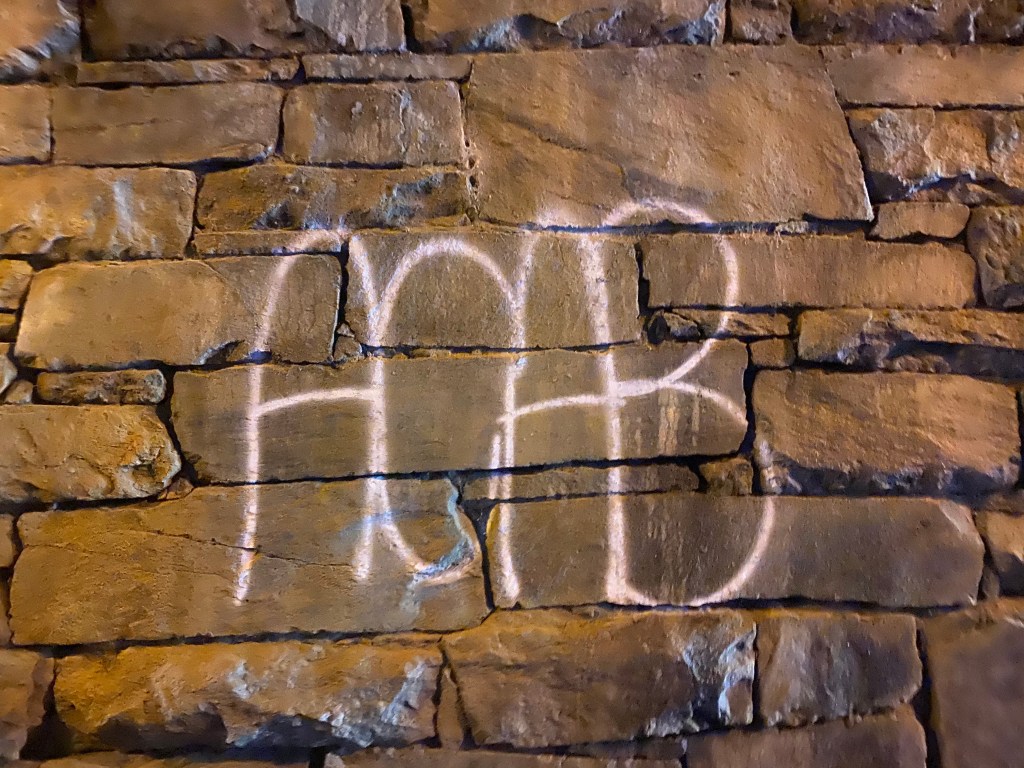
Very little else of the historic track remains in Alexandria. But then again, Alexandria is no longer the type of city that sustains railroads, foundries, and tanneries as it did in its commercial and industrial heyday. The tunnel once attracted anything form concerned parents, drunkards, vagrants, to the occasional murderer. Nowadays, it’s a breezeway for runners and bicyclists’ daily workout regimen. The tunnel, in many cases, is one of the few remaining pieces of that city’s history untainted by gentrification and modern conveniences. The city that exists around it today is much different. Alexandria, for better or worse, has evolved into tunnel town’s polar opposite. “It wasn’t always high-priced townhomes, archaeologist Garrett Fesler once said. “It was a working, thriving city.” Whatever tiny part the Wilkes Tunnel played in that narrative; it kept its working class literally on track.
Footnotes
- Alexandria Gazette, September 4, 1907; Alexandria Gazette, April 1, 1911.
- Evan Berkowitz, “Construction Unearths 20th-Century Railroad Tracks,” Alexandria Times, July 20, 2017. Accessed 12 July 2020, Link.
- Virginia Department of Historic Resources, “Orange and Alexandria Railroad’s Hoof’s Run Bridge,” PDF Upload (April 2018), Accessed 11 July 2020, Link.

 Offbeat NOVA