
By Angela H. Eng, Offbeat NOVA
In Xanadu did Kubla Khan
Samuel Taylor Coleridge, Kublah Khan
A stately pleasure-dome decree:
Where Alph, the sacred river, ran
Through caverns measureless to man
Down to a sunless sea.
I can’t recall where I first heard about the Potomac Arks. I might have been doing some research for another project when some small mention of them caught my eye—the floating brothels of the Potomac. And somehow, when I was imagining these boats, small snatches of Coleridge’s fragmented poem would come to mind: opulence, metaphorical pleasures, and the river.
Intrigued, I decided to research more, and soon found out that the Potomac River was filled with these brothel boats in the years after the Civil War up until sometime between the 1920s and 1940s.
According to John Wennersten’s Historic Waterfront of Washington, “As Washington became a center of military and industrial activity [during the Civil War], it also became a city awash in a tidal wave of cash . . . Prostitution, an activity long associated with the Potomac waterfront, increased dramatically.”1 Around the same time, local boat builders invented the “Potomac Ark,” an inexpensive houseboat that could house fishermen and shipyard workers.2 Frederick Tilp, author of This Was Potomac River, described what these boats were like:
The standard specifications called for a boat 24 feet by 10 feet by 12 inches draft, with a flat bottom and square ends. It would have cedar clapboard siding, red-painted flat-tin roof, two windows, two doors, and would be lighted by kerosene lamps, and would use a coal fired stove for heating and cooking. Arks moored at the water’s edge, rested on the bottom at low tide, and poling and rowing were their only means of propulsion.3
Frederick Tilp, This Was Potomac River
Though these boats were designed for fishermen and shipyard workers, pollution caused fishing and shipbuilding to decline; eventually, the arks were sold to sex workers that operated close to the river.4 In time, the river was filled with hundreds of floating brothel boats. By the early 1900s, the arks began to spread beyond the confines of Washington and to nearby cities in Maryland and Virginia. These states were safe havens for the arks because Alexandria had “sympathetic politicians and influential gentry,” while Maryland State Police were “too busy chasing oyster pirates.”5
Tilp described the ark operations as a “‘one woman” type of enterprise. Each woman ran her own business on her own ark, at whatever location she pleased.6 Parke Rouse, in a Daily Press article about historical bawdy houses in Virginia, quoted the Virginia Canals and Navigations Society’s description of the arks: “small floating houses of prostitution, most of them painted white or blue (the more high-class boats usually were white with blue roofs and shutters) lined the shores and clustered around gambling casino boats.”7
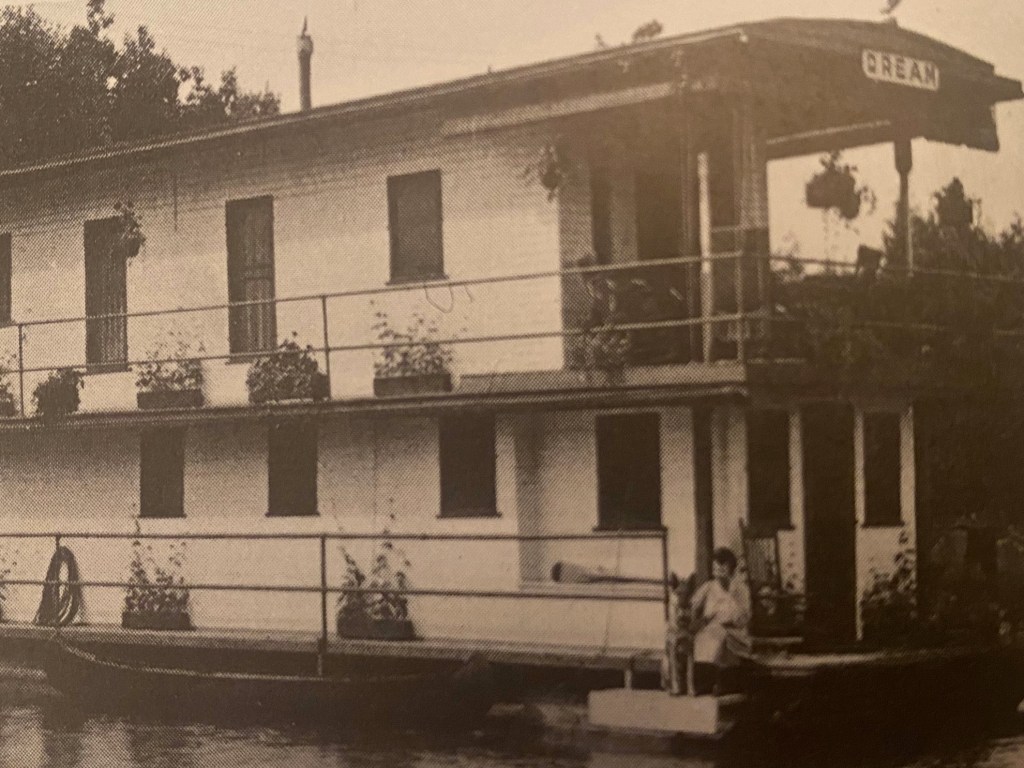
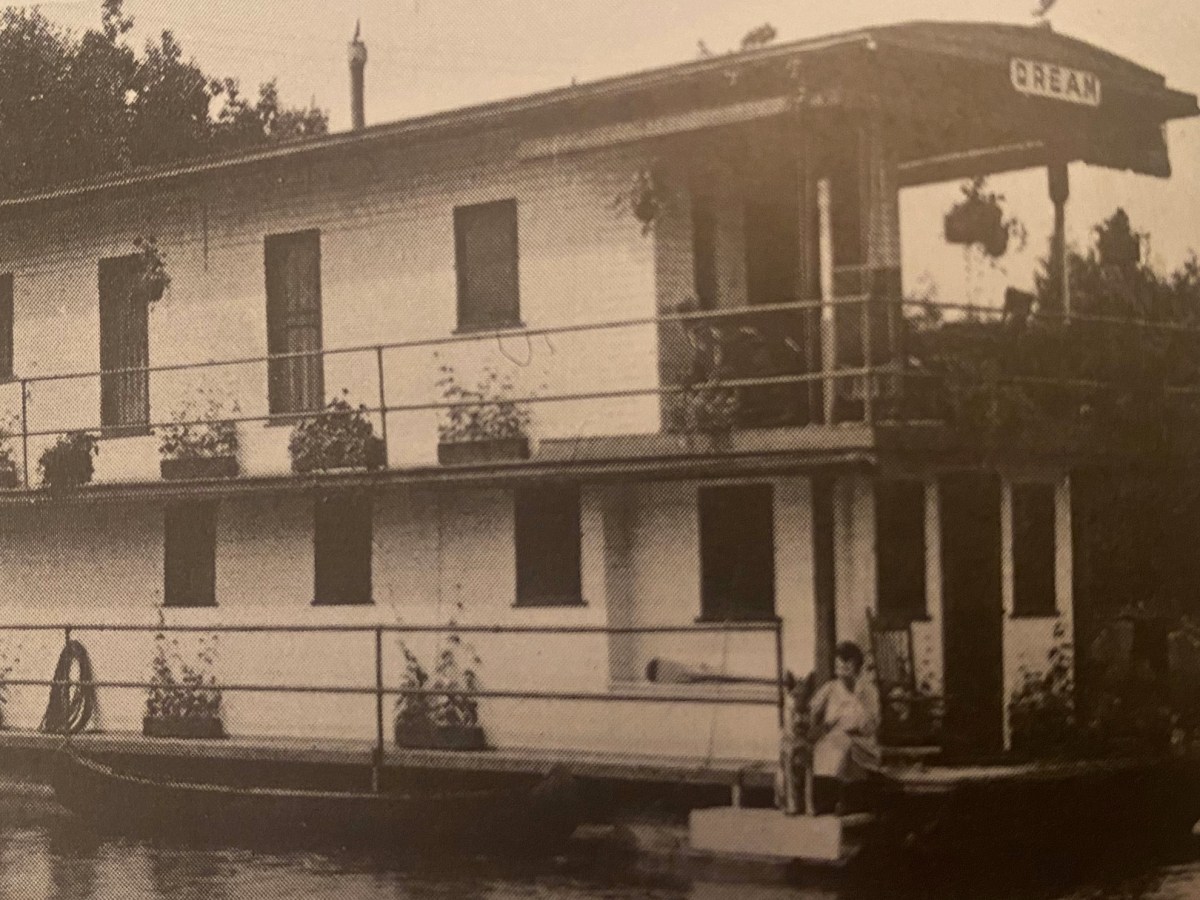
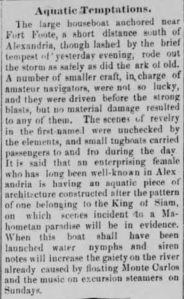
The most famous of these arks, according to Tilp, was the only known two-story houseboat named the Dream, run by a lady named Madam Rose. Though there is little mention of the arks in the press during this time period, the Dream was featured in a 1905 Alexandria Gazette article. The article stated that the infamous brothel survived a “terrible northwest storm” and the “scenes of revelry on board were not checked by the wild outside elements” and small boats “continued during day and night, carrying patrons to and fro.”8 Tilp, when citing the article in his book, also mentioned a second opulent boat the Dream’s owner was building, “patterned after one belonging to the King of Siam.”9 Unfortunately, like the majority of these boats, its fate is unknown.
These brothels and gambling arks flourished because Virginia had no jurisdiction over the river and because Maryland and the District ignored them.”10 A Washington Post article from 1905, when describing a gambling ark that frequented the waters just outside of Alexandria, acknowledged that “The Ark is slow but clumsy, but she flirts airingly outside the law . . . If the Ark happens to be lying inside the District line and the metropolitan officers attempt to raid her, the anchor is up in a trice and in thirty seconds she has drifted into Maryland or Virginia, beyond the reach of pursuing officials.”11 Likewise, if Maryland or Virginia police attempted a raid, the boat would then cross back over into the District. Similarly, these brothel arks evaded the law.
A popular spot for these boats was Jones Point, Alexandria. Here, the boundary lines between Maryland, Virginia, and D.C. all intersected, so it was easy for these arks to operate in the waters just beyond the city. Now a park, Jones Point has the original D.C. boundary stones and the point lighthouse preserved. A historical marker at the lighthouse even mentions these arks. The marker specifies that the oil that fueled the lighthouse lamp was red for a time, which coincided with the height of popularity for the arks, thus making the waters of the Potomac a literal “red light district.”12

And so these illicit businesses boomed until the late 1920s, when the surveys for George Washington Highway began.13 Donald Shomette, a Mallows Bay historian,14 notes that the Potomac Arks saw a resurgence during the great Depression, since scavengers would come to the wrecks in Mallows Bay and acquire scrap metal; as a result, the colonies of bootleggers, gamblers, and prostitutes thrived once more.15 Though I can’t recall where I might have read it, supposedly the remains of some of those boats are among the shipwrecks in Maryland’s Mallows Bay. Though the arks would survive through World War II, they were entirely wiped out by the 1960s.16 The last known photograph of an ark is in Tilp’s nautical tome; taken in 1957, the photo shows a small ark in Great Hunting Creek, Virginia.
And so the Potomac Ark disappeared from history. Until 1993, that is. Alexandria city workers had started demolishing a blighted part of the Alexandria waterfront and ceased operations when they discovered that the structure was part of a wooden barge sunken in the dirt.17 The Washington Post continues, “City historians quickly arrived and declared it an ark, probably built about 1900, and the only known survivor among the thousands of houseboats, gambling barges and floating brothels that lined the Potomac River from the Civil War to after World War II.” Though historians could not ascertain what the use of this particular ark was, there’s no doubt it is a unique and priceless part of history on the Potomac.

The ark was given to the Alexandria Seaport Foundation. The foundation restored the ark and it now serves as the McIlhenny Seaport Center, the headquarters for the foundation. The foundation assists troubled youth through mentoring and teaching woodworking and boat construction.
It’s funny to think that this ark may have once been a gambling house or brothel, but now serves as a safe haven for troubled youth. That’s pretty cool to me.
Footnotes:
- Wennersten, John R. The Historic Waterfront of Washington, D.C. Charleston, SC: The History Press, 2014.
- Frederick Tilp, This Was Potomac River (Bladensburg: Tilp, 1987), 306.
- Tilp, Potomac River, 306.
- Ibid.
- Ibid.
- Ibid.
- Parke Rouse, “Bawdy Houses Abounded in Virginia.” dailypress.com, August 16, 2019. Accessed it September 17, 2020, LINK.
- “Aquatic Temptations,” Alexandria Gazette and Virginia Advertiser, August 14, 1905.
- Tilp, Potomac River, 308.
- Rouse, “Bawdy Houses.”
- “Houseboat for Gamblers: Gamesters Revel on Former Ferryboat Moored Near Alexandria,” The Washington Post, Mar 18, 1907.
- The historical marker is located just south of the Jones Point lighthouse in Jones Point Park, Alexandria, VA.
- Tilp, Potomac River, 308.
- Mallows Bay, Maryland, is the marine sanctuary where, per the website, “protects and interprets the remnants of more than 100 World War I-era wooden steamships – known as the ‘Ghost Fleet’ – and other maritime resources and cultural heritage.”
- As quoted in Fenston, Jacob and Tyrone Turner, “Ghost Fleet: Exploring The WWI Skeleton Ships Of The Potomac.” WAMU 88.5, October 22, 2019. Accessed September 16, 2020, LINK.
- Tilp, Potomac River, 308.
- Hodge, Paul. “Discovering a Lost Ark.” The Washington Post. WP Company, February 18, 1993. Accessed September 16, 2020, LINK.
 Offbeat NOVA