

By Angela H. Eng, Offbeat NOVA
When I first came upon the story of the Fairfax Butt-Slasher I thought, this has to be some kind of blown-out-of-proportion urban legend.
We had stories like that where I was from—the Pembroke Mall Leg Slasher or the Lynnhaven Mall Car Stalker. In the Pembroke Mall variation, a person—usually a man—would hide underneath a car. When the owner of the car, almost always a woman, returned her car with her hands full of shopping—almost always Christmas shopping—the man under the car would slash at the woman’s legs, leaving a series of gashes that would require stitches. In the Lynnhaven Mall variation, the victim would be leaving the mall late at night and would be the owner of the only car left in the parking lot. Like the other story, the victim would be juggling shopping bags and be preoccupied with getting home. Of course, someone—almost always a man in these stories as well—would be lurking nearby the car or sometimes IN the car, waiting to attack. We told these stories so much as kids, I can’t remember if they actually happened or not.
Supposedly, the “Mall Slasher” trope has been in vogue since the late 1970s and has some similarities to actual events, but most of these stories have been reduced to urban legend status.1 I think I can be forgiven for thinking the Butt-Slasher was another one of these outlandish stories reduced to middle-school whispers or high-school bathroom conversation.
Turns out, the Fairfax Butt-Slasher was not a punchline—it was totally real. The Butt-Slasher was responsible for a series of attacks on young women during most of 2011.

The first victim of the Butt-Slasher was a pregnant woman in her 20s. She was leaving Fair Oaks Mall in Fairfax, Virginia, in February 2011 when she noticed someone behind her:
I’m pushing the door open, and then all of sudden, he’s right there behind me, and I felt a pinch on my bottom and I thought he just grabbed me and I was like, ‘Hey, you just cut my leggings,’ and he was like, ‘No, no, no. It was my bag.’ He was carrying a little, yellow bag.2
At first, the victim said, she didn’t even know she was cut. However, the cut was deep and she ended up with a permanent scar.3
The attacks continued: one on March 11 at the Tyson’s Corner H&M, and another on May 16 at the Fair Oaks Mall Ann Taylor. On June 8, a 21-year-old woman was shopping at the T.J. Maxx at Fairfax Towne Center in when she felt a pinch on her buttocks. The woman did not realize that she had been the victim of an assault and did not report the attack to police until later.4
It’s hard to gauge the mood of Fairfax at this time, but perhaps it is best summed up in this 2011 tweet:

By this time, the police had put a profile together: according to the victims, the suspect was a heavyset, 5-foot-6 Latino man in his late 20s. He was using a box cutter or a razor to slice at women’s buttocks shortly after distracting them.5 Some experts speculated that he may have had a rare sexual disorder known as piquerism.6 A Psychology Today article from 2015 cites Dr. Anil Aggrawal’s definition of the disorder: “sexual arousal from penetrating another person’s body with sharp objects (such as pins, razors, knives, etc.).”7 Though the article names the Fairfax Butt-Slasher as an example of piquerism, is it clear by the other examples that the Butt-Slasher’s case was downright mild.
On June 18, the slasher struck again at the Tyson’s H&M, followed by another attack at a Marshall’s in an area called the Greenbriar Towne Center. All of the attacks followed the same pattern: distracting a young woman, slashing her with a sharp object, then disappearing. On July 25, he attacked an 18 year-old shopping at Forever XXI. She was distracted by a rack falling, then, as the Herald Sun in Australia reported, “felt a ‘sharp pain’ in her backside which she dismissed as a coat hanger. Later she realised her behind was cut and bleeding and her denim shorts had been slashed. The wound was about an inch and a half (4cm) long.”8
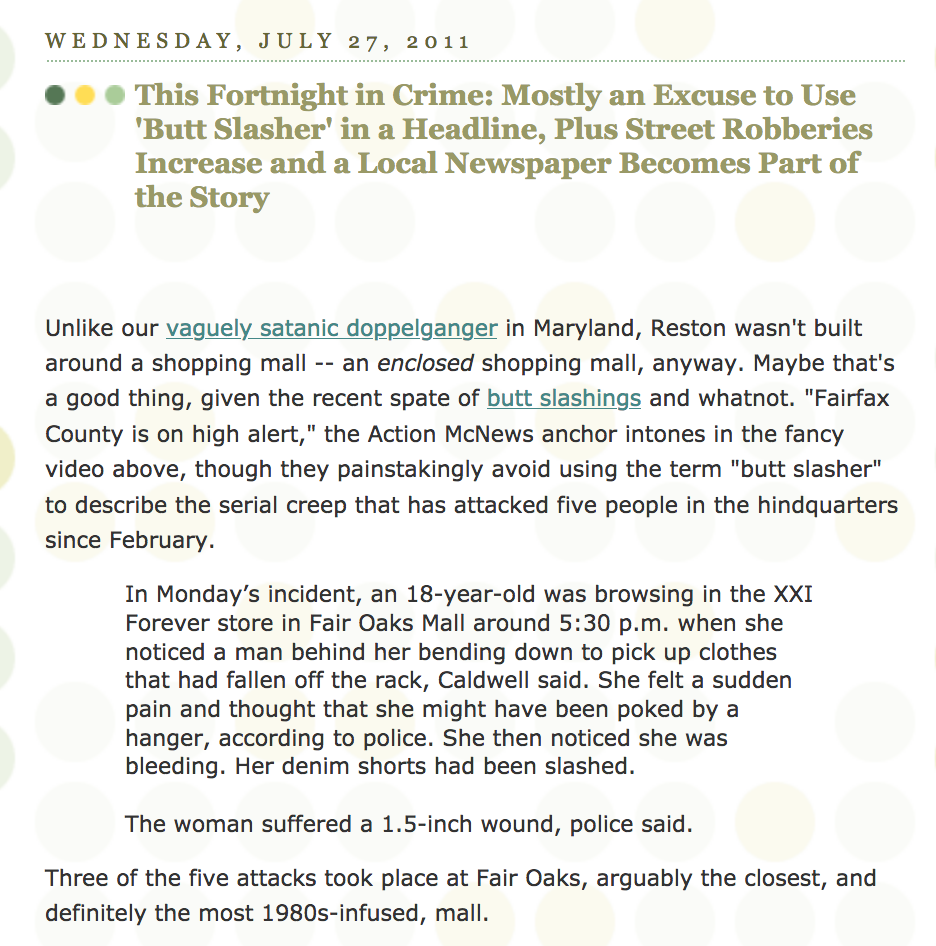
The news had reached as far as Australia, where the suspect was known as “the serial bum-slasher.” In late July, following the Forever XXI attack, the Restonian blog made a half-serious, half-joking post about the phenomenon. Though the blog is slightly tongue-in-cheek, the August edition of the Fairfax Connector took a more serious turn:
However, said police spokesman Lucy Caldwell, ‘Women shouldn’t feel this is isolated just to Fair Oaks Mall. This type of behavior could happen anywhere’ . . . police ‘don’t want women to feel unduly afraid to go shopping. But if they feel at all uncomfortable in a store, they should report it to store security. There’s no reason to believe it won’t happen again, so women should stay alert . . . they should also consider shopping with a friend,’ she said. ‘Actually, these are general safety tips women should always use — these incidents just highlight them.’
Being a woman is grand in 21st century America.
Eventually, the slasher was identified as 41 year-old Johnny Pimentel, a former day laborer. The police were able to identify him via an anonymous tip.9 By September, the news reported he had fled Northern Virginia. Eventually, in January 2012, he was arrested near a shopping mall in Peru. One article mentioned that it was unclear how he got to Peru, and it was also unclear whether he could be brought back to the United States to stand trial.10 Eventually, almost an entire year later, he was extradited to the United States in December 2012. He remained in jail, plead guilty to the charges against him, and was sentenced on September 6, 2013. At the hearing, he was reported as saying, “I’m very remorseful for all the things that are occurring, and I ask you to pardon me.”11
However, he was sentenced to 20 years in prison, and the judge suspended all but 7. That would make this year the year of his release, but I couldn’t locate any up-to-date information on him.
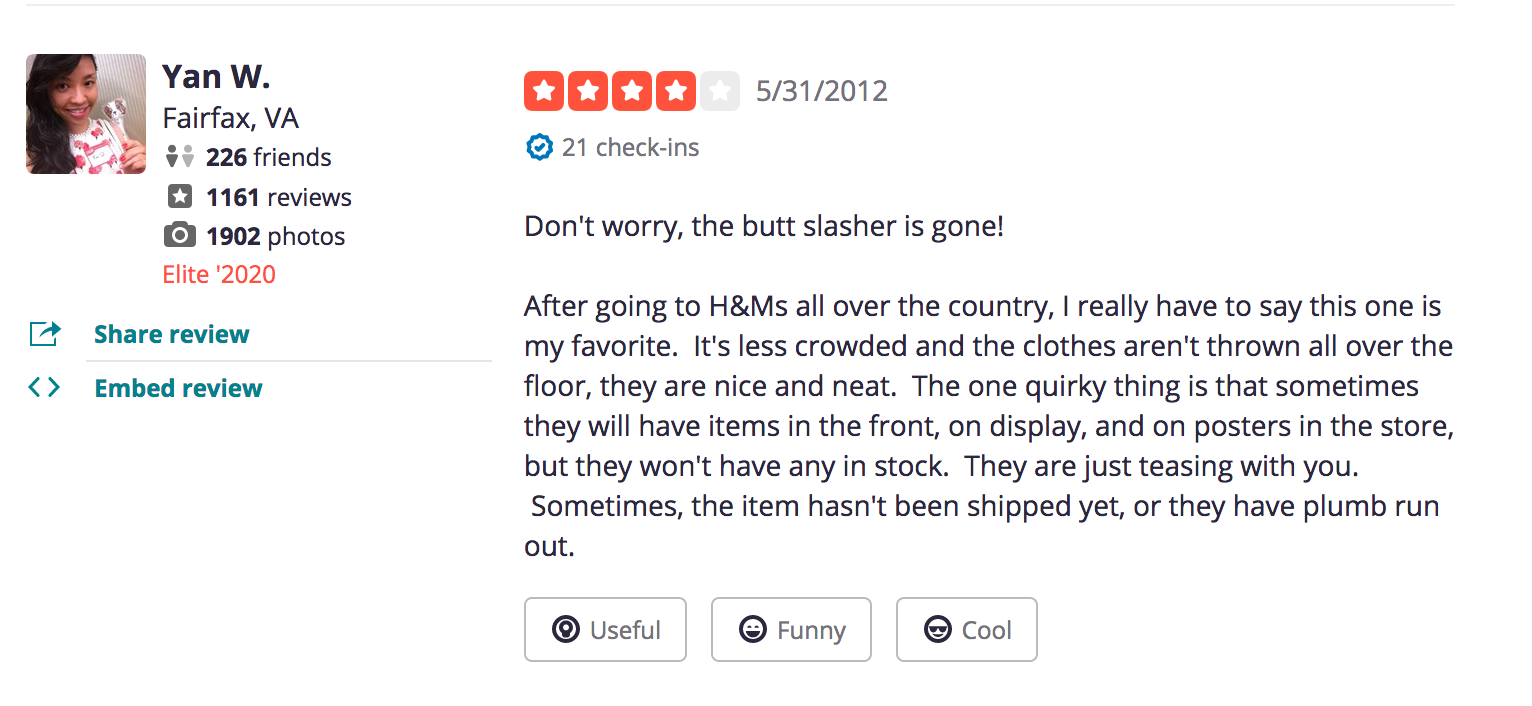
Perhaps a fitting end to the story is at the start of this 2012 Yelp review of the Tyson’s Corner H&M:
If folklore experts examine stories as cultural artifacts and search them for clues about the attitudes, fears, and beliefs of the cultures they come from, it would be easy to dismiss the stories I heard from my hometown as stories about women’s fears of being vulnerable, or even dismiss it as some kind of anti-capitalist tale.
But the more I read about this story and the attitudes surrounding it, I had to wonder—what happens when the urban legend is true?
Footnotes:
- Peter Kendall, “URBAN YARN OF `MALL SLASHER` JUST WON`T DIE,” Chicago Tribune, September 2, 2018. Accessed October 25, 2020, LINK.
- Matthew Stabley John Schriffen, “Butt-Slashing Victim: ‘I Didn’t Even Know I Was Cut at First,’” NBC4 Washington, July 29, 2011. Accessed October 25, 2020, LINK.
- Stabley and Schriffen, “Butt-Slashing Victim.”
- Reshma Kirpalani, “Serial Butt Slasher Blamed for 6 Assaults in Virginia,” ABC News, August 3, 2011. Accessed October 24, 2020, LINK.
- Kirpalani, “Serial Butt Slasher.”
- Ibid.
- Mark Griffiths, Mark, “Life on a Knife Edge.” Psychology Today, Sussex Publishers, 1 Jan. 2015. Accessed October 24, 2020, LINK.
- Herald Sun, “Serial Bottom Slasher Strikes Again,” Herald Sun, 2011. Accessed October 18, 2020, LINK.
- Christina Caron, “Serial Butt Slasher Suspect Is on the Lam From Virginia Cops,” September 8, 2011. Accessed October 19, 2020, LINK.
- NBC4 Washington and the Associated Press, “Serial Butt Slasher Located, Police Say,” NBC4 Washington, June 17, 2013. Accessed October 20, 2020, LINK.
- NBC4 Washington and the Associated Press, “Virginia ‘Butt Slasher’ Sentenced to 7 Years in Prison,” NBC4 Washington, September 6, 2013. Accssed October 20, 2020, LINK.
 Offbeat NOVA