
By Angela H. Eng, Offbeat NOVA
One day last summer, Matt and I were in Old Town, trying to find a spot for takeout. We took a turn down a road named River Canal Way and stumbled into some kind of corporate conglomeration of office buildings and gazebos. However, as we turned around in the loop at the end of the road, I noticed a strange-looking fountain that was spewing water not up, but out towards the waterfront.
So like any amateur history bloggers that keep a keen eye out for the weird and usual, we parked and got out of the car for a closer look.
I was totally unprepared for what we saw.

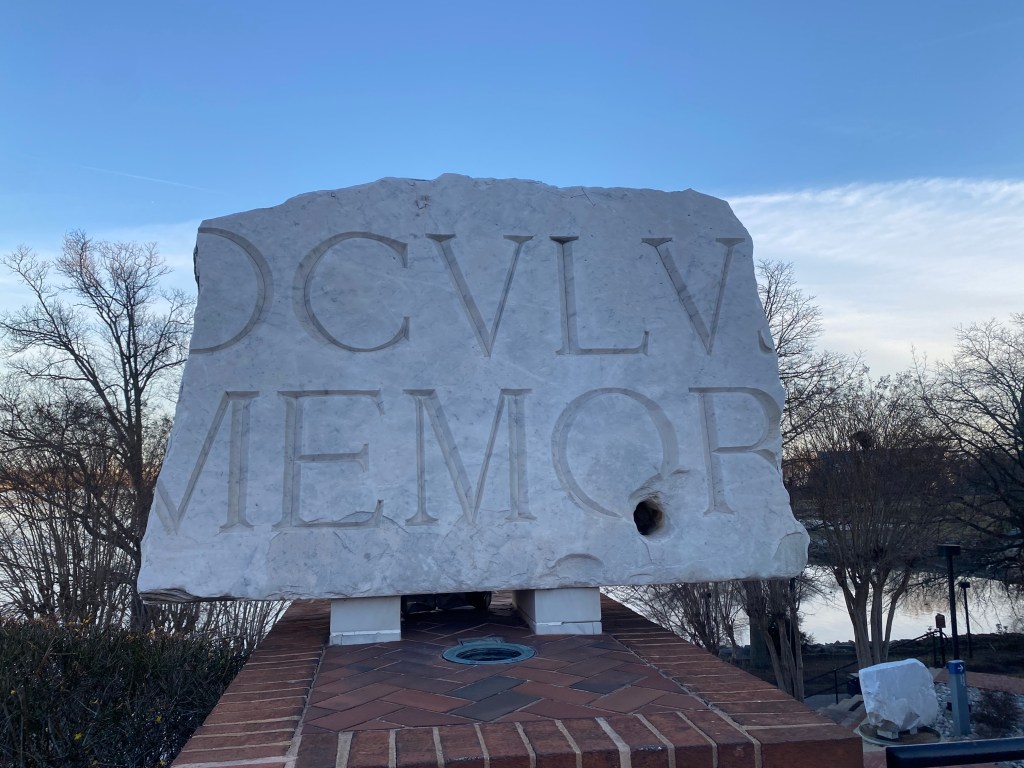

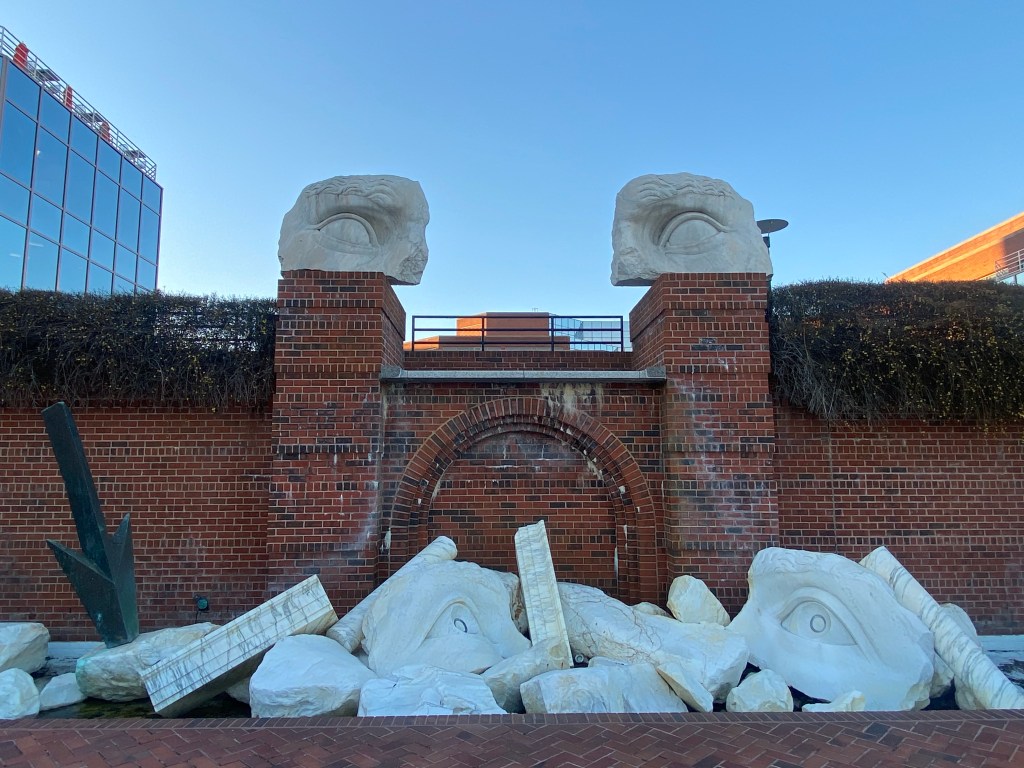


It was a giant pair of stone lips, made of marble and styled after a neoclassical statue. The water from the lips flowed forward in a small river of sorts, and cascaded over the edge of a small shelf. Two giant slabs of marble perched on top of columns on either side of the shelf, and one read “DCVLV MEMOR.” They framed, perfectly, a small-scale obelisk just like the Washington Monument. The Potomac glittered behind the obelisk, creating a picture-perfect view.
We had to pick up our food, so we got in the car and I did some research. It turns out that the fountain is part of a larger art installation called “Promenade Classique.” It is also part of Tide Lock Park, which is known for containing remnants of the old locks that once passed through Alexandria on the way to Washington, D.C.
The installation is described by The Washington Post as
the first large-scale American commission for the renowned French sculptoral team of Anne and Patrick Poirier. Working with landscape architect M. Paul Friedberg, the Poiriers devised a succession of neoclassical sculptural elements, starting with a bronze lightning bolt, which, except in winter, launches the flow of water. From there, the water makes its way past gargantuan sculptural fragments, through a reflecting pool and into a heap of “ruins” (shown at right) under a waterfall at the river’s edge.1
The Washington Post (Dec. 23, 1990)
So there was more? Given the surreal nature of the odd lips, we had to go back and see the “gargantuan sculptural fragments” that made up the “ruins.”
The only experience with hyperreal ruins I ever had was at Busch Gardens’ Escape from Pompeii or Roman Rapids rides, so I was excited to see what the park had in store for us. Unfortunately, we didn’t make it back to the park until the dead of winter, but that added an even more surreal layer to the park—all the water was drained from the fountains and there was a slightly dirty sheen to the marble.
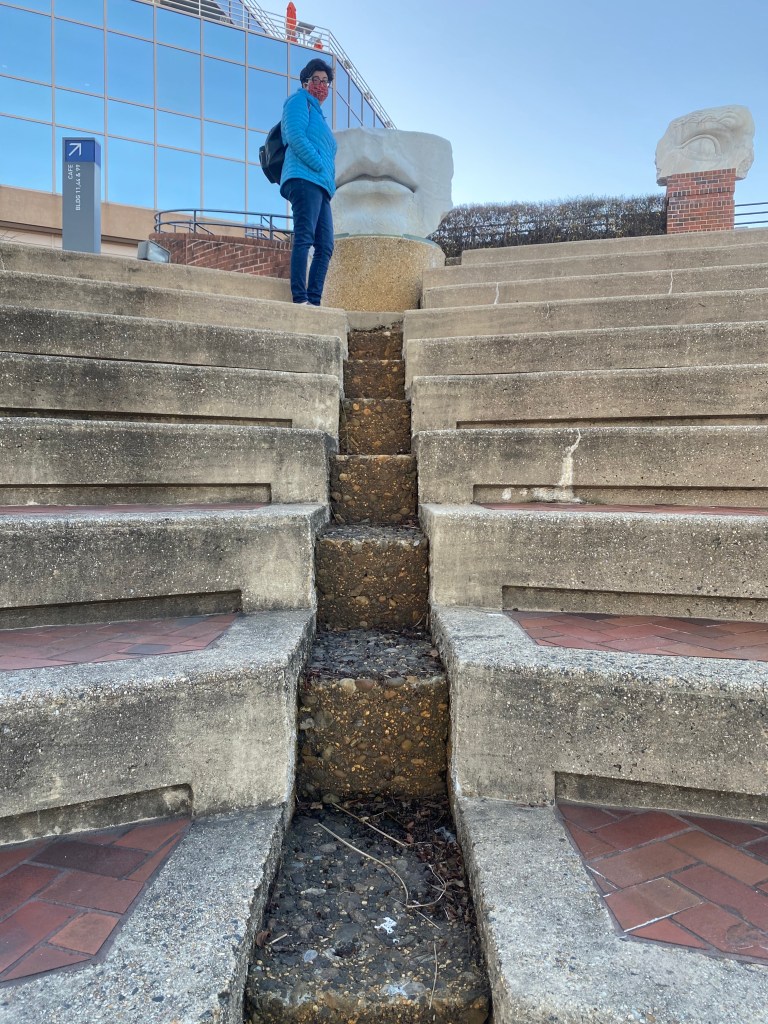
We walked past the giant bronze arrow and to the massive lips, which now stood in an empty pit with decaying leaves at the bottom. This time, though, we walked to where the water used to pour over the edge and discovered two curved sets of stairs. The stairs led to a lower level of the promenade, with the obelisk sitting on a dais at the waterfront. In between the sets of stairs were sections that looked amphitheater-like, broken up by small dark runnels.
Going down the amphitheater levels was a little more treacherous than I thought it would be (the steps were steep!), so I stuck with the stairs. At the bottom of the waterfall was a jumble of sculptural ruins, with two large eyes standing out more than the rest. The large slabs at the top of the columns also had eyes, and more lips stood at the top of the runnels, where more water had no doubt flowed in the summer.
I can’t help but think of our visit to the park as an allegory for this whole time in quarantine. Fragmented. Disruptive. Drained. However, winter is almost over.
Footnotes:
- “Promenade Classique.” The Washington Post. Dec. 23, 1990. Accessed on March 8, 2021. LINK.
 Offbeat NOVA