
By Matthew T. Eng, Offbeat NOVA
If you are one of the many individuals who have since gone back into the office in the past year or months, you have undoubtedly forced yourself to talk about SOMETHING with your coworkers. Or if you are like me, you get Covid within three weeks of going back to work in a tight office stuffed to the gills with people coughing in their cubicles. Corporate cringe be damned, we are in it for the culture:

Of course, there are always the staples: the weather, the score of a sports game, and of course, the ubiquitous weekend plans. I always have the yardwork talk locked and loaded for such an occasion.
Lately, a lot of the water cooler talk (and we call it that only as a reference, because who the hell is still using a water cooler and talking near it in 2023) has been about the price of food. It’s the perfect conversation starter while you are waiting to heat up your sad, lukewarm leftovers. In recent months, going to the grocery store in Northern Virginia will net you about $50 a bag (and you better bring your own, too — we aren’t animals).
And let’s not even talk about Costco. I know some things there are necessary, but if I come out of there spending less than $300, I will chalk it up as a moral and financial victory. I need my Babybel cheese, damnit.
I was looking through some Northern Virginia history books I checked out from the library that completely blew my mind and put the current inflation going around the United States in perspective.
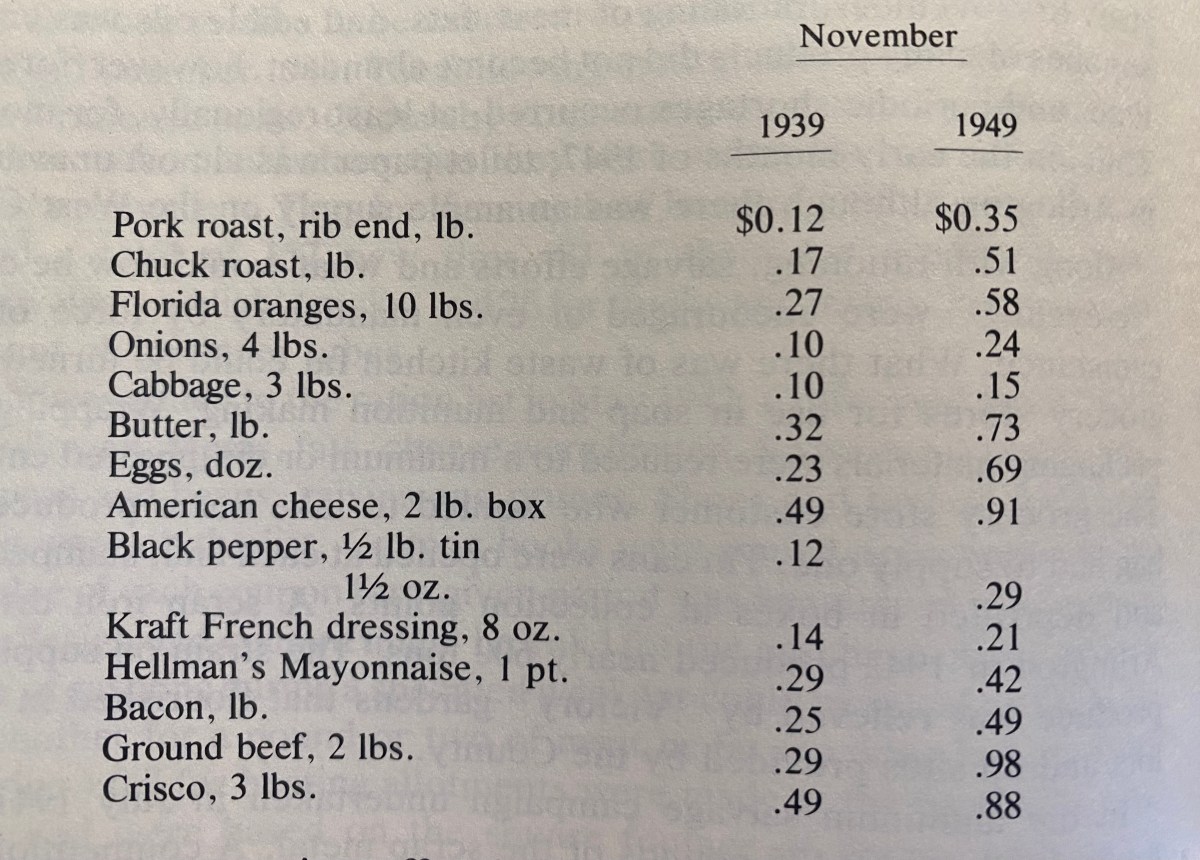
Towards the back of Arlington County, Virginia: A History, published by the Arlington Historical Society, is a chart comparing the price of common goods between 1939 and 1949 in the post-war years. While many well-known items were rationed during the war years like sugar, coffee, and meat, the hope was that prices would return to normal after V-J day. It was once patriotic to collect your used household fats. You know…for victory.

The Office of Price Administration was established in 1942 as a safety net for price controls on these goods. For the most part, the Administration did its job, keeping inflation in check and prices reasonable. But as the book pointed out, “prices did rise during the decade, especially after controls were lifted.” The book included a chart from the Arlington Sun on comparative prices between 1939 and 1949. At first glance, the prices seem normal; cheap even. It’s only after you use the CPI Inflation Calculator from the U.S. Bureau of Labor that things get interesting.

If we use the calculator to adjust for inflation, the cost of some of these items would make the “egg crisis” of 2023 look like a doorbuster deal on Black Friday. Keep in mind, America was going through a recession that began in November 1948 that lasted until 1949.
Right now, the average consumer cost for a dozen eggs is $2.66. That cost, adjusted in 1939 has the same buying power as $5.00. Once prices rose after the restrictions were lifted, that same carton of eggs would cost you $8.74.
If you wanted to make a BLT sandwich, it’s going to set you back $6.21 for the bacon and $5.32 for the jar of mayonnaise. The bacon is shockingly the same as the 2023 average, which makes the 2023 inflation nearly consistent with that of 1949. As global markets continue to slide and talk of “recession” remains at the top of the news (unless you like Titanic and Russian coups), it’s always interesting to see how far the American dollar has stretched across time. At least when I make an egg salad sandwich this summer, I will have some perspective. I’ll make sure to have my “Ok, boomer” commentary locked and loaded at the office microwave because the high prices have always been something to complain about.

 Offbeat NOVA