Categories
Matthew Eng northern virginia

10 Strange Statues and Monuments in Northern Virginia

By Matthew T. Eng, Offbeat NOVA

What comes to mind when you hear the words “Northern Virginia?” Maybe it’s something about the traffic or the job market. What else does everyone talk about when they live here, right? Maybe an image of high-priced homes and real estate comes to mind. One of the last things you would think about would be “weird and unusual monuments.” But here we are. There are several in the area that come to mind, from the oddly-themed statues in oversized business parks to the downright head-scratching advertisements of local businesses. These statues and monuments are often hidden in plain sight. Some have become local legends in their own right, with stories of their construction and placement toeing a thin line between truth and lore. 

Here’s ten strange statues and monuments in Northern Virginia.

1. Restaurant Phoenician Ship (2236 Gallows Road, Vienna)

The Northern Virginia area is familiar to a diverse array of cuisines from around the world. Virtually anywhere you go, you will find restaurants to satisfy whatever your appetite may be. 

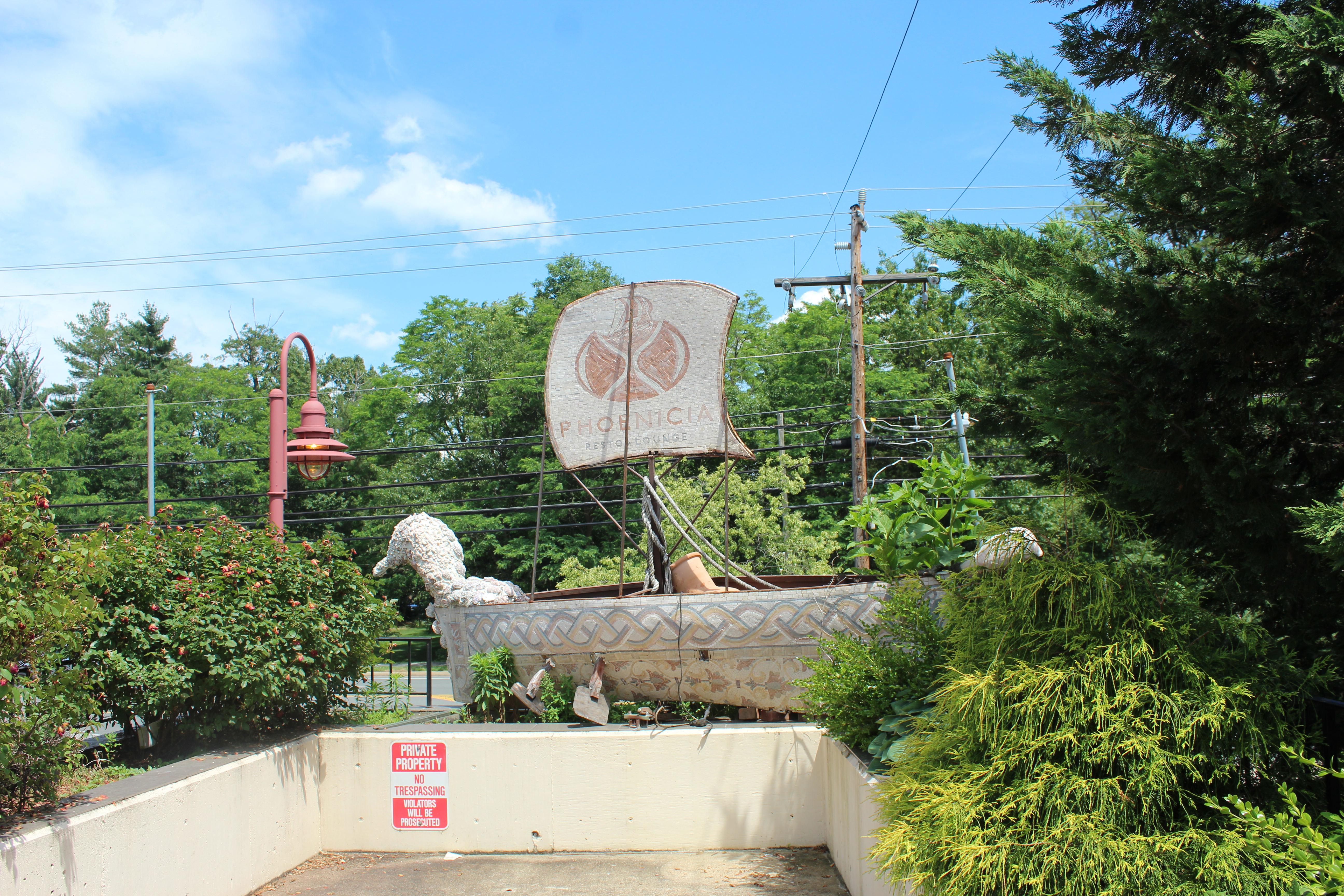
If you are in the mood for the food of the Mediterranean, there is a place just down the street from the busy Tyson’s Corner area in Vienna called the Phoenicia Resto & Lounge. According to their website, the restaurant offers a “classic mezzo-style Mediterranean menu of dishes served in a laid-back environment.” Users on Yelp say the food served there is everything from absolutely “amazing” to “meh” and “just ok.” The hummus is a particularly good menu item, apparently. Part of that laid-back feel might be due to the large concrete model of a Phoenician ship directly adjacent to the restaurant. 

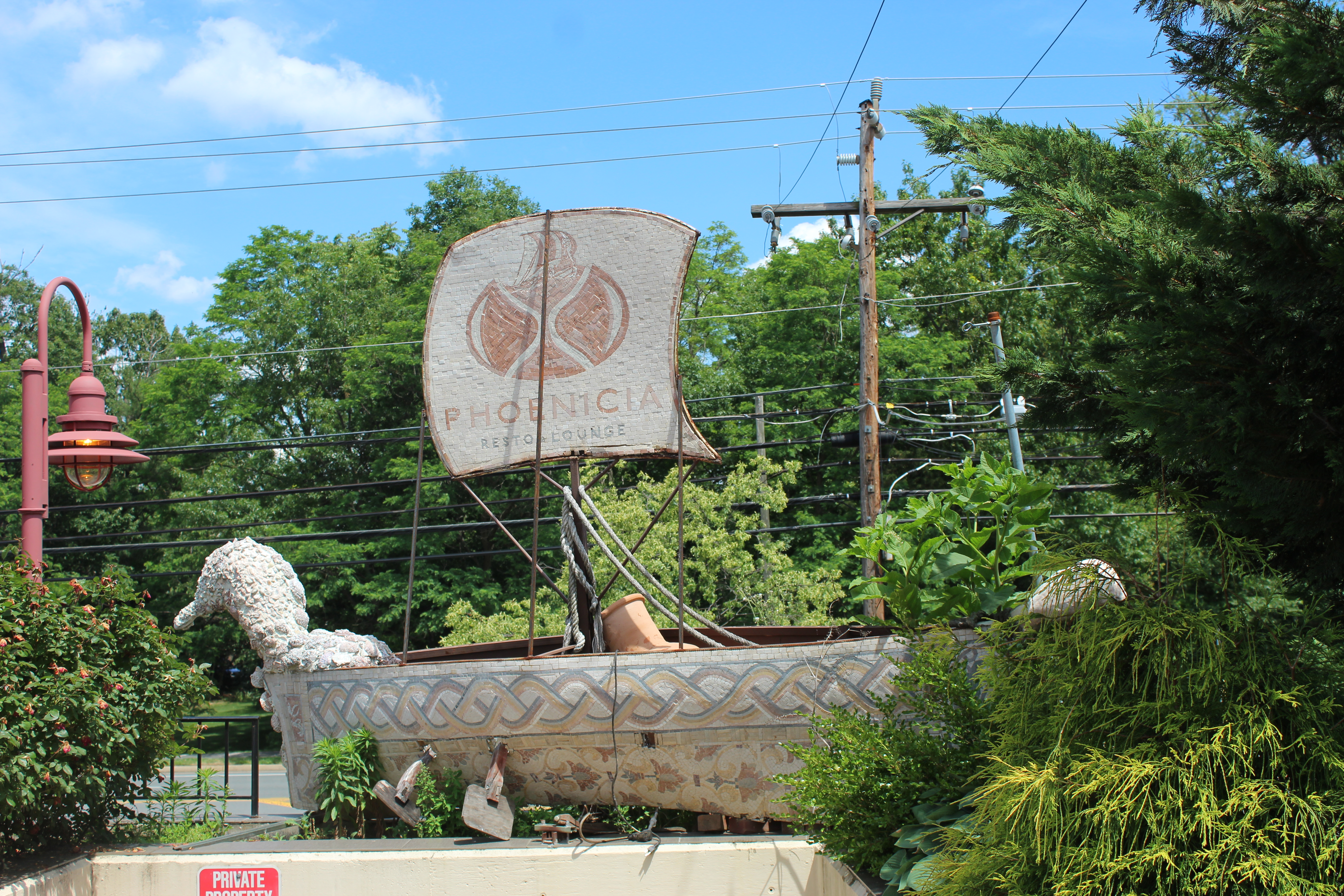
The concrete ship is built on the top of a roof of an underground garage. The ship is decorated with an ornate mosaic pattern, with floral accents near the hull and a criss-crossed line pattern on either side of the ship. The sail of the ship is also an advertisement for the restaurant, with the business logo also proudly displaying the likeness of a Phoenician ship. The figurehead at the prow of the landlocked ship resembles an eagle or some sort of bird. 

You can actually walk up a small bank of steps into an outside seating area and take pictures with the ship atop the garage. According to one user on roadsidemerica.com, the sail bearing the name of the restaurant was lowered in 2019. When Offbeat NOVA was there to capture the ship several months ago, the sail was thankfully back on. 

Having a ship as your design with the restaurant’s name makes sense. Phoenician’s were the epitome of trade, culture, and intellectualism in their time, all bolstered by their maritime dominance. Need more proof? If you’ve ever had a chance to ride Spaceship Earth at Epcot Center, the most famous line of the entire ride is “If you can read this, thank the Phoenicians.” 

The next time you are driving down Gallows Road on the way to mall, look to your left and thank the Phoenicians, or at least stop in for some of that hummus. 

2. Ductwork Tin Man (8441 Lee Highway, Fairfax)

When the tin man embarked on a soul-searching quest in the Wizard of Oz for a heart, I doubt he thought his journey along the yellow brick road would take him to Lee Highway in Fairfax. 

This “tin man” sits atop the Lee-High Sheet Metal building. HIs body is made completely of ductwork. A crude face with a smile is drawn on the unusually small statue. In fact, it’s small enough that the casual passerby would completely miss it while driving past. In recent years, it has shown signs of wear on the body, particularly its chest.

This particular statue should not be confused with the Tin Man Sheet Metal Fabrication, LLC, located in Manassas, VA. That particular business has a “tin man” in their logo, but no physical statue like at Lee-High Sheet Metal. The business is so proud of it that the statue is included in all of their advertisements at the front of the shop. Currently, the tin man is holding an American flag. If anything, the flag the statue is holding will help you spot it easier from the road. 

3. Vinyl-Lite Window Factory Sign (8815 Telegraph Road, Lorton)

This next one follows the same basic principle of the ductwork tin man. 

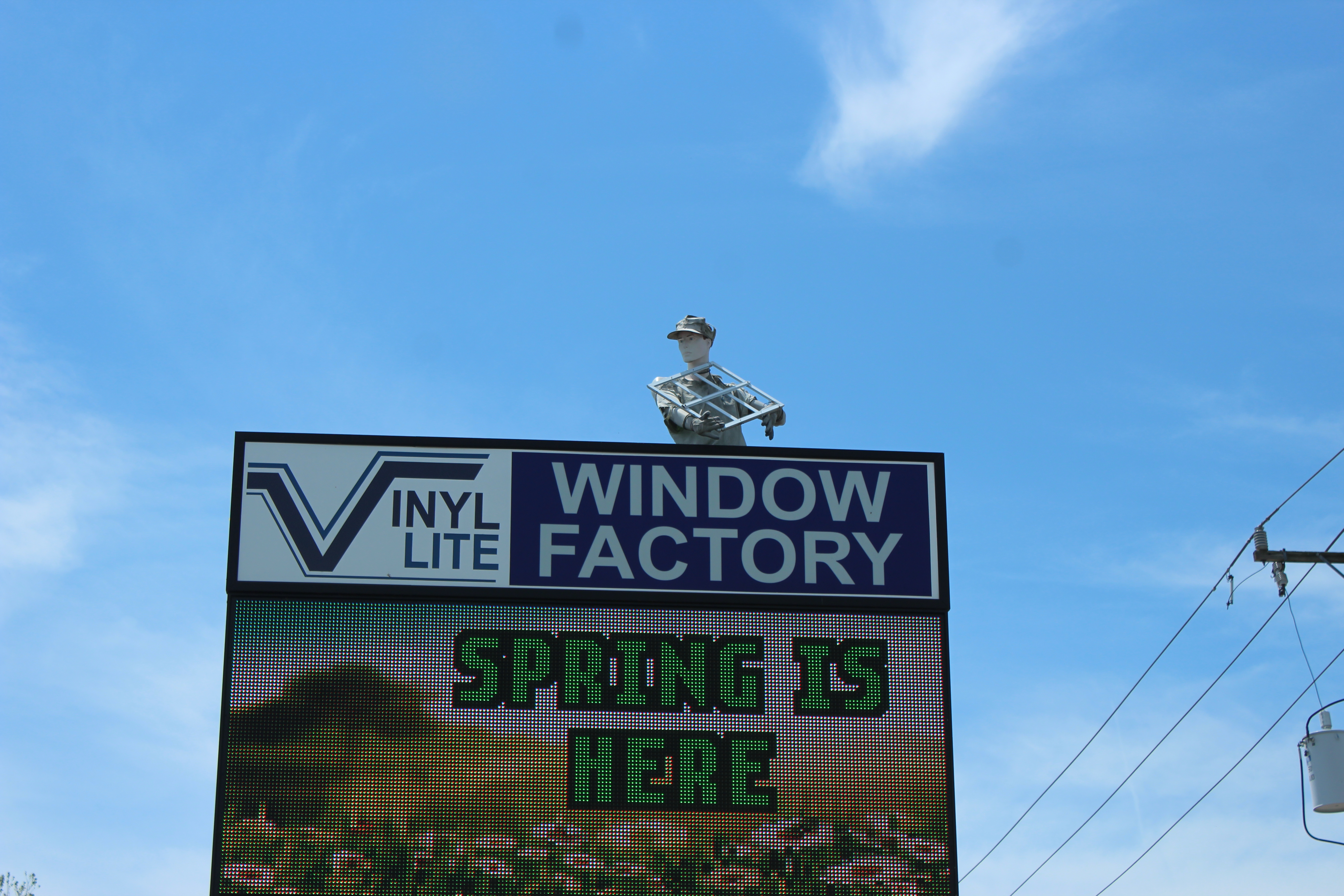
Atop the Vinyl-Lite Window and Showroom company sign in Lorton, VA, is a stark white mannequin holding (what else, but) a window. The mannequin is wearing a uniform of the company — another excellent product placement. The sign sits facing north on Telegraph Road on the edge of the large property and showroom building. Looking back at Google Street images, the digital sign was erected sometime between 2009 and 2012 without the man atop it. The earliest date where the figure is shown is October 2016. 

The property, like so many similar businesses, is adorned with American flags. According to the company website, Vinyl-Lite has been manufacturing and installing replacement windows for more than thirty years in the Lorton, VA, area. The mannequin is a reassuring message of their “personal, professional, and trustworthy local service.” Prospective customers know exactly what they are getting, even if they might miss that rather odd statue traveling along Telegraph Road. 

4. Spite Flamingo Lawn Decoration (5325 Franconia Road, Alexandria)

You may have heard of the phenomenon of “spite houses.” These are buildings constructed or modified to intentionally irritate neighbors and developers. Although there are many around the United States, some of the most famous are located in Northern Virginia, in particular Alexandria. But have you ever heard of a spite flamingo?

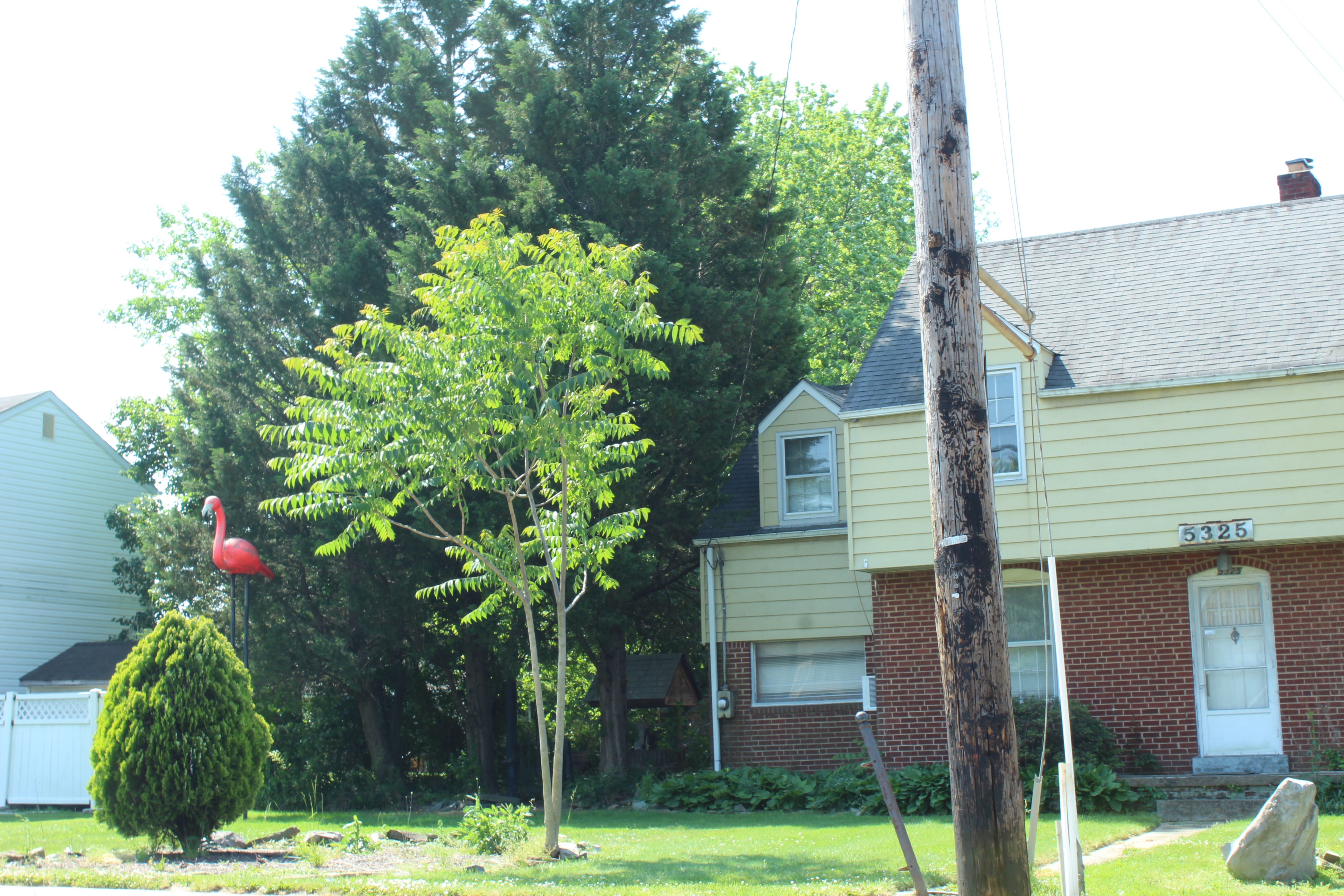
According to urban legend, the origin of a pink flamingo statue the height of a basketball backboard is based on a disagreement amongst neighbors. The overly tall lawn ornament stands at least twelve feet tall along Franconia Road in Alexandria. 

According to the Fairfax Underground message board, the statue has resided there for nearly thirty years. A rumor from one of the message board posters on Fairfax Underground solved the origin of the statue. The poster stated that someone in the county code enforcement office said that the owner of the house where the pink flamingo was wanted to make an addition to his home. The addition apparently required approval from his neighbors due to the size of the project. According to legend, the neighbors to their left declined, and Fairfax County told the homeowner that “in order to proceed, the addition would have to stay within (a certain amount of) feet of his home and no taller than (a certain amount of) feet.” In response to this, the owner put up the large flamingo conforming to the county’s specifications just to make the neighbor angry. 

One commenter pointed out the story’s likely falsity because of the process for approval of new construction solely resting in the hand of the county, not neighbors. Either way, it makes for an interesting piece of Northern Virginia lore. 

One particular user of that forum, “Hennessy,” said this about the statue:

“I like the flamingo. It sticks a finger in the eye of all the stick up the ass people who demand homes all be exactly alike.”

Fairfax Underground Message Board

In a historic neighborhood like Rose Hill, they are exactly right. Unlike a lot of other statues and monuments on this list, this one is assuredly something you can’t miss. 

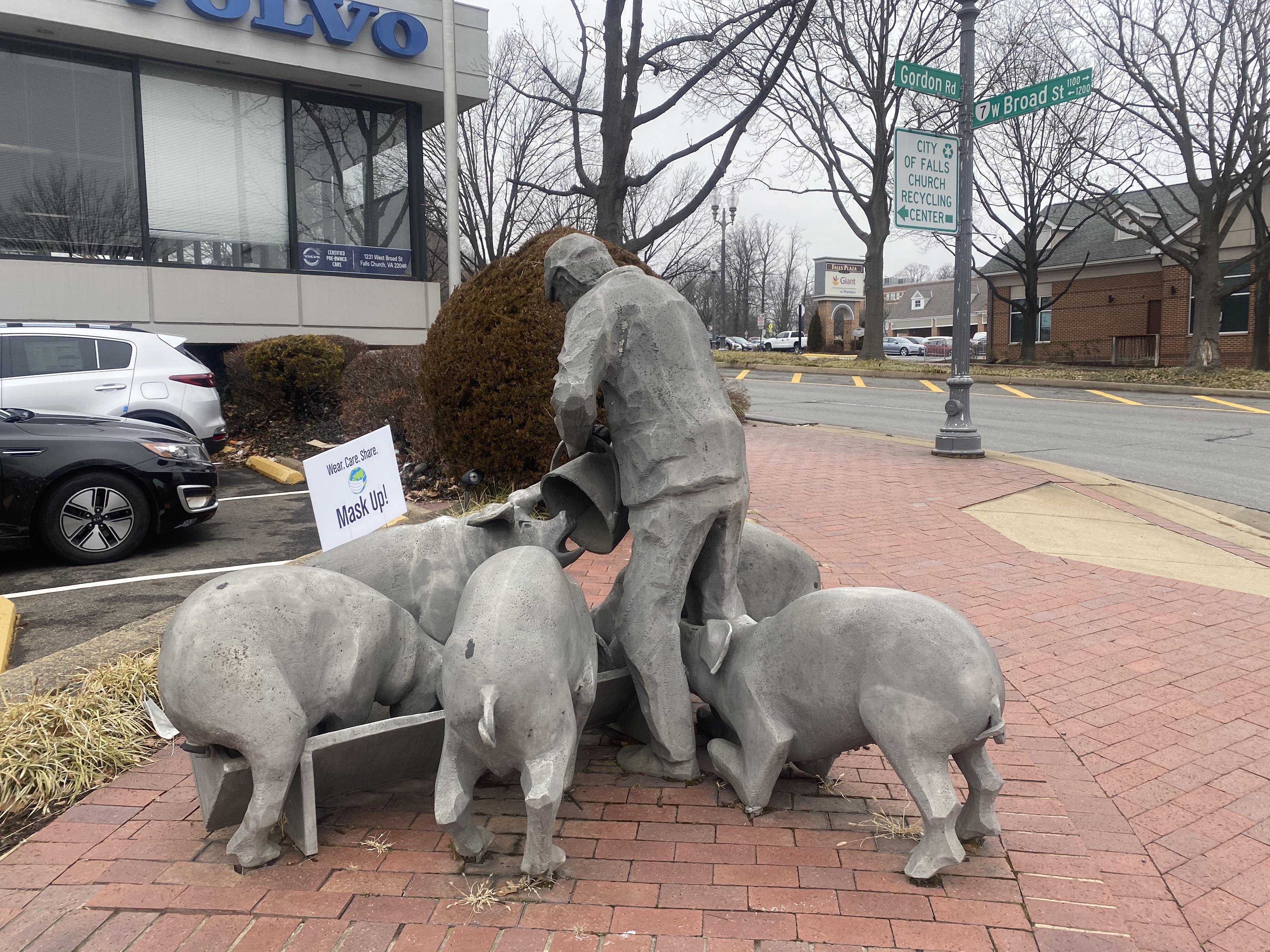
5. Man Feeding Pigs/Man Eating Dog Food (1125 W. Broad St, Falls Church)
The Beyer family is no stranger to Northern Virginia. Don Beyer currently serves as a U.S. Representative for Virginia’s 8th congressional district in the heart of Alexandria, Falls Church, and Arlington. He previously served as the 36th Lieutenant Governor of Virginia from 1990 to 1998 and the United States Ambassador to Switzerland and Liechtenstein after that, from 2009 to 2013. 

Before Don Beyer began his storied political career, Beyer graduated from college and began working at his father’s Volvo dealership. He and his brother eventually bought the dealership from his father, expanding to nine in the Northern Virginia region. Back in the early 1980s, Don decided to place a sculpture at the front of his Volvo dealership in Falls Church. He was inspired by the work of his uncle, Richard Beyer, a World War II veteran of the Battle of the Bulge who abandoned a career with Boeing to pursue his passion of art and sculpture on the West Coast. Beyer was known for his overly eccentric art pieces, including an image of a man grabbing the breasts of a fish in Des Moines, Washington. 

After talking it over with his uncle, Don decided to commission a sculpture as an important landmark to the city. He ultimately chose a sculpture of a man feeding pigs, inspired by Richard’s family farm in McLean. The official title of the piece is “Man Slopping Pigs.” The statue was dedicated in a small ceremony on May 6, 1984. The statue is made of wood and dipped in cast aluminum. 

The sculpture depicts a man feeding five pigs at a trough. The man’s tongue appears to be sticking out as he is feeding the hogs. Although the sculpture is meant to merely represent a fondness for Richard’s childhood growing up on a farm near Washington, D.C., Richard Beyer’s personal sculpture website database notes in their description of the piece that it may actually represent “five bureaucrats at the government trough.” 

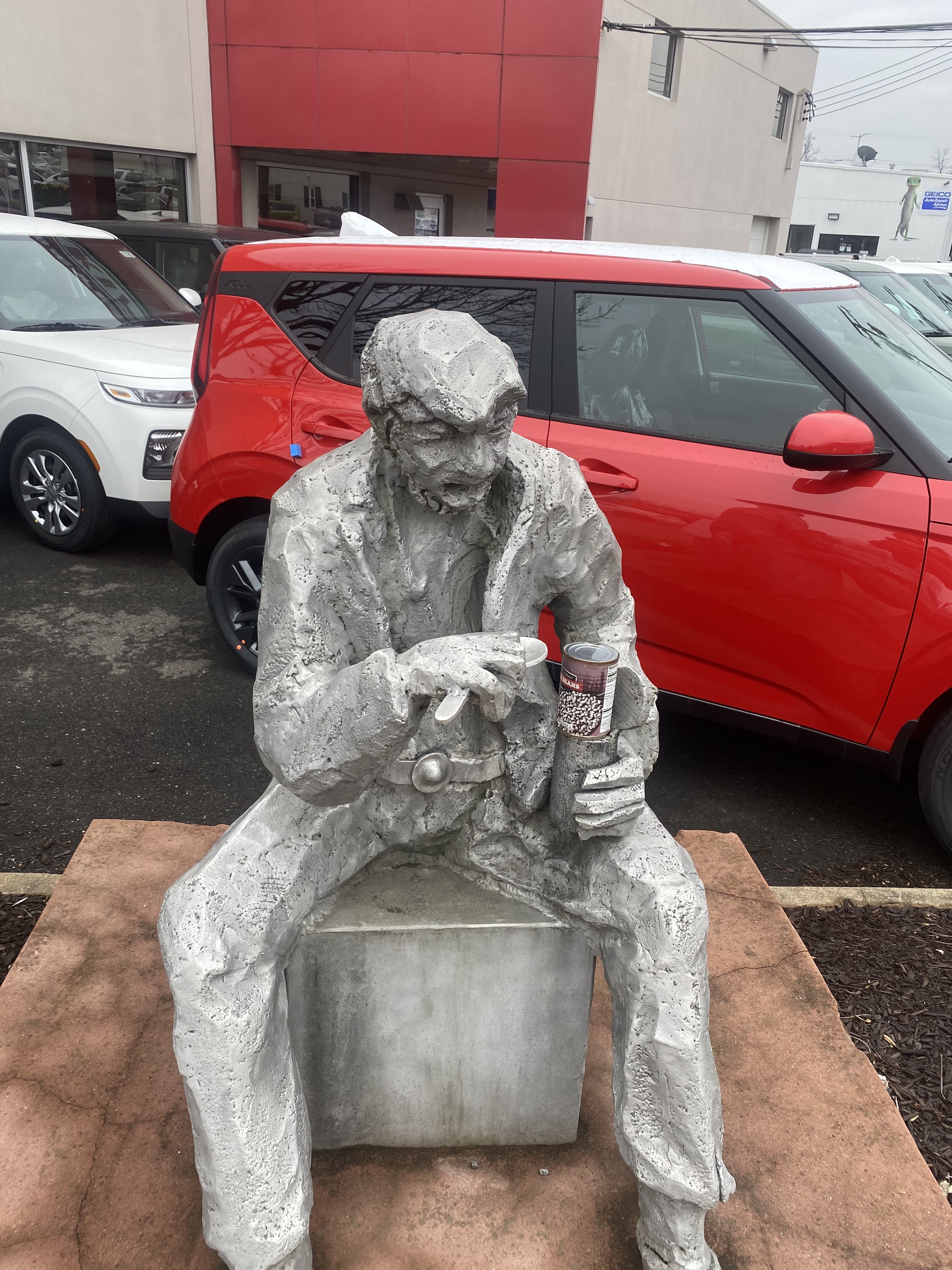
The statue sits on the on the corner of Beyer’s Volvo dealership today on West Broad Street in Falls Church, VA. Directly across from it at the Beyers’ KIA dealership sits another Richard Beyer original with a far more interesting origin. Unveiled at its present location on Gordons Street, “Man Eating Dog Food” depicts a life-sized man sitting down, eating what appears to be dog food from a can. Beyer described it as “our retirement plan,” whatever that means. Don’t ask Don Beyer, he doesn’t know or understand it either, apparently. From 2010 to 2012, the statue was placed on the streets of Lake Oswego, Oregon. The statue had obviously mixed reviews amongst the residents of Lake Oswego, with some loving It, while others simply confused by its intention. Why? Not only is the man eating dog food, he has a tail growing out of his backside as well. 

The statue made its way to the East Coast in 2014, and was unveiled opposite Beyer’s other sculpture as a posthumous tribute to the renowned artist. Richard Beyer died in 2012. Some news articles speculate that the sculpture was inspired by the Great Depression and Steinbeck’s Grapes of Wrath. Others owe it to the wonderfully odd mind of Richard Beyer himself. 

Either way, these two sculptures have made an impact on the Falls Church community and the Beyer family. Dan Beyer, grandson of Richard, was so inspired that he created two large bronze feet coming out the ground in front of the Beyers’ Alexandria, Virginia, Subaru location. 

Statue of Feet at Beyer Subaru in Alexandria. (Matthew T. Eng/Offbeat NOVA)

Once again, we ask why? I think that will be left as a Beyer family secret. For us, we can drive by and simply enjoy the eccentric art installations. 

6. Scrap Metal Cowboy (114 Gordons Road, Falls Church)

Scrap Metal Cowboy on Gordons Road, Falls Church (Matthew T. Eng/Offbeat NOVA)

Just down the street from the Beyer sculptures on Gordons Road is a ten-foot-tall cowboy made out of sheet metal. This piece is an excellent compliment to the tin man made out of ductwork in Fairfax earlier on this list. 

The cowboy is standing in front of the Dixie Sheet Metal Works building. His bright red and blue clothing, albeit faded now, is complemented by a head made of a wind turbine that sits beneath a cowboy hat. The cowboy is pointing to the south, perhaps to the main entrance into the building. His arm even has the likeness of an arrow. Given the proximity to the previous entry, one might assume the area along Gordons Road and W. Broad Street is a hub of roadside attractions. Two odd sculptures in one area is one thing, but three? That’s much more than just a coincidence. If you are ever in Falls Church, do yourself a favor and take a quick detour down the road to check out these interesting statues and sculptures. 

7. Giant Watering Can (8453 Richmond Highway, Alexandria)

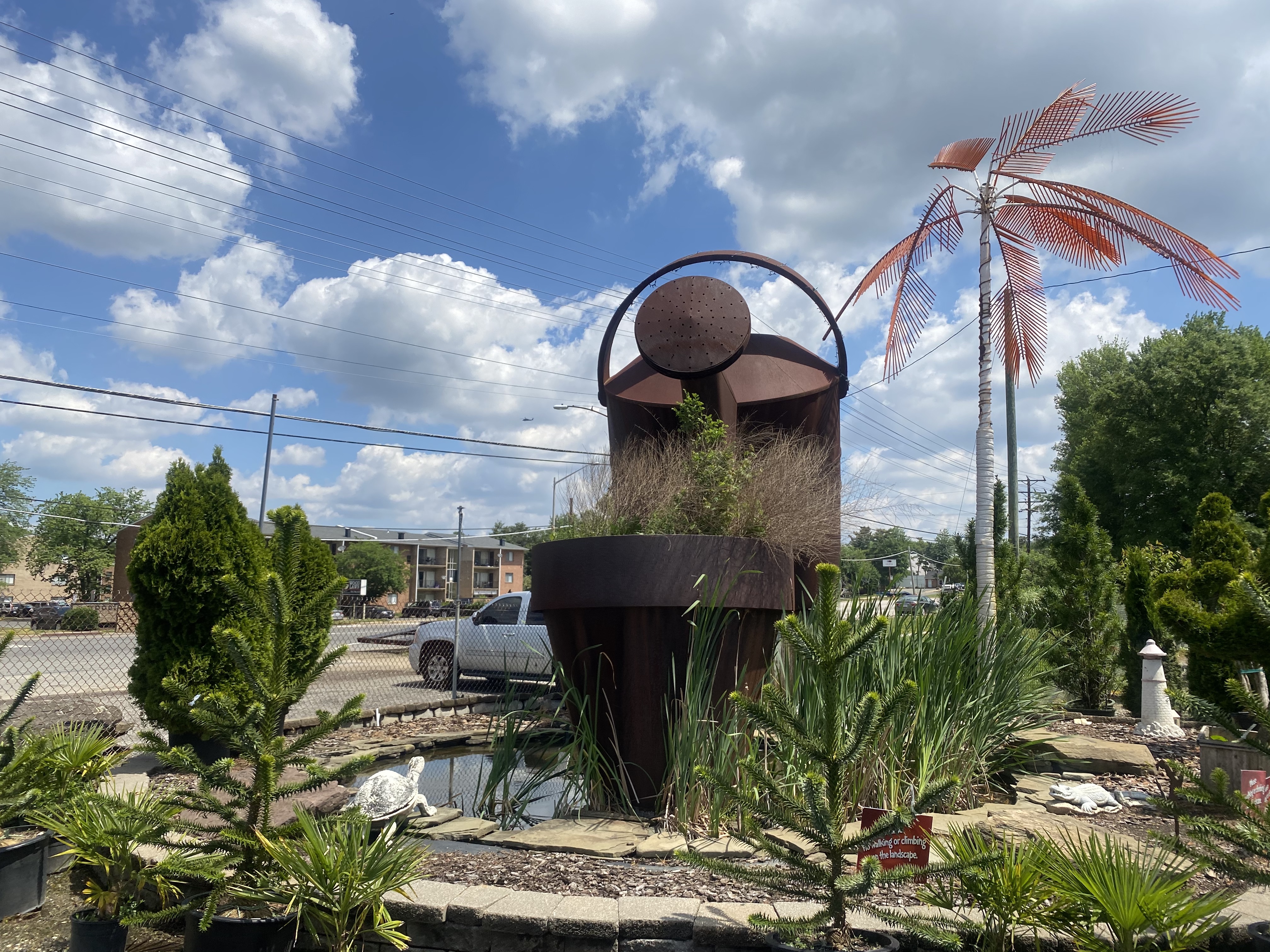
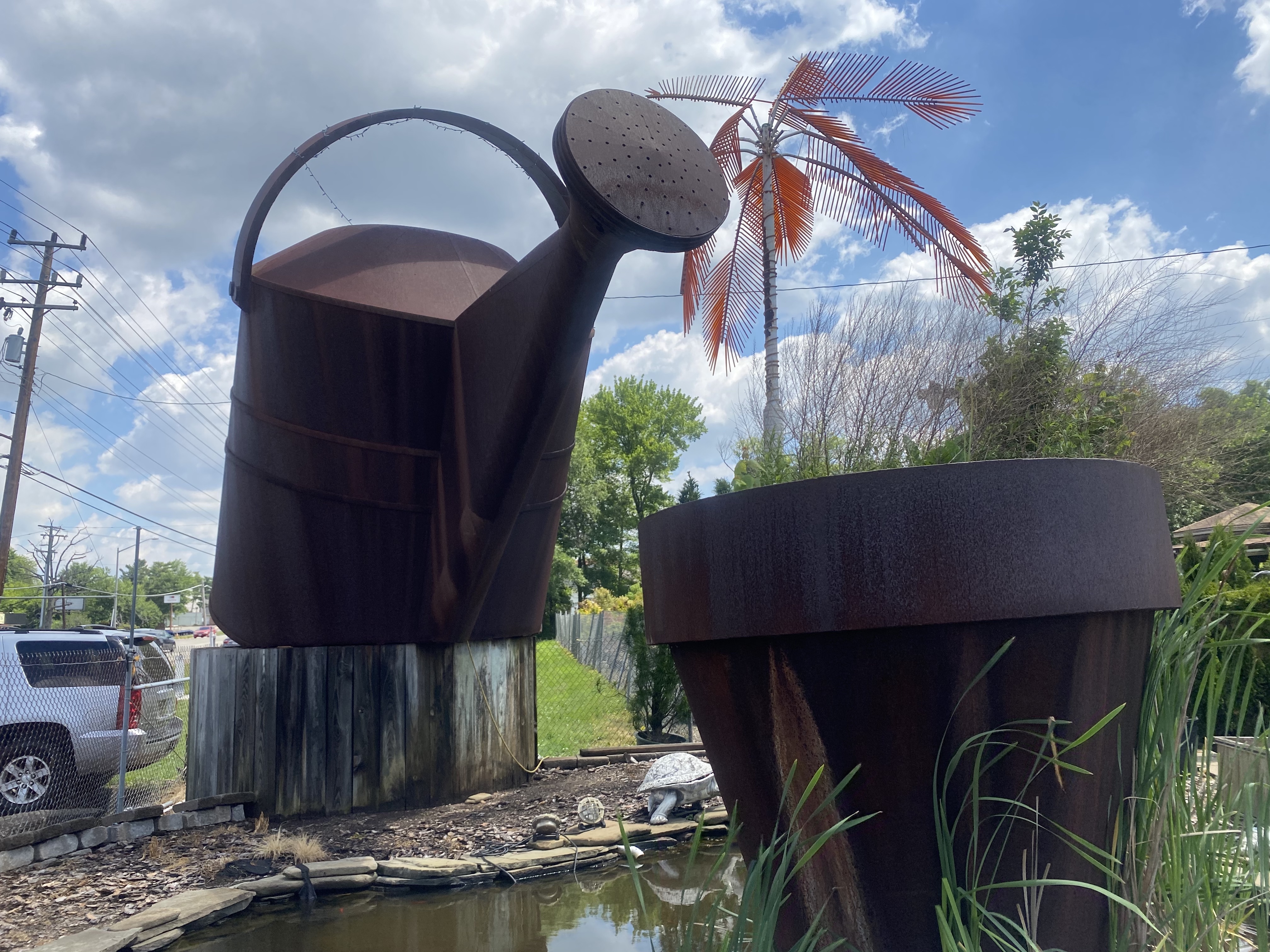
Most people will know this next sculpture simply as the “Giant watering can.” The functional sculpture is located at the Holly, Woods & Vines garden center off of Richmond Highway in Alexandria, VA. The watering can is approximately eighteen feet tall and twenty feet wide. Several neon palm trees flank the watering can. In warmer weather, the sculpture actually flows water from its end into a flower pot resting in a small pond filled with water and decorative reptiles. Driving by, you can always see a customer or two marveling at the giant structure, especially when its flowing in the warmer months. The garden center also has a terra-cotta warrior statue in the middle of a gazebo among other similar lawn statues you can purchase. 

There is an identical can and flower pot in downtown Staunton, Virginia. That sculpture was made by local artist Willie Ferguson in the 1990s. Ferguson has several sculptures in an around the Staunton, VA, area. One would assume the giant watering can in Alexandria is also Ferguson’s creation. 

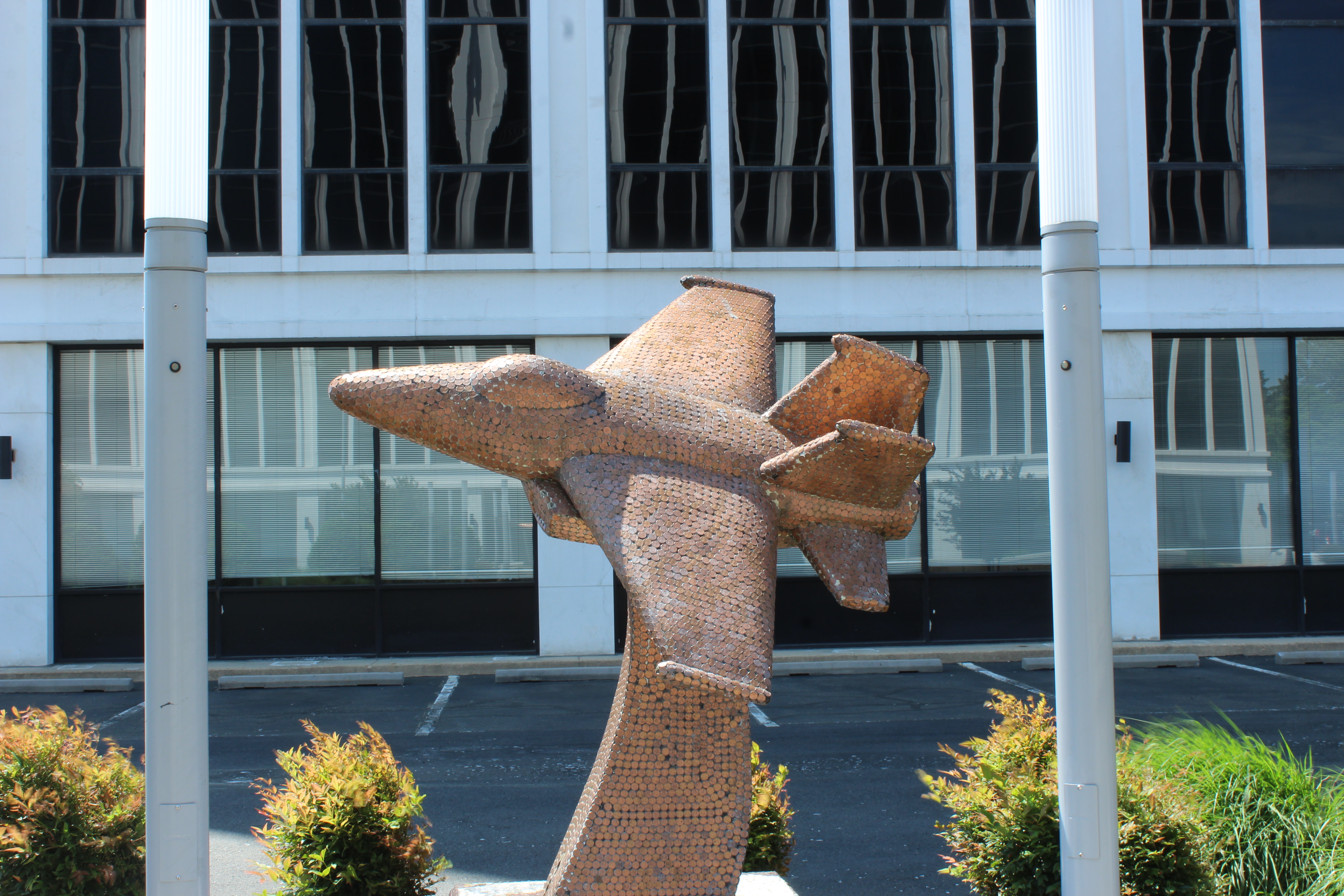
8. Fighter Jet Made of Coins (6400 Arlington Blvd, Falls Church)
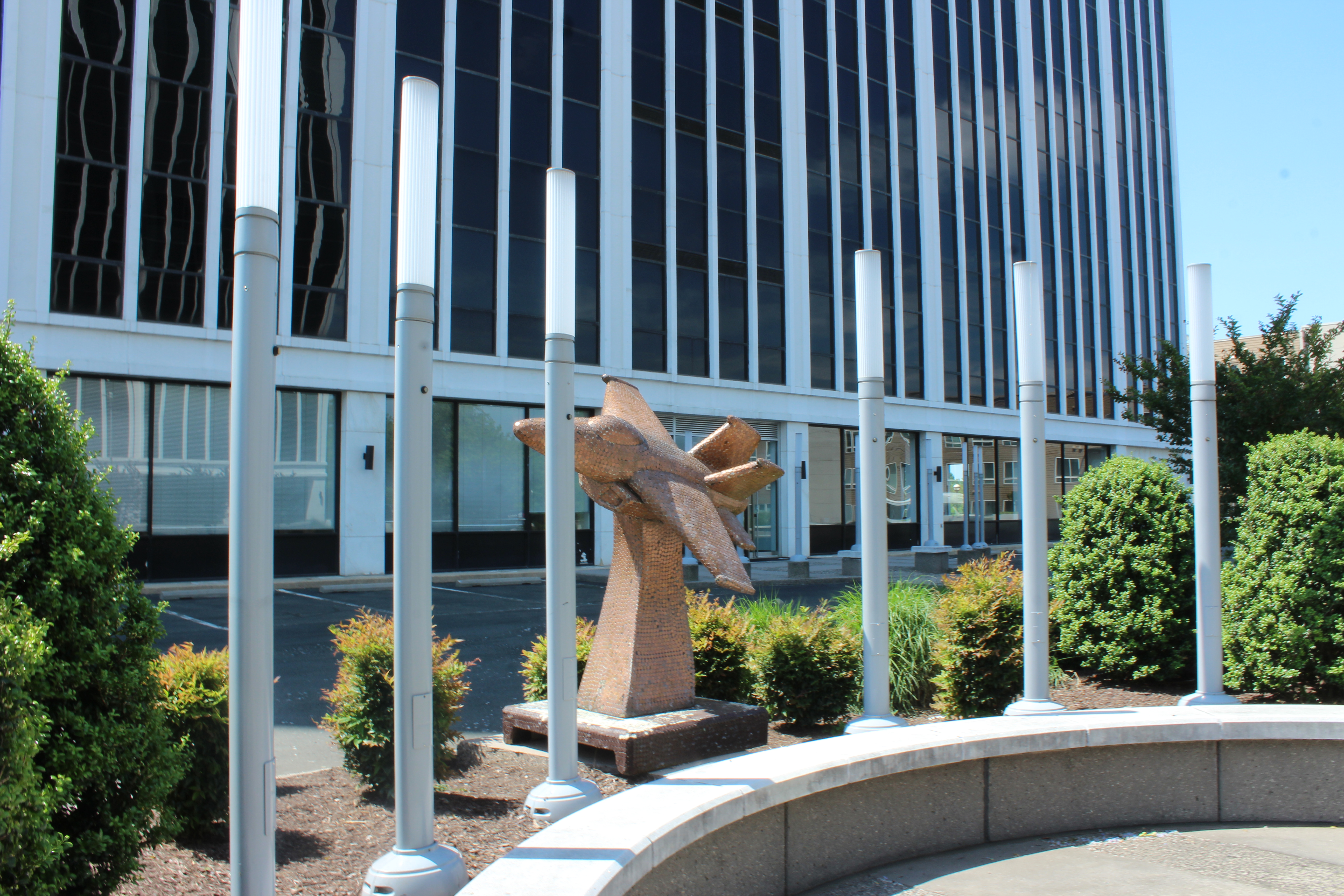
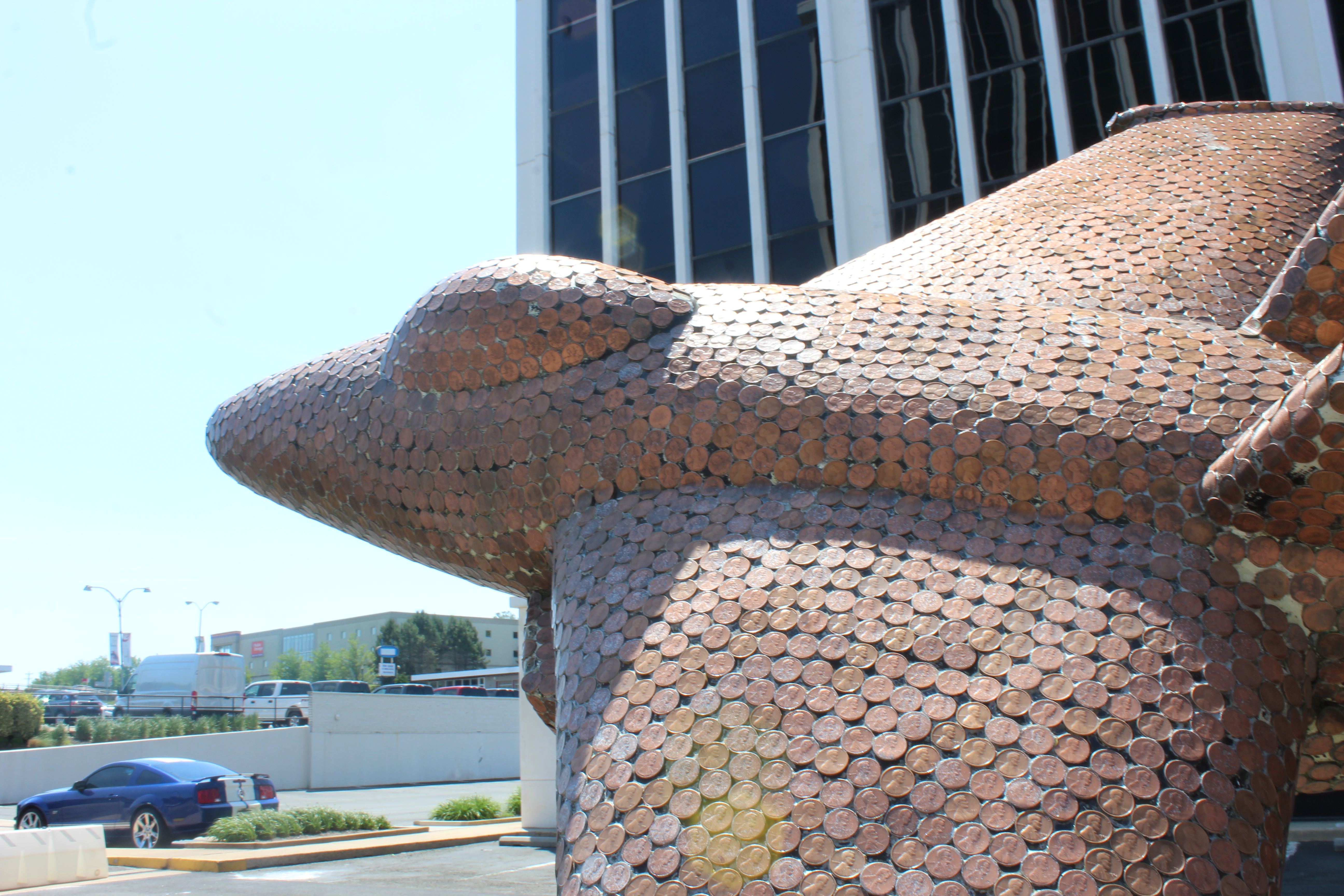
Sandwiched in between two large office buildings just south of the mind-numbing Seven Corners area is a small and unassuming statue of a fighter jet covered entirely with pennies. The sculpture, called “Pennies from Heaven,” is the creation of artist Courtney S. Hengerer of Alexandria, Virginia. The sculpture is in the middle of a sitting area between the two high rise office buildings, complete with benches, an archway, and some halfway decent landscaping.  

According to an article in the Washington Post, the genesis of the project began back in 2007 as a campaign by the Crystal City Business Improvement District to commission artwork to commemorate the area’s connection to flight. In all, fifty works of art were commissioned, including “Pennies from Heaven,” in April 2008. The planes are reminiscent to other cities commemorating their history with repetitive statues, or “statue events:” think of the cow statues in Chicago, Mermaid statues of Norfolk, or the horse statues of North Carolina’s Outer Banks. 

The artist, Courtney S. Hengerer, described her take on the statue as “sort of monotonous, but meditative.” In all, over 14,000 pennies are covering the sculpture. The original location of the sculpture was in Crystal City at the BB&T offices on 23rd Street. Many of the other sculptures were later sold off after the campaign ended. When the office moved to its current location in Falls Church, so did the statue. It resides there today for office workers to enjoy in the sunshine. 

9. The Elk of Prince Street (318 Prince Street, Alexandria)
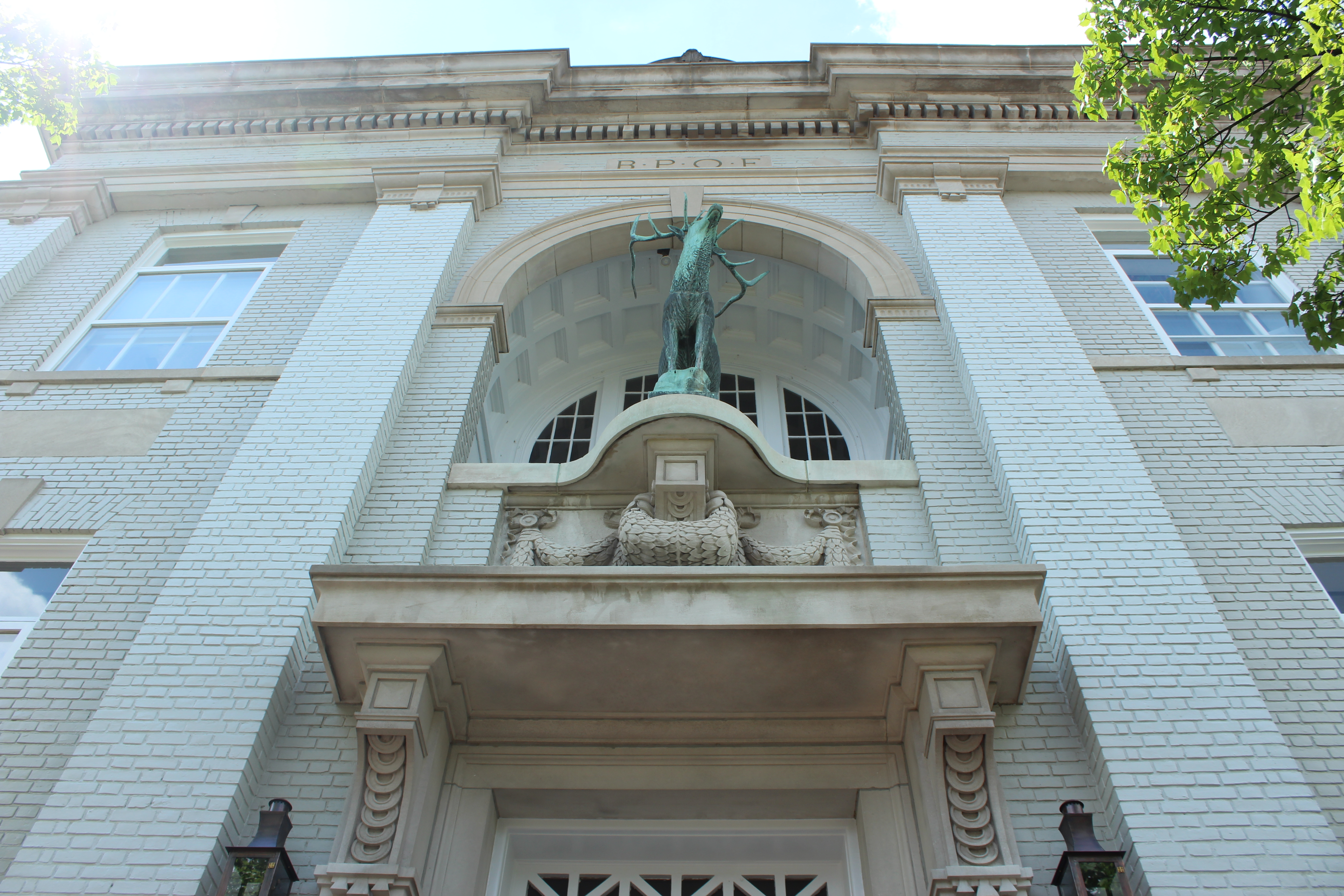
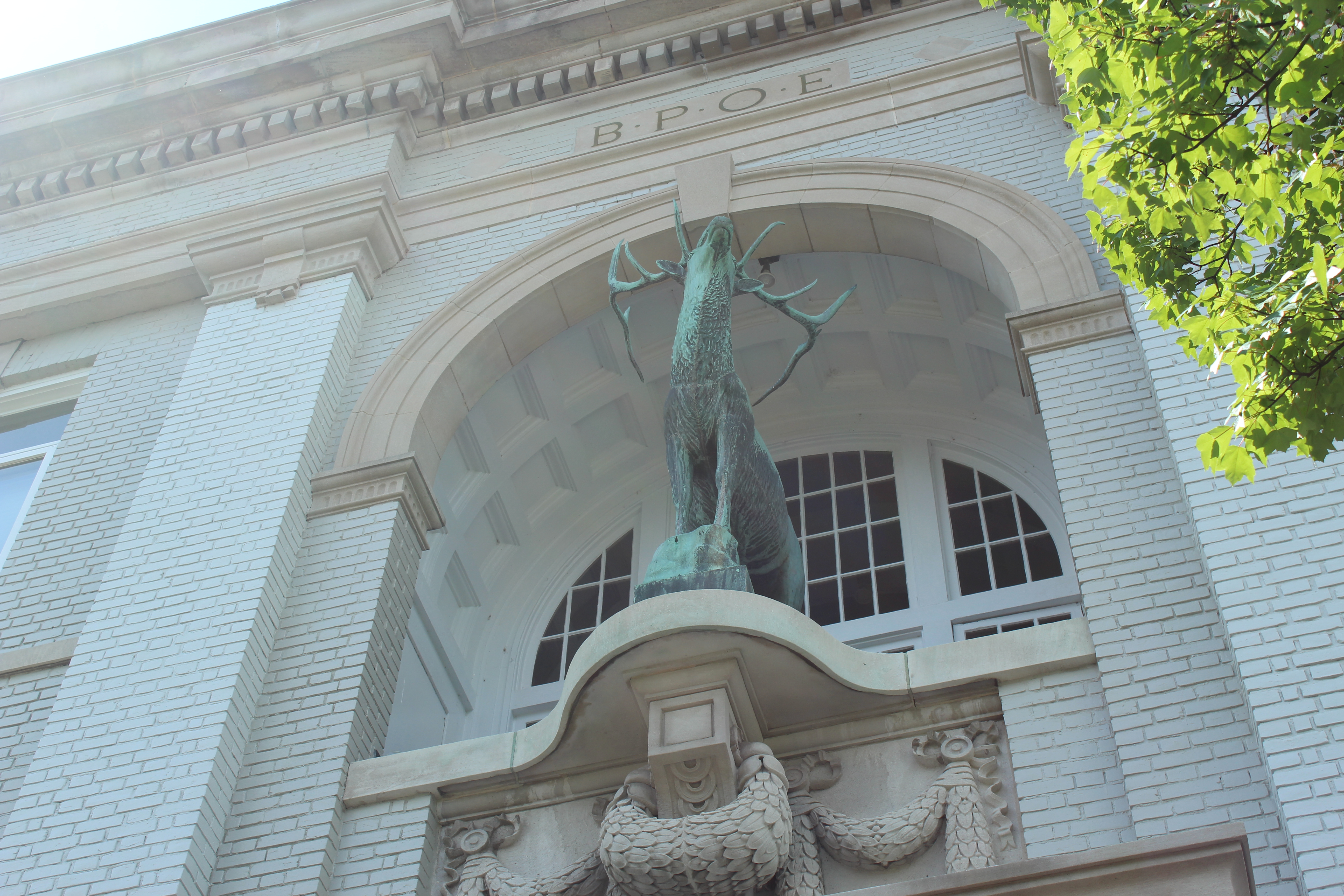
There is a statue in the heart of Old Town Alexandria that looks like something out of the television show Hannibal. A large bronze statue of an Elk stands atop the former headquarters of the Alexandria Elks Club on 318 Prince Street. The Elk is the unofficial basket of the Benevolent and Protective Order of Elks, or “B.P.O.E.,” as its inscription reads directly above the elk’s head. The statue rests within the alcove of the building to this day. 

The Alexandria Elks Club Lodge #758 was founded in 1902 when the organization purchased property on Prince Street. A new, larger lodge was opened the following year on 318 Prince Street inside the red brick building. According to the Alexandria Times, the elk was constructed in Salem, Ohio, and weighed half a ton. The elks planned to sell the building in 1983, and hoped they would take their mascot with them. Then-Mayor Charles E. Beatley, Jr., refused, saying it was part of the “architectural fabric of the city.” The building is now made up of high-priced condominiums. Elks Lodge #758 ended up settling on 7120 Richmond Highway, in the former building of the Jolly Ox (better known as the Steak and Ale). 

10. The Tyson’s Tooth (1954 Old Gallows Road, Vienna)

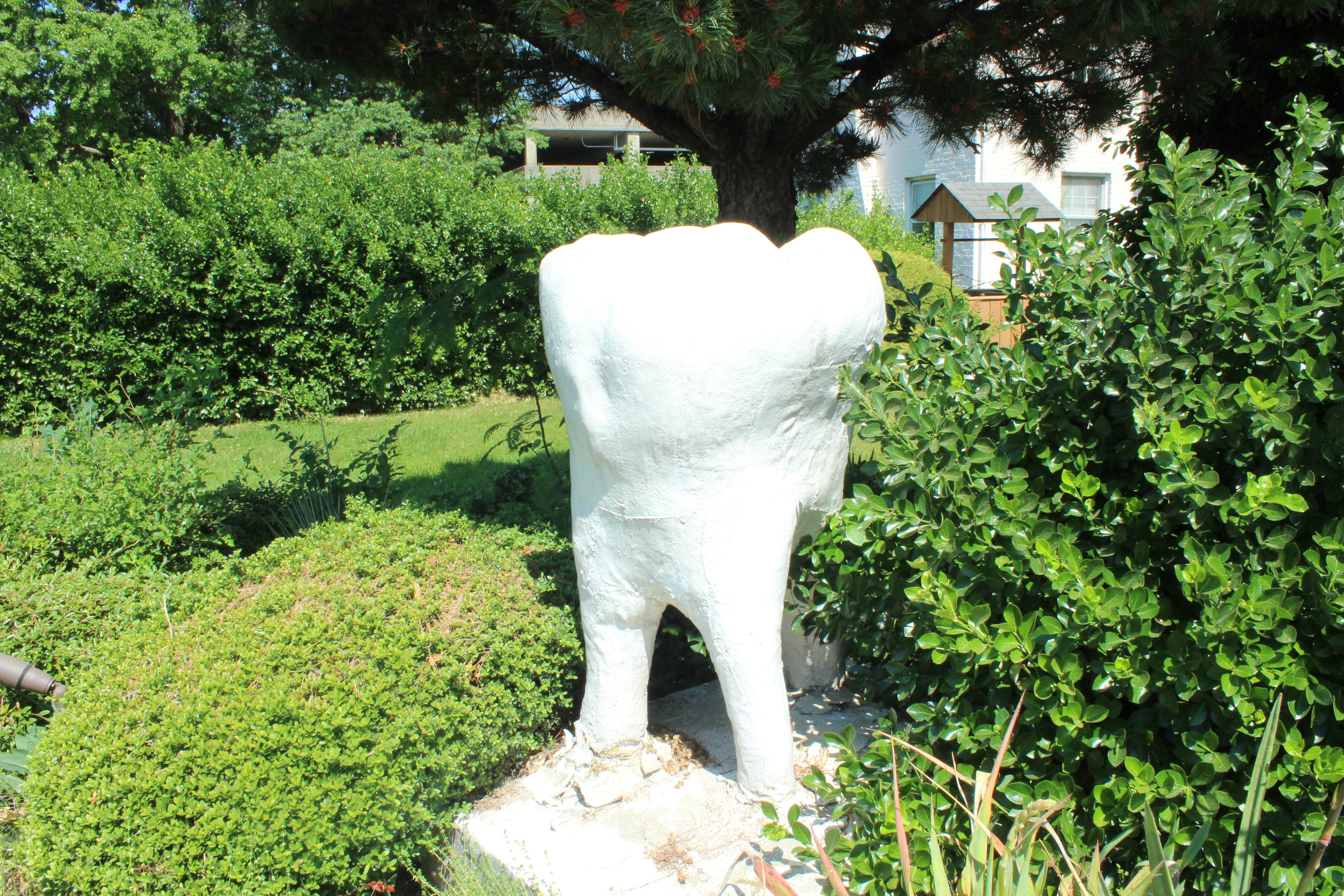
Just down the street from Tyson’s Center Mall is a small single-family home that serves as the dental offices of Dr. Thomas A. McCrary, Jr. The charming building of the family business at 1954 Old Gallows Road is known as the “The Tooth House,” named after the “landmark six-foot statue” in the front garden. Dr. McCrary went so far as to market his business on a website of the same name. The molar sits the edge of the property partially hidden by several bushes. The tooth appears to be made of stucco, but definitely not concrete. A small wooden well is located in the background closer to the house. As far as emblematic statues that typify a business, this is our personal favorite in the area. 

This was of course not an exhaustive list and could not cover the entire breadth of Northern Virginia. What strange statues and monuments make your list?
Categories
Alexandria Matthew Eng

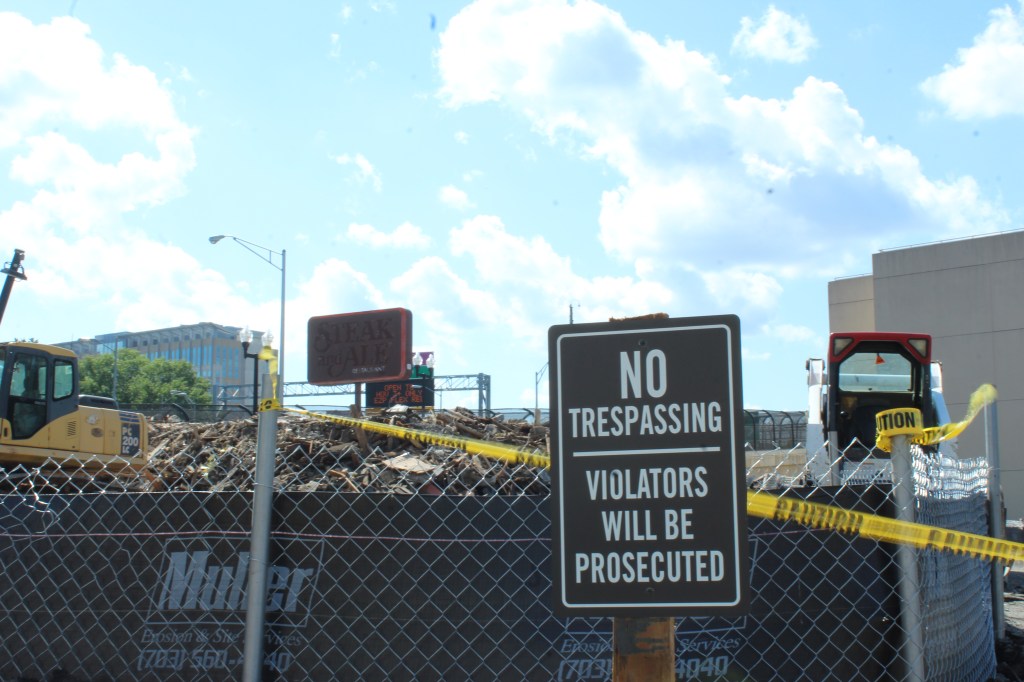
The End and (Almost) End: Steak and Ale and Topgolf Alexandria Update

By Matthew T. Eng, Offbeat NOVA

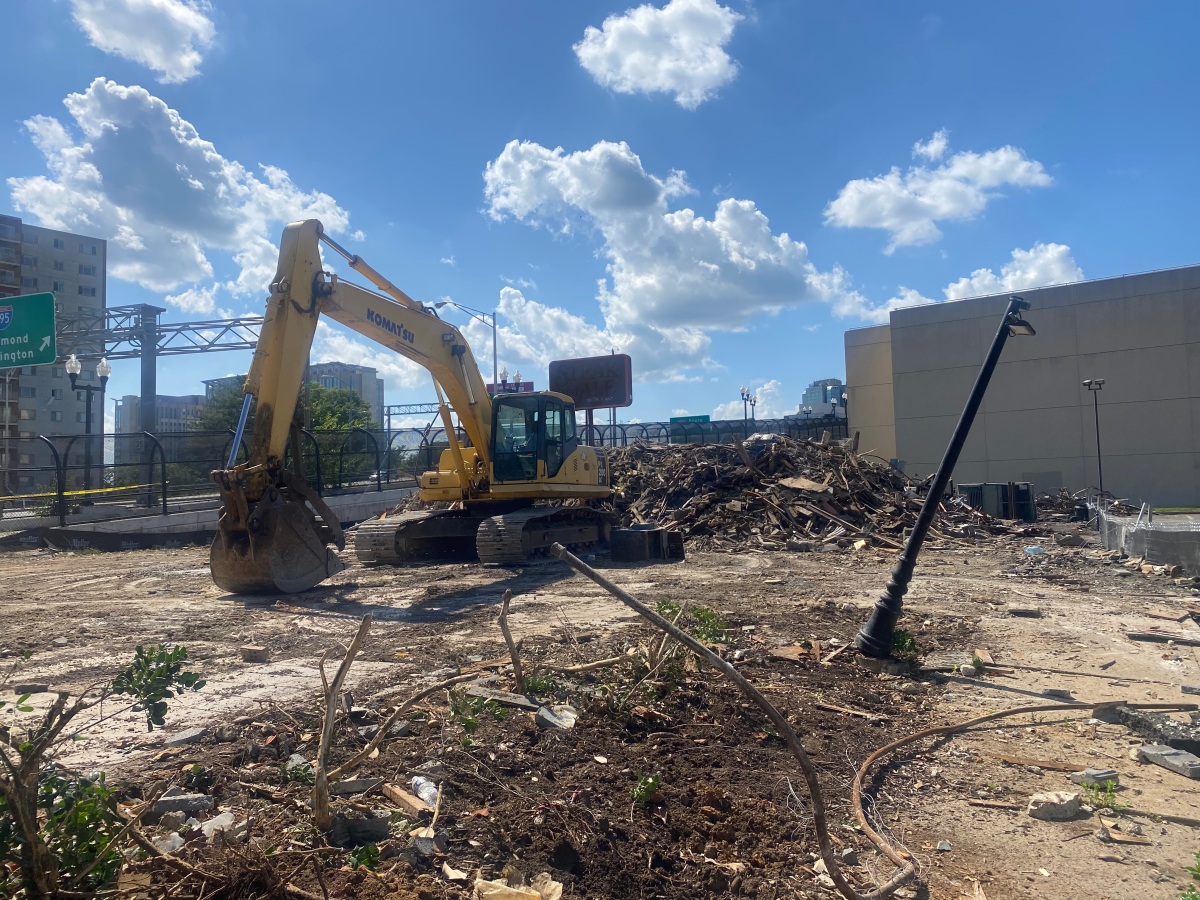
Earlier this year in February, I traveled down Seminary Road in Alexandria near the I-395 Interchange to snap some pictures of the abandoned Steak and Ale Restaurant at the intersection of Kenmore Avenue. I wanted to do a story about the building and the restaurant chain itself. I talked about how Steak and Ale was a symbol of the dying existence of Chain Restaurants in the United States. I ended the article with this statement: 

“The Steak and Ale in Alexandria will eventually go away entirely. Its property will be swallowed up by gentrification. For businesses, this is the circle of life. COVID has only accelerated the process.”

Well, it seems that the time has come. 

The decaying restaurant was torn down today. I got the tip from some pictures that were taken on a community page about Northern Virginia history on Facebook. It was nice to see so many personal stories about that establishment dating back to the 1970s in its heyday. Anyone who has ever eaten at a now-defunct chain restaurant knows exactly what the sentiment is. You don’t miss it, but you miss it. In a post-COVID world slowly approaching reality, how many of the chains still standing will be around to open their doors at the end of the year? 

The pictures from the Facebook group showed the building still in the process of being torn down. I had to work until 4pm, so I hoped that some of it would be left standing when I got there. By the time I zipped up the few miles up the road to the intersection of Seminary Road and Kenmore Avenue, it was no more. Several construction vehicles were in the vicinity, now dormant after their day of labor. A few workers could be seen at the end of the roped-off parking lot, chatting amongst each other.

The building, dormant and abandoned for nearly two decades, was finally gone. Walking to the site, I could smell the old wood, dust, and debris in the air. The only thing still standing from the establishment were the two signs that anchored the restaurant at the entrance to the parking lot and behind the back of the building near the bridge that looped over I-395. I snapped as many pictures as I could, thanking my former self that a trip to the site on a cold day in February was a good idea. Today, the weather was over 94 degrees at 4:30 in the afternoon. 

Surely, the Landmark area will look entirely different in ten to fifteen years. With news of Landmark Mall finally reaching a new plan as a new hospital, it’s hard to tell what that section of Alexandria will look like. Much of that area, Landmark and Little River Turnpike, has remained untouched by the tidal wave of gentrification felt in other areas of Northern Virginia. 

“Not with a bang, but a whimper…”

Driving home down Van Dorn Street in Alexandria, I decided to make a day of it. How did the other abandoned building we wrote about for Offbeat NOVA, the original Topgolf in America, fare today? 

Not great. The parking lot, completely empty save one big-wheeler at the edge of the large lot, had accelerated its process of neglect since I last visited it at the beginning of the year. The building and its surrounding area, once known for its lush and well-kept landscaping, is entirely overgrown and unkempt, even if the area just outside of the complex is manicured (no doubt by Fairfax County). The main clubhouse is entirely boarded up, with the surrounding complex showing severe signs of decay in the year and a half since it closed down. In some cases, it was worse off than Steak and Ale ever was. 

Topgolf was still standing…for now. 

On the way out, I noticed a large board at the entrance to the building. The board was a notice of a hearing from the Fairfax County Planning Commission for Wednesday, July 14, 2021. Part of the hearing will deal with the proposed plan for the Topgolf site, originally brought forth in 2015. The proposal is for a mix of residential and commercial use, with up to approximately 275 residential units and 20,000 square feet of retail. So it seems it is only a matter of time for before Topgolf meets its end in similar fashion to what I saw today. The DMV moves so fluidly, and the rapid acceleration of closed business during COVID has only made the prying eyes of developers hungry. 

Drop a comment about your memories of Steak and Ale and Topgolf Alexandria. 

Categories
Matthew Eng offbeat music spottsylvania county

Offbeat Music: The (Fredericksburg) Escape Plan

By Matthew T. Eng, Offbeat NOVA

Have you ever had that feeling when you’re having a panic attack and your heart is jumping into your throat? You feel like you can’t breathe and your mind is spinning out of control? That’s how I would describe listening to the mathcore band Dillinger Escape Plan

And honestly, I am probably being conservative with my explanation.

If you put on any Dillinger record, you are in for a wild ride. Throughout their twenty-year career, the New Jersey band brutalized audiences large and small with their aggressive blend of mathcore and metalcore, often using odd time signatures and elements of progressive rock, bossanova, and jazz intermixed with piercing vocals. They aren’t everyone’s cup of tea, but they were for me. Their debut album, Calculating Infinity, is still in my goto rotation when I am mad at the world and just want to listen to somebody else scream so I don’t have to. If you ever feel that way, I highly suggest it.

If you were into underground or indie music in the early 2000s, you knew of two main bands you didn’t want to sit in the front for. The first was Les Savy Fav. Of course, the performances I saw were always electric and fun, but that didn’t stop the lead singer Tim Harrington from trying to suck face with you while wearing only underwear. The other was Dillinger Escape Plan. No, the lead singer would definitely not make out with you, but he might violently attempt to bash your head in with a microphone stand. 

Anybody who saw Dillinger in the early 2000s knew to stand clear of the front, because everyone from the singer to the guitarists would repeatedly smash their instruments like weapons on unsuspecting fans. I can recall seeing a young fan get hit in the head with the backside of a guitar neck in the early 2000s. If metalcore had a “most dangerous band” award, they would be the undisputed winners. I only managed to see them a few times before they broke up a few years ago, but every time was both impressive and scary to watch. Who doesn’t like a band that keeps you on your toes, right?

So why bring this up on a blog for Northern Virginia history? Although their connection to the area is minimal at best (one of the original guitar players used to play in a seminal hardcore punk band in the early 1990s in the Hampton Roads area called Jesuit), an act of theft occurred in Fredericksburg in 2006 that LITERALLY lived up to their name. 

On June 10, 2006, Dillinger Escape Plan traveled down to begin their tour in Fredericksburg, VA, at KC’s Music Alley, a medium-sized music venue just off the main downtown area of the historic district on Princess Anne St. The band was just a few days away from releasing a digital EP of cover songs, called Plagiarism. It was the first time the band had performed in the area since they formed. Needless to say, kids who attended the show were not ready. They did not get the memo about the front row that I had known about. 

The band performed in their usual fashion. A YouTube video from user “Metal Nick” has the first two songs of that concert.

From their official press release of the show: 

This was their first show ever in these parts and it wasn’t too much unlike any other Dillinger show prior. Greg climbed on the P.A., hung from the ceiling, blew fire… Ben swung his guitar violently and jumped off of his gear a lot. The band has been doing this for several years and it’s part of what people come to expect when paying to see DEP live. Any damages incurred by the venue always get covered from the band’s guarantee.

lambgoat.com

A few people in the audience apparently took the violent stage act as a threat of violence. Dozens of people huddled around their tour bus and threatened violence of their own against the band after they finished playing. Although nobody was hurt, somebody managed to snag fill-in guitar James Love’s guitar, a custom pink Ibanez, in the process. The thief only just managed to escape, as a member of fellow touring band Cattle Decapitation put a hammer through the window of his blue Cooper Mini. Apparently, the thief’s name was “Jeff.” 

The Ibanez Guitar (Flickr)

I do not know if the guitar was ever recovered. If you look at age-old message boards on the topic (yes, they were very big in 2006), you will see everything from sympathy and anger to expressing that the band was due for a “good old fashioned ass kicking” anyway. 

KC’s Music Alley is now known as “KC’s Music Alley at Central Station and is still open today. It seems like a typical sports bar and venue during the week. You have standard poker nights, comedy nights, and other assorted events reminiscent of similar venues. There is full restaurant there, as well. Feel free to visit them and get some loaded cheese fries or a “Central Station Burger” and think about that time you almost got your head sliced open by a guitar. Just don’t, you know, steal it. 

Categories
Arlington Matthew Eng Podcast

The Washington Luna Park Assault Case (Part III)

This is the last of a three-part series on the an assault case that happened in the opening year of Washington Luna Park in 1906. Read the first article HERE. Read the second article HERE.

By Matthew T. Eng, Offbeat NOVA

Offbeat NOVA · (S1E3) The Washington Luna Park Assault Case (Part III)

The facts continued to repeat in the newspapers. Ms. Gooding failed to identify the prisoner when she first saw him in the lineup. This was corroborated by four officers who saw her pick another man. The man she identified had been in jail since January of that year. She was also the only person to testify of the assault because Forrest Gooding had run away to the park gate for help. She also claimed to have throat bruises, but no physician was ever called to testify to that condition, and she appeared otherwise normal, if not a bit frazzled.1 

“Do these facts seem to justify an impartial, unbiased mind in reaching a conclusion of guilt and fixing the punishment at death? Was not the alibi proved by a preponderance of testimony, or was it not certainly sufficient to raise in the minds of the jury a reasonable doubt of the prisoner’s guilt, and was not the failure to identify at once, at first sight, a fatal obstacle to the prosecution’s case?”2


Evening Star, November 14, 1906. 

Clements fully believed in the man’s innocence. He wasn’t the only one. With the appeal put in place, the only thing to do was wait. 

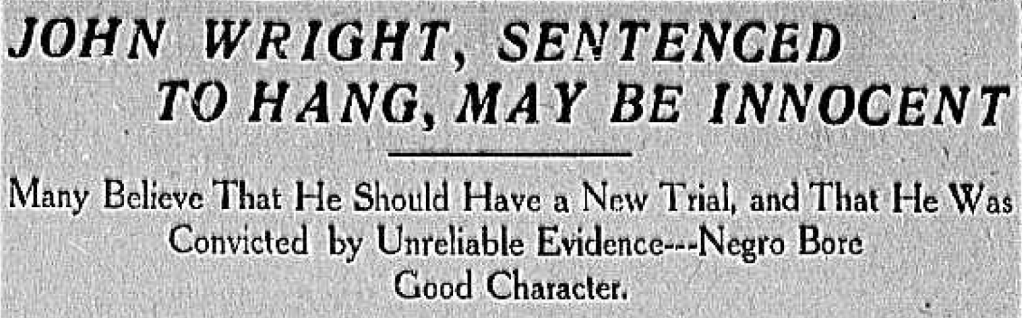
The answer came in the second week of December, just one week before Wright was sentenced to hang on the following Friday. On December 11, 1906, James Clements received a writ of error from the Virginia Supreme Court of Appeals. That in the least postponed the hanging from happening the following week. The writ claimed that new evidence had been found and that the verdict was circumstantial and largely due to public clamor than actual evidence. The case went under review once again because of Ms. Gooding’s inability to recognize the individual at first and Wright’s strong alibi on the night of the alleged incident. The liveryman’s testimony that Wright returned to the stable around the same time of the incident made it very difficult to connect the two. Wright was hopeful he would get a new trial.

The case was argued before the higher court on January 10th of the following year, with no decision made after the first week in February. Throughout this, Wright continued to proclaim his innocence. A decision was finally made by the Court of Appeals in Richmond in mid-March, which affirmed the decision of the lower court on a decision of three to two.4 

Richmond Times-Dispatch, March 22, 1907

The next day, the Richmond Times-Dispatch ran with the headline “Court Divided, But Wright Must Hang.” The verdict could not be reversed in a case like this unless it was found that new evidence was insufficient to warrant the finding of the jury. The decision also stated that no new trial would be granted. The article ended with a haunting and foreboding warning for trials of its kind to come in the future:

“It is further stated that the guilt of the accused is purely a question of fact, and that if the witnesses for the Commonwealth were worthy of credence, of which the jurors were the exclusive judges, there can be no question that the verdict is neither contrary to the evidence nor without evidence to support it.”5 

Richmond Times-Dispatch, March 15, 1907

John Wright was a dead man walking. Wright was sentenced to hang on May 31, 1906. 

Interest in the case continued to grip the local community. Clements continued to fight for Wright. He went to work and prepared another petition to the court of appeals for a rehearing. More revelations came out regarding the other crime Wright was accused of, the murder of Jackson Boney. According to one report, a woman named Anna Green, a woman of “debased character,” accused Wright of murdering Boney when she herself was with Boney on the night in question near the Long Bridge that connected Virginia to the district. The details she offered authorities was “beyond belief,” and put Wright nowhere near either incident. Her testimony would have undoubtedly spread doubt to Wright’s conviction. Yet these facts and information were summarily dismissed from appearing at the case.6  

In the midst of these appeals, it was reported in the Alexandria Gazette that Forrest W. Gooding had gone missing on April 26, 1907. Mrs. Gooding noted in the article that Gooding had been in a nervous condition since the conviction of Wright and that Black individuals in the neighborhood had “threatened to kill him.” No mention in the news was ever made of his reappearance.7 

A small community movement began towards the end of May 1907 to present Virginia Governor Claude A. Swanson with a request to overturn the execution by hanging. Governor Swanson put another stay in the execution until August 30th so he could fully absorb all details of the case. It was decided by Governor Swanson on that date that he would commute the sentence, and instead give Wright a life sentence in prison. With all the facts laid before him, Swanson had in his official statement “a serious doubt as to the identity and guilt of the prisoner.”8 

Wrongfully accused or not, Wright escaped the gallows but was resigned to live his life as a prisoner, not a free man, for a crime he undoubtedly did not commit. 

THE END

The park continued to run for nearly another decade before it met its untimely end in 1915. On April 9, 1915, a fire destroyed the roller coaster. According to the Washington Post, “the origin of the fire is thought to have been from sparks from a blaze in the woods adjoining the park.” The closest fire stations were in Washington and Alexandria, so the park’s premier attraction was a total loss, even if very little else was taken by the flames. Regardless of this fact, the park was closed and dismantled later that year.9 

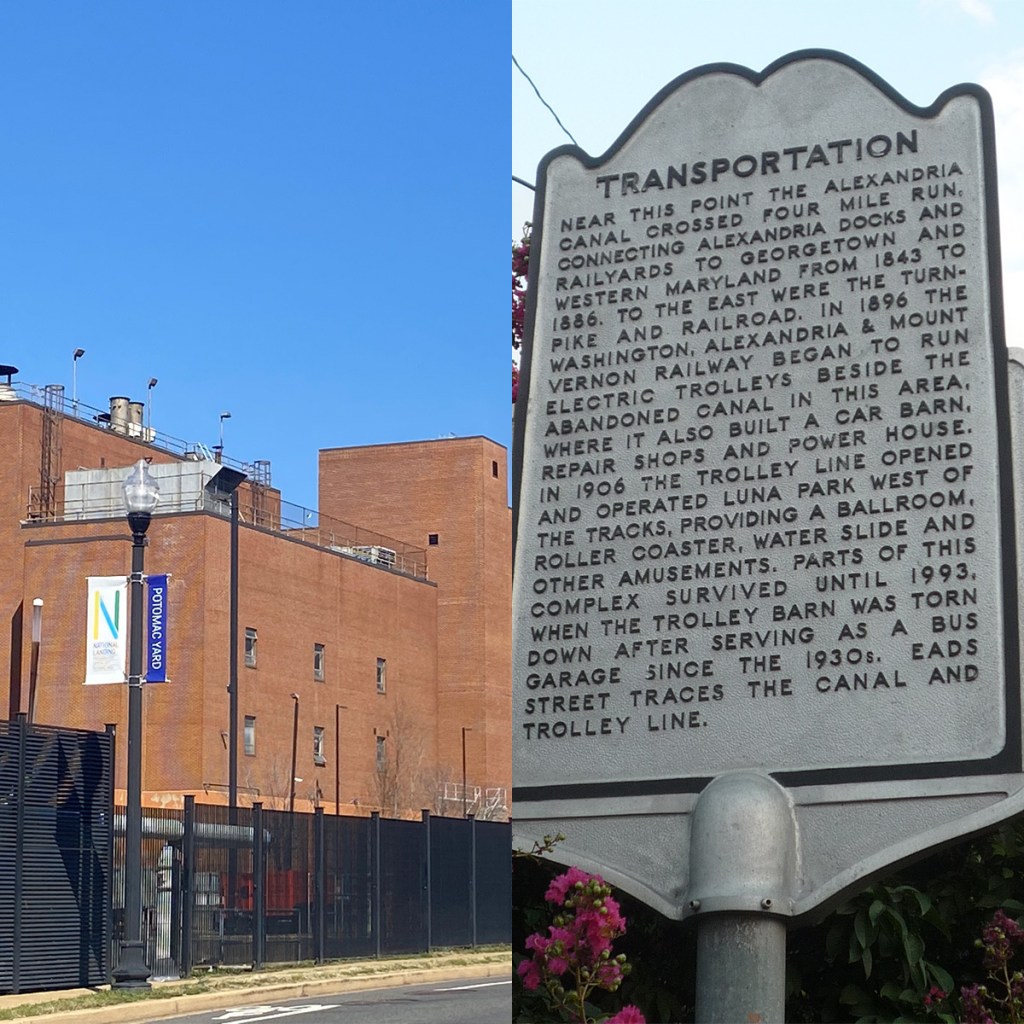
The site of Luna Park today is the Arlington County sewage treatment facility. Nearby on the corner of Glebe and South Eads is an unassuming transportation marker hidden in a tree. (Matthew Eng/Offbeat NOVA)

Today, the land on the corner of Glebe Road and South Eads St. near Four-Mile Run is occupied by the Arlington County sewage treatment facility. No evidence of the park exists. Only a small transportation marker for the Washington, Alexandria, & Mt. Vernon Railway exists behind a gate and an overgrown tree. I couldn’t help but think how close I was standing to the incident with John Wright and Mable Risley on a warm evening in the later summer of 1906. 

I wanted to come out of my research on this once beautiful park with sanguine thoughts and waves of nostalgia. Instead, I have very mixed emotions about the park’s legacy. In the wake of the racially motivated violence we have witnessed in recent memory, I take pause and think about how many of these incidences have occurred in American history. Too many. 

How many like John Wright were lucky enough to narrowly avoid the gallows? How many more were lynched without the benefit of a trial? There are multiple examples in the area when mob mentality won out at the turn of the century. It’s sobering to think how little some things have changed over the course of one hundred years. With so much progress, society continually lags in the pack. All you have to do is read the news. It would be at least comforting to say incidents like that of Mr. Wright were unprecedented. But the world sadly does not work that way. Not then. Not now.

Forest S. Gooding Death Notice (Ancestry)

I don’t know what happened to John Wright at this moment in time. There are prison records in Richmond, but that will take time to find out at this time. Life was easy for the Goodings, however. Census records show that the couple settled in Wheaton, Maryland, in Montgomery County, shortly after the yearlong trial and commutation process ended for Wright. By 1910, the two had two children, including a newborn son named James. When the 1920 census was collected, the Gooding’s had four children. Forest Gooding died on September 23, 1929. Mabel remained a caretaker beyond her husband’s passing, dying in 1976. 

But what happened to John Wright?

Should I look up Joseph Thomas or his more common alias, John Wright? These are questions I will ask myself self in the future when it’s safe to venture out and research more intimately. Rest assured, I want to bring some sort of closure to this story. I think John would want that — a slice of freedom he was never given. His story, like those both known and unknown by the public today, matters. His life matters. Especially since the only life he got was one attached to a sentence from a broken system. 

Footnotes:

  1. Evening Star, November 14, 1906. 
  2. Evening Star, November 14, 1906. 
  3. Richmond Times-Dispatch, December 12, 1906. 
  4. Alexandria Gazette and Virginia Advertiser, March 14, 1906.
  5. Richmond Times-Dispatch, March 15, 1907. 
  6. Richmond Times-Dispatch, March 22, 1907. 
  7. Alexandria Gazette, April 27, 1907. 
  8. Virginia Citizen, August 30, 1907. 
  9. “Luna Park – 1915,” Arlington Fire Journal & Metro D.C. Fire History, June 24, 2009. Accessed April 24, 2021, LINK.

Categories
Arlington Matthew Eng Podcast

The Washington Luna Park Assault Case (Part II)

This is the second of a three-part series on the an assault case that happened in the opening year of Washington Luna Park in 1906. Read the first article HERE.

By Matthew T. Eng, Offbeat NOVA

Offbeat NOVA · The Washington Luna Park Assault Case (Part II)

Forrest W. Suddenly Gooding took the stand on Halloween in John Wright’s trial at the Circuit Court of Alexandria county. He identified Wright, the defendant, as the one who assaulted them on the 9th of September. Gooding retold his side of the story to the jury and Commonwealth’s Attorney Crandal Mackey, whose job it was to prove Wright’s guilt. Mackey would later make fame in Arlington and Alexandria as a champion of prohibition.   

Crandal Mackey was the district attorney in charge of convicting John Wright of assault against Ms. Mabel Risley on September 9, 1906 (Offbeat NOVA)
Crandal Mackey (WETA/Boundary Stones)

It was noted in the Alexandria Gazette article that the two had been married in the month and a half since the incident. 

A variety of other witnesses took the stand that day. Ms. Risley’s sister, Mamie L. Sullivan, took the stand to testify that she had, despite being happily married, been in “ill health ever since the occurrence.”1 

Mabel Risley, now Mabel Gooding, took the stand in the late afternoon until almost six in the evening. She also identified Wright as the assailant who committed the crime. She also testified that Mr. Wright had jumped out of the underbrush, knocked Mr. Gooding unconscious with a club in one hand and a pistol in another before choking her, assaulting, and robbing her. Hannah Thomas, the common-law wife of Mr. Wright, testified that he had taken her out for a drive that Sunday afternoon, returning the horse and buggy to a livery stable between 8 pm and 9 pm.2 

Testimony opened up on the first of November with Captain Edward S. Randsell of the Washington District jail. Randsell testified that the couple came to the jail on September 22nd to identify Wright. According to him, when given a lineup of Wright and five or six other individuals, she pointed to another African American man named Henry Johnson, alias “Alabama Joe.” A police officer with her let her know that that was not the correct person, and she correctly identified Wright as the accused after some gentle persuasion by the policemen, Officer Wood. Yet Randsell testified that Wright was not correctly identified first and that it was “not done properly.”3 

More corroborative testimony happened that day in the defense of Wright. A total of four officers at the jail, James Corrigon, William A. Sword, Thomas S. Hope, and Captain Randsell, all stated that Mabel Gooding identified Henry Johnson as the responsible individual, and kept her eyes on him most of the time.  The warden of the jail testified to not taking an active interest in the case, yet told Mr. Mackey that Mr. Wright should not sign papers presented by Mr. Mackey. He felt it was in the best interest of John Wright to seek counsel before signing anything presented by a Commonwealth’s Attorney. He was absolutely right. A cross-examination from Mrs. Gooding yielded little results.4  

At 3 pm, Wright took the stand. He denied all charges, accounting for his whereabouts that evening. As corroborated in his wife’s testimony, Wright declared that he was driving when the crime took place. He denied ever owning a pistol. He noted that the policemen Wood directed Ms. Gooding toward Wright, asking her “Is this the man” after incorrectly picking him out in the lineup. She only identified him after he spoke. Wright also denied ever being near Luna Park. The Evening Star included a play-by-play of his testimony, going further into the allegations made against Officer Wood: 

“He stated that he was arrested by Policeman Wood of Washington, and that the officer said” ‘I have got $100 on you.’” 

Evening Star, November 1, 1906

The jury was then sent away to deliberate after the evidence and testimonies wrapped up around 8:30 pm.5 

If you opened up the newspaper on November 2, 1906, you would see one of the local headlines read: “Joseph Thomas, Alias Wright, Sentenced to Be Hanged.” 

John Wright trial verdict in the Luna Park Assault Case (Offbeat NOVA)
Evening Star, November 2, 1906

At midnight that night before, the jury indicted John Wright for criminal assault on Mabel Risley, now Ms. Gooding. The deliberation only lasted forty-five minutes. The punishment was death. When asked if he had anything to say, Wright said nothing. The sentence was to be carried out on December 14, 1906, between 6 am and noon. The article noted that Wright “did not apparently realize the gravity of the penalty imposed.”6

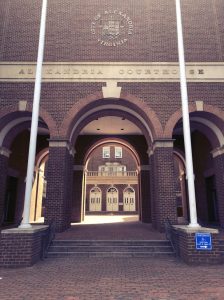
A motion was put forth by Wright’s attorney, James E. Clements, to set aside the verdict and grant a new trial. This was immediately overturned by the judge in charge, Judge Charles Edgar Nicol. Clements moved for a stay of execution for forty days to allow counsel for the defense to prepare an appeal to the state supreme court. The judge reiterated that Wright had received a fair trial before “an intelligent jury.” At that point, the death penalty had not been conducted by Alexandria County authorities since 1873.7 

One of the other attorneys for the defense argued that there should be some consideration as to whether a crime was actually committed, as it was shown that no rape has been committed. He arraigned Commonwealth Attorney Mackey for not trying Mr. Wright on the murder of Jackson Boney, something that was completely tossed out through the course of the trial. Mackey surmised that attempted rape was “punishable by death, and he asked that Wright be sent to the scaffold.”8

circuit court alexandria john wright offbeat nova
Circuit Court in Alexandria today (Library of Congress)

A reported for the Evening Star contacted defense attorney James E. Clements a week and a half later, asking him about the progress of Wright’s case. It was noted that the sheriff and Crandall Mackey had all but secured a guarantee for a December 14, 1906, hanging. Clements stressed he still had room for an appeal to Judge Nicol, and was in preparation to send the necessary papers to Richmond at the court of appeals of Virginia. He also said that he had not understood that “it was a part of the duty of a commonwealth’s attorney to personally assist in hanging a man he had prosecuted.” By then, the public in Alexandria County was well aware of the trial, asking if the swift verdict of a death penalty justified by the case’s shaky evidence? Why the haste?9 

Footnotes:

  1.  Alexandria Gazette, November 1, 1906. 
  2.  Alexandria Gazette, November 1, 1906. 
  3.  Evening Star, November 1, 1906. 
  4.  Evening Star, November 1, 1906. 
  5.  Evening Star, November 1, 1906.
  6.  Evening Star, November 2, 1906. 
  7.  Evening Star, November 2, 1906. 
  8.  Evening Star, November 2, 1906. 
  9.  Evening Star, November 14, 1906. 
Categories
Alexandria Arlington Podcast

The Washington Luna Park Assault Case (Part I)

This is the first of a three-part series on the an assault case that happened in the opening year of Washington Luna Park in 1906.

By Matthew T. Eng, Offbeat NOVA

Offbeat NOVA · (S1/E1) The Washington Luna Park Assault Case (Part I)

I love amusement parks. I love the smell of fried food, the ambient crescendo of screams heard on roller coasters, and the sounds of laughter amongst the tightly packed crowds. As a father, I try to give my daughter the same wonderful experiences I had as a kid in amusement parks. Some of my best memories were spent in places like Walt Disney World, Busch Gardens, Kings Dominion, and Six Flags.

When I found out that an amusement park once existed in the immediate D.C. metro area, I had to learn all about it. The initial reviews of Washington Luna Park were promising. 

I wanted to know everything about a location that once declared itself the “greatest amusement resort west of famous Coney Island, New York.”1 Just a ten-minute trolley ride south from Washington, D.C., the park’s creators chose an ideal place to attract citizens from the entire region to have fun in the summer sun. 

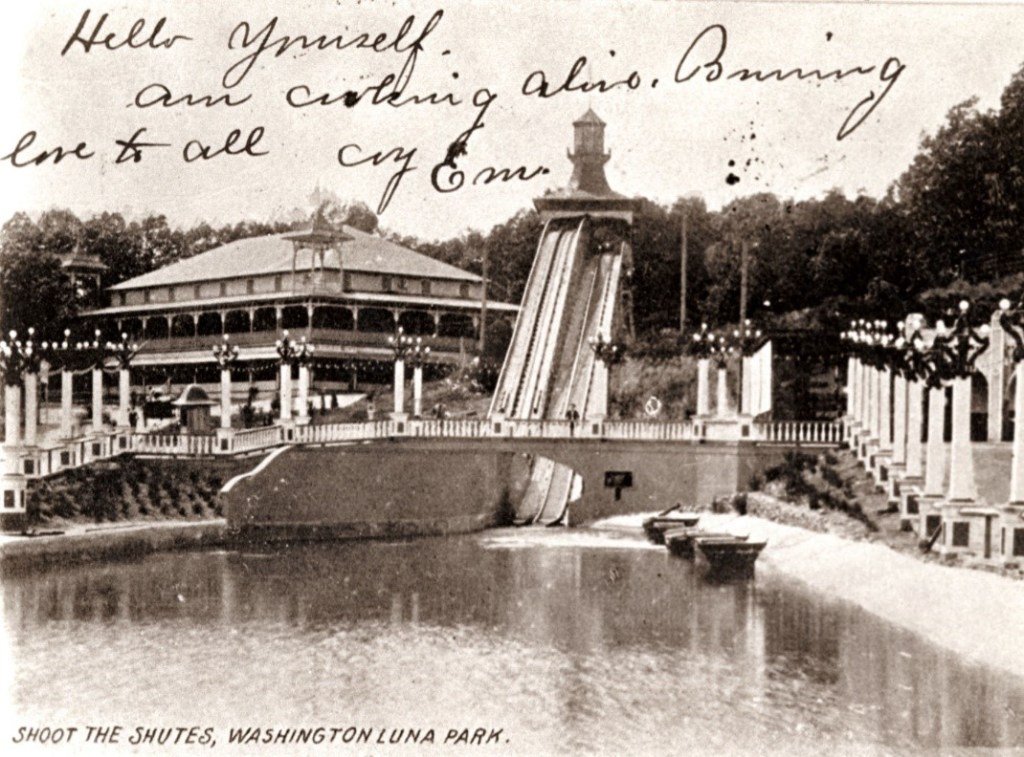
Unfortunately, pictures of Washington Luna Park are relatively scarce. I could only tell the story of the park through the newspaper reports. Thankfully, the Alexandria Gazette was a great place to start combing through the history of the park, from its opening day on May 28, 1906, to its demise nearly a decade later. 

What was Luna Park? 

Washington Luna Park
Washington Luna Park (Arlington Historical Society)

The Washington Luna Park was one of many similar establishments built around the country at the turn of the century. The park was the brainchild of Frederick Ingersoll, a well-known jack-of-all-trades who excelled in business, building design, and invention. The Luna Park theme parks were a wildly popular and lucrative model for entertainment complexes around the United States. The best example that still survives today is Luna Park in Coney Island, New York City. 

The January 15, 1906, edition of the Alexandria Gazette included an article on a “Proposed Park” that would offer residents of Northern Virginia and Washington, D.C. a “new place of summer amusement, in the way of a magnificent park.” Washington Luna Park was built and designed by Ingersoll, fresh off the success at Luna Park in Cleveland. He envisioned a new 40-acre park located “midway between Washington and Alexandria, near the Four-Mile Run powerhouse.” The park was estimated to cost $300,000 and would include approximately 75,000 electric lights, still a novelty for the era.2 It was designed to serve as a “trolley park,” meaning the patch of land it rested on along the Four Mile Run crossing ran straight past the electric-powered Washington, Alexandria, and Mount Vernon Railway that skirted the old water route of the Georgetown-Alexandria canal. The short trip between Washington and Alexandria meant visitors had a high potential of stopping at Luna Park for a day or afternoon of diversion.3 

Alexandria Gazette, May 15, 1906

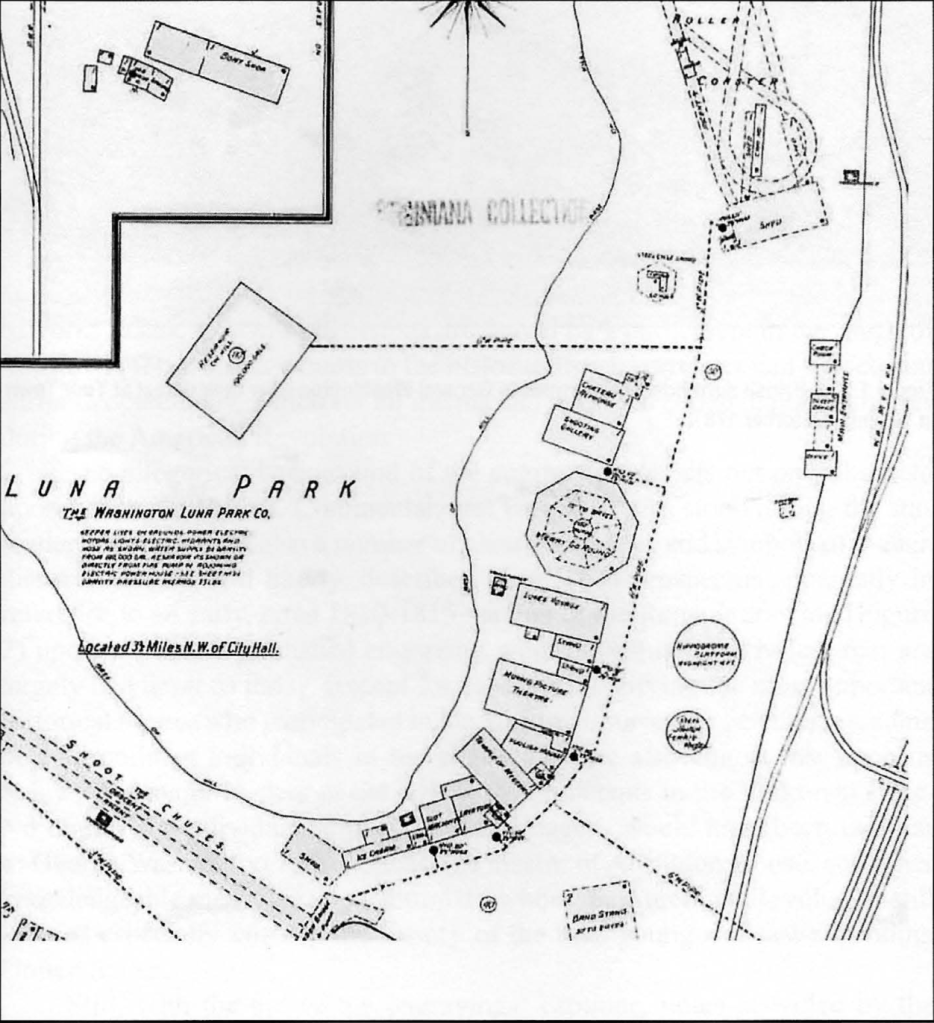
Opening day for the “Coney Island Near Washington” was set for May 28, 1906. The park offered scenic views of the river, daily concerts of big band music from a free outdoor hippodrome, a large outdoor picnic area for several thousand people, Japanese tea gardens, and saltwater taffy.4 No alcohol was permitted on the site. The lagoon in the park boasted 350,000 gallons of water. The biggest draw for the park were the rides. Although there were a total of thirty attractions throughout the trolley park, several stand out. The park had a figure-eight roller coaster, circus arena, and, most notably, a chute-the-shoots slide, a ride concept still in existence today at Kennywood in Pennsylvania.5 The ride had a 350-foot incline on it before it plunged into the large lagoon of water. Washington Luna Park was “a city in itself…equipped with the best gifts of nature.”6

Washington Luna Park Map (Offbeat NOVA)
Map of Luna Park (Arlington Historical Society)

Attendance was steady in the opening weeks. The park organizers had high hopes after the first initial flurry of visitors at the end of May that it would be the most popular theme park of its kind in the country. Organizers continued to offer the same amusements each day, with several relatively popular “B and C list” acts to draw more paying customers into the park. The Norins high divers, a well-known family of death-defying performers, took twelve dives a day in the opening weeks. In June, famous aeronaut Roy Knabenshue made scheduled flights in and around Luna Park on a six-day stint from June 12th to the 18th. For two ascensions daily, he was paid $1,000. By the beginning of August, the park was well on its way to making its first season both successful and profitable.7 

THE EVENT

If you asked anybody who knows about the park’s limited history, they would most likely say the most sensational thing that happened in the inaugural year was the escape of elephants from the park in late August. Any mention of Washington Luna Park in papers or online articles mentioned the flight of four elephants (Tommy, Queenie, Annie, and Jennie) into Alexandria. The elephants “smashed a barn, decimated a cornfield, and trampled a graveyard” before being caught. All four elephants were rounded up a week later near Baileys Crossroads in what some call “The Pachyderm Panic of 1906.”

After reading through several articles in the Alexandria Gazette about the elephant escape in late August of 1906, I was satisfied with the direction a proposed segment on it would take. For posterity, I decided to press through and see all news and incidences before the end of the first season in September. That’s when I found out about the unfortunate story of John Wright and his alleged assault of a woman at Luna Park in September 1906. Although the incident occurred over one hundred years ago, it felt as if it was ripped from our headlines today.  

Less than two weeks after the drama of the elephant escape, a new challenge to the park’s reputation emerged on a pair of warm evenings in early September. On the night of September 6, 1906, two individuals were assaulted just outside of Luna Park’s grounds. Local D.C. resident Joseph Saddler accompanied Ms. Tassie Bywater from Rappahannock County to the park when they were both assaulted just after 10 pm that evening. According to the article on the “mysterious assault,” Saddler was shot in the neck and beaten outside the picnic grounds by an unknown assailant. The article stated that:

“There was intense excitement at the park when Saddler, with the blood spurting out of his wounds, rushed through the park gate, and in hand with Miss Bywater, whose clothes were literally covered with his blood.”9

Alexandria Gazette, September 7, 1906

The bullet penetrated into his body and lodged in his jaw. He also had visible wounds on his cheek and scalp. He later confessed that a black man came upon them while they were waiting for an Alexandria trolley car. The man began beating him on the head with a stone and fired the shot into his neck. According to Bywater, the blast was so close to them that the shot burned her, also splattering the wound’s blood all over her clothes. Although Saddler was confident in his own testimony, Ms. Bywater was unsure if “the man who did the shooting was white or black.”10

It was surmised in the news the following day that the assailant was “either a jealous lover of Miss Bywater or an angry relative,” not a black man. Just three days after the first assault reported at Luna Park, on September 9, 1906, another incident occurred nearby where the first took place between 8:30 pm and 9 pm. This time, however, the presumed aggressor would not remain unfounded. 

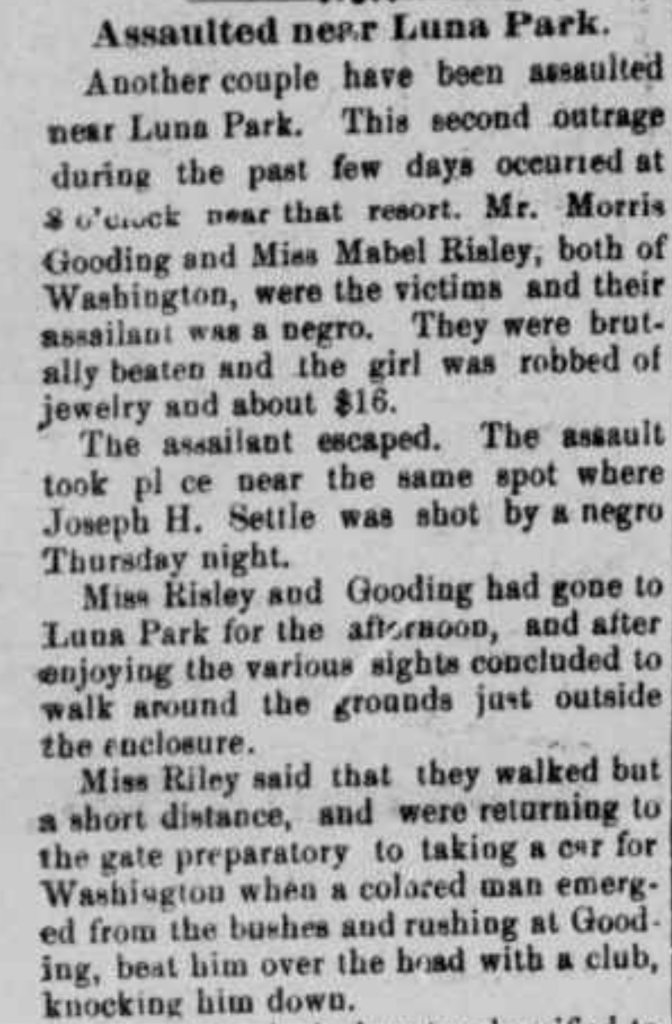
According to the news report in the Alexandria Gazette, Washington-area residents Mr. Forrest Gooding and Ms. Mabel Risley were the victims of a similar assault. The article stressed that the assailant was once again “a negro.” They were reportedly beaten and robbed of their jewelry and $16 nearby where Mr. Saddler was shot.11 

luna park assault 1906 (offbeat nova)
First mention of the assault (Alexandria Gazette, September 10, 1906)

Mr. Gooding and his companion took a stroll beyond the main gate that evening before deciding on a trolley car back to Washington. It was then that a “colored man emerged from the bushes,” and beat his head with a club. He then turned to Ms. Risley and demanded her jewelry and cash. She began to run when he pulled out a revolver and threatened to shoot her. He then grabbed her, “burying his fingers in her throat,” and “choked her until almost fainting.” Two gold rings, a pocketbook, and a watch were taken before the assailant ran off. Mr. Gooding did not witness any of the events involving his date and the assailant. Risley, who was “nineteen years old and attractive,” stayed in shock from the incident through the night. Both individuals were treated at a hospital for reported injuries.12 

Authorities at the park had a competing story about the incident. According to them, no pistol was discharged, and both individuals were approximately a quarter-mile away from the gate. It was only after they were confronted that Gooding ran towards the park to raise an alarm. One of Goodings’ ears were bleeding at the park, but nothing that would exactly deem as serious head trauma. The park stressed that they were not liable for any visitors who strayed outside the confines of the park itself.13

One newspaper, the Evening Star, included some proposed dialog between the “colored ruffian” and Gooding. When Gooding supposedly asked what the man wanted after he popped out from a cluster of bushes, he replied that he was going to kill him. He then proceeded to hit Gooding in the head near the ear with a two-foot-long club. Stunned, the assailant turned to Ms. Risley, who was told at gunpoint to give him her handbag or he would kill her. He then lunged for the bag, grabbed it, and left. There was no mention of forced trauma to the woman, despite saying so earlier in the same article.14

A black man was arrested the following day under suspicion of being the attacker. He was held in the county jail. The next day, the Luna Park managers offered up a one hundred dollar reward for the arrest of those responsible for the “murderous assaults” near the park. The police believed the person who assaulted Ms. Risley and Mr. Gooding on September 9th was the same person who attacked Tess Bywater and Joseph Settle. The assaults were committed in almost the same spot, three days apart. Although Ms. Risley denied Mr. Gooding fired a shot at the assailant, she was still in shock from her abrasions on her throat and arms. Despite her shock, she was positive she could describe the perpetrator as “a negro of medium height, wearing black clothing” and possessing a “slight mustache.” In the meantime, the individual who was arrested had yet to be interrogated.15 

The park closed for its inaugural season on September 22, 1906. Yet Luna Park stayed in the news for well over a year. The name of a verified suspect stayed out of the papers until October 8, 1906, when the Alexandria Gazette included a short article “On the Charge of Murder.” The African American individual’s name was Joseph Thomas, who also went by the alias of John Wright, found a week after the incident occurred in Washington, D.C. It was reported on the 8th that a requisition from Virginia Governor Claude Swanson for the removal of Wright to Alexandria county for a trial on charges related to the murder of another African American man, Jackson Boney. It was noted that Wright was also wanted on the charge of assaulting Risley and Gooding. At the time, Wright was being held in the Washington Jail. 

From there, things escalated quickly. What began as an assault case for Wright became a trial for his life within a few weeks.

Footnotes:

  1.  Alexandria Gazette, August 7, 1906. 
  2.  Alexandria Gazette, January 15, 1906. 
  3.  Marty Suydam, “From Trolley Park to Sewage Treatment: Luna Park,” Arlington Historical Magazine, May 2016. Accessed April 24, 2021, LINK.
  4.  Alexandria Gazette, May 16, 1906. 
  5.  Suydam, “From Trolley Park to Sewage Treatment.” 
  6.  Alexandria Gazette, December 30, 1905.
  7.  Alexandria Gazette, May 26, 1906; Alexandria Gazette, June 11, 1906. 
  8.  Alexandria Gazette, August 21-27, 1906. 
  9.  Alexandria Gazette, September 7, 1906. 
  10.  Alexandria Gazette, September 7, 1906. 
  11.  Alexandria Gazette, September 10, 1906. 
  12.  Alexandria Gazette, September 10, 1906; Evening Star, September 10, 1906.
  13.  Alexandria Gazette, September 10, 1906. 
  14.  Evening Star, September 10, 1906. 
  15.  Alexandria Gazette, September 11, 1906. 
Categories
Matthew Eng offbeat eats Prince Willilam County

Offbeat Eats: Et Tu, Egg Foo Young? (UPDATE)

By Matthew T. Eng, Offbeat NOVA

This is an update to our January 23, 2021 Offbeat Eats article on the Taste of Asian restaurant in Gainesville, VA. You can read it HERE.

Fear leads to panic, panic leads to pain
Pain leads to anger, anger leads to hate
– “Danny Nedelko,” Idles

I have previously mentioned that I do not get to see my parents that often during this COVID pandemic. Although my parents moved up to the Northern Virginia in December 2019 from Virginia Beach, our plans to get together often were prematurely cut short due to the Coronavirus. Since then, this last year has only saw my family visiting my parents a handful of times. They are thankfully taking precautions as serious as we are. 

Not everybody should be Florida…nor should they. Anyways. 

We had a chance to get together this past weekend. If you read our brief Offbeat Eats article on Chinese food, you might venture to guess where I wanted to pick up food after our visit: Taste of Asian in Gainesville. My dad took out his take out menu from the restaurant and jotted down several soups, appetizers, and dishes for everyone to share. That of course included my personal favorite, egg foo young. My dad left the room to make the phone call to place our order while my daughter played with my mom. Several minutes later, my dad entered the living room from his office looking perturbed. When I asked why, he said he tried calling several times without an answer. Puzzled myself, I went to find the number on Google to make the call when I saw a short line of text written underneath the restaurant’s name: Permanently Closed. 

It seems that Taste of Asian had closed between the last time we visited in late January and March 2021. When I told my dad, he lowered his head and held the takeout menu a little tighter. He seemed a little upset while he stared at the order he would never make. I knew why. He didn’t even have to tell me.

My father is Chinese. He was born in Hong Kong in 1951. He lived in a one room apartment in the slums of the city. No running water. No toilets. Yet, through all of that, his family was resilient. His father left his family when he was an infant to work in a Jersey City laundromat to save up money for his family to immigrate. Jesuits taught my father English in the meantime, and when it came time for my family to come to the United States, my father was armed with a love of the New York Yankees (something still many feel is distinctly “American”) and the myriad possibilities America had to offer. 

Some Chinese call America the “Golden Mountain.” My family felt that way and took it to heart. Facing his own challenges of adversity, my dad worked hard and carved out his own path on that mountain. For him and countless other Asian immigrants of the “model minority,” I can only imagine how it must feel to see similar situations dashed due to Coronavirus. Sure, there are other businesses that have been forced to close due to the pandemic, but not at the rate and intensity of Asian businesses. And if you don’t believe me, there are facts and information. 2,800 hate incidences since March of 2020. Between February and April of 2020, an estimated 233,000 Asian-American small businesses closed. Restaurants, service industries, small businesses. There are two kinds of viruses that exist. One of the body and the other of the mind. 

I can’t tell you exactly why Taste of Asian closed. I can only speculate. But if I have learned anything, I have learned to trust my gut. My gut tells me that this wonderful restaurant was another casualty to Coronavirus and a decline in sales due to the prevalent thoughts of the time. I felt compelled to drive out to the restaurant to see if anyone was there. It was empty. The owners left a lovely note about their fifteen-year business. It breaks my heart to pieces.

Taste of Asian Closing Note (Matthew Eng/Offbeat NOVA)

I’ve seen racist comments from friends and family over this past year. I was mocked to a degree as a kid. There were only two or three other asians in my elementary school growing up, so I know I stuck out like a sore thumb. A few bullies squinted their eyes and thought it was funny. Seeing those comments took me back to a place I never thought I would have to visit again. I’ve kept my mouth shut for the most part. I am upset and ashamed for not speaking up. I mostly did it out of respect for family members or friendships. For one, I think of my daughter. She may only be one-quarter Asian, but I want her as proud of her heritage as I am. You can’t fight hate with hate. Only knowledge and understanding.

What I do know is that Taste of Asian was a small family business. When we were able to visit them in person, they always gave us excellent service with a smile. They served excellent food, and I hate updating my previous post on their egg foo young by telling you that I’ll never have it again. 

The egg foo young from the new place was okay, but not nearly as good as Taste of Asian’s.

We ended up supporting another Chinese restaurant down the street in Gainesville. Yes, we ordered the egg foo young. Unfortunately, it was not as good as Taste of Asian’s. 

Stop AAPI hate. For more information, visit this LINK

Be as water, my friends.

我愛你

Categories
Alexandria Angela H. Eng

A Walk in the Ruins: Alexandria’s Promenade Classique Park

By Angela H. Eng, Offbeat NOVA

One day last summer, Matt and I were in Old Town, trying to find a spot for takeout. We took a turn down a road named River Canal Way and stumbled into some kind of corporate conglomeration of office buildings and gazebos. However, as we turned around in the loop at the end of the road, I noticed a strange-looking fountain that was spewing water not up, but out towards the waterfront. 

So like any amateur history bloggers that keep a keen eye out for the weird and usual, we parked and got out of the car for a closer look. 

I was totally unprepared for what we saw. 

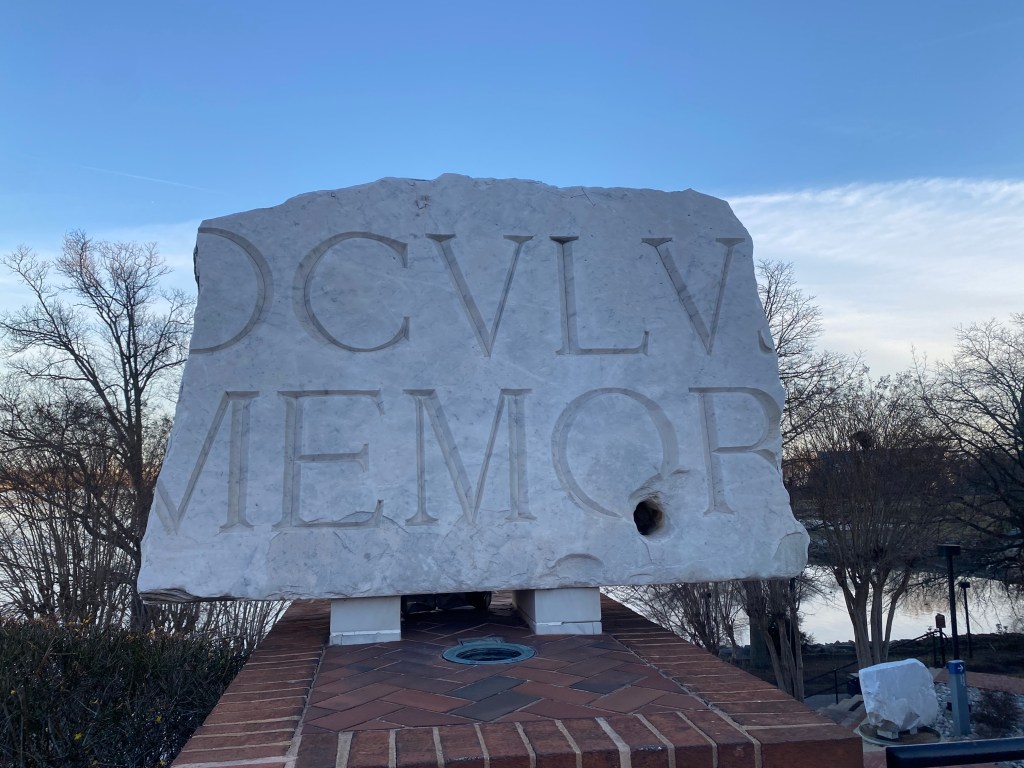
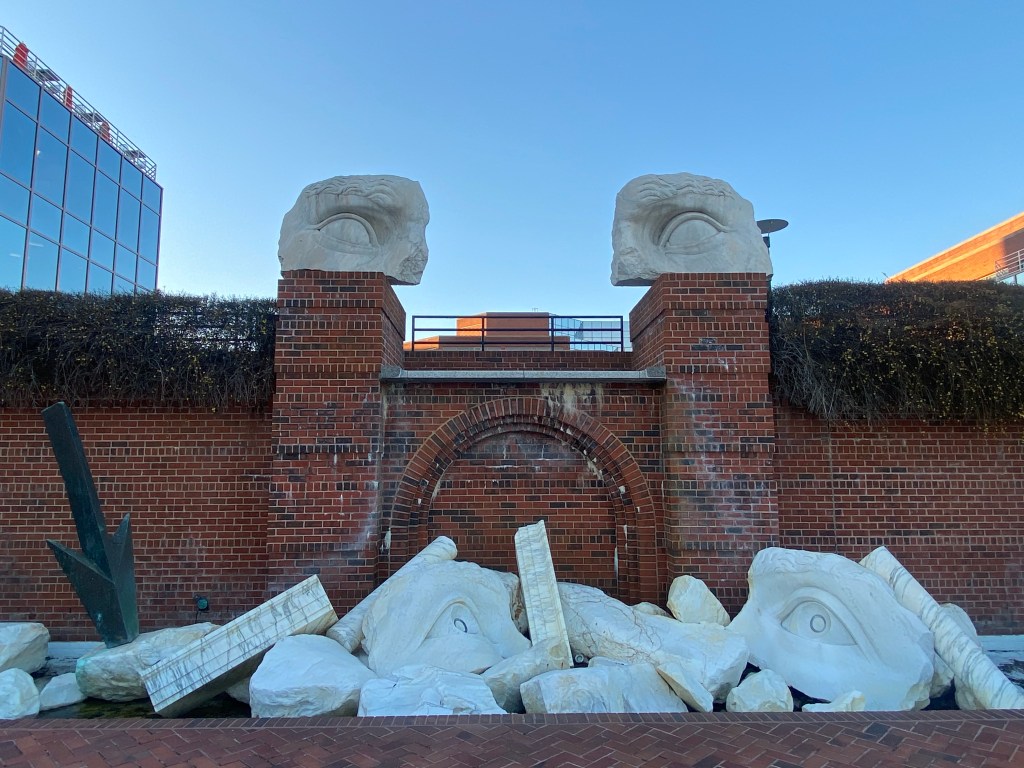
It was a giant pair of stone lips, made of marble and styled after a neoclassical statue. The water from the lips flowed forward in a small river of sorts, and cascaded over the edge of a small shelf. Two giant slabs of marble perched on top of columns on either side of the shelf, and one read “DCVLV MEMOR.” They framed, perfectly, a small-scale obelisk just like the Washington Monument. The Potomac glittered behind the obelisk, creating a picture-perfect view.

We had to pick up our food, so we got in the car and I did some research. It turns out that the fountain is part of a larger art installation called “Promenade Classique.” It is also part of Tide Lock Park, which is known for containing remnants of the old locks that once passed through Alexandria on the way to Washington, D.C. 

The installation is described by The Washington Post as

the first large-scale American commission for the renowned French sculptoral team of Anne and Patrick Poirier. Working with landscape architect M. Paul Friedberg, the Poiriers devised a succession of neoclassical sculptural elements, starting with a bronze lightning bolt, which, except in winter, launches the flow of water. From there, the water makes its way past gargantuan sculptural fragments, through a reflecting pool and into a heap of “ruins” (shown at right) under a waterfall at the river’s edge.1

The Washington Post (Dec. 23, 1990)

So there was more? Given the surreal nature of the odd lips, we had to go back and see the “gargantuan sculptural fragments” that made up the “ruins.”

The only experience with hyperreal ruins I ever had was at Busch Gardens’ Escape from Pompeii or Roman Rapids rides, so I was excited to see what the park had in store for us. Unfortunately, we didn’t make it back to the park until the dead of winter, but that added an even more surreal layer to the park—all the water was drained from the fountains and there was a slightly dirty sheen to the marble. 

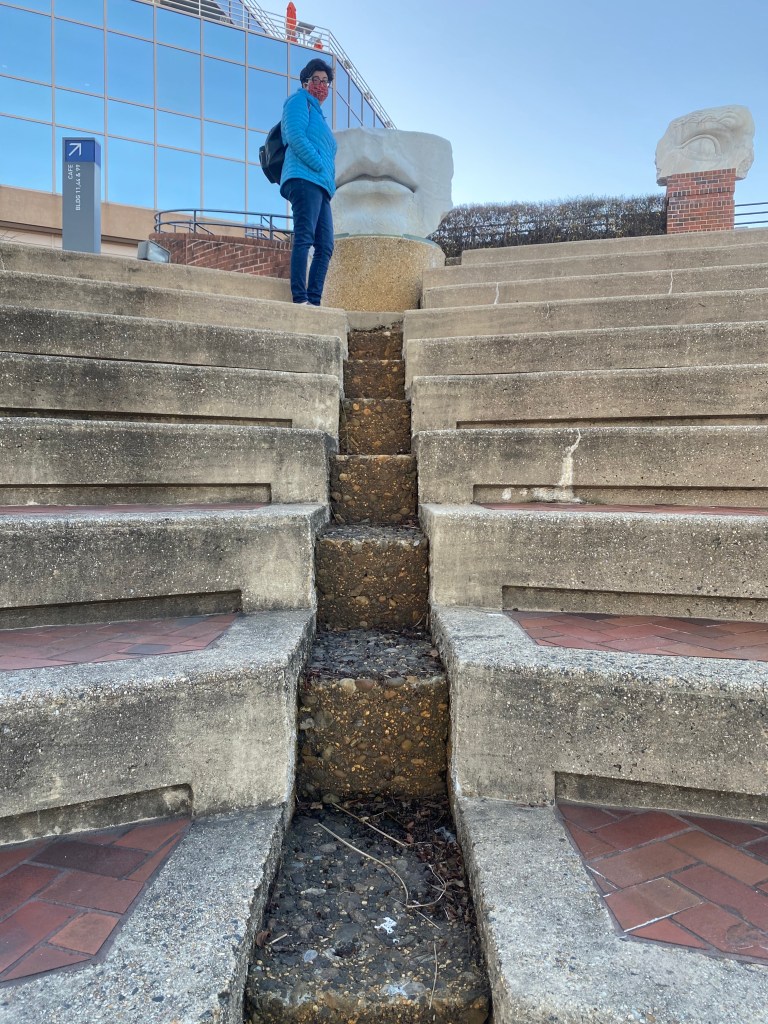
We walked past the giant bronze arrow and to the massive lips, which now stood in an empty pit with decaying leaves at the bottom. This time, though, we walked to where the water used to pour over the edge and discovered two curved sets of stairs. The stairs led to a lower level of the promenade, with the obelisk sitting on a dais at the waterfront. In between the sets of stairs were sections that looked amphitheater-like, broken up by small dark runnels. 

Going down the amphitheater levels was a little more treacherous than I thought it would be (the steps were steep!), so I stuck with the stairs. At the bottom of the waterfall was a jumble of sculptural ruins, with two large eyes standing out more than the rest. The large slabs at the top of the columns also had eyes, and more lips stood at the top of the runnels, where more water had no doubt flowed in the summer. 

I can’t help but think of our visit to the park as an allegory for this whole time in quarantine. Fragmented. Disruptive. Drained. However, winter is almost over.

Footnotes:

  1. “Promenade Classique.” The Washington Post. Dec. 23, 1990. Accessed on March 8, 2021. LINK
Categories
Matthew Eng Postscripts prince william county

Offbeat Postscripts: Steel City NOVA in Mindhunter

Offbeat Postscripts is a series of short posts where we cover small topics of offbeat history in Northern Virginia. 

By Matthew T. Eng, Offbeat NOVA

When we started this blog in July of last year, I talked about the reasons we started the project. One thing that prompted us to begin this endeavor was, like so many other people borne out of boredom and the nearly infinite amount of time on our hands, a Netflix binge. For us, the binge-worthy show in question was Netflix’s Mindhunter

Above all other shows I binge watched (or rewatched) in while in quarantine (Cobra Kai, Black Sails, Gotham, Stranger Things, etc.), I enjoyed Mindhunter the most. After all, it got both of us thinking about this project. As much as Holden Ford wanted to discover the psychology behind serial killings, I wanted to learn more about the history, legend, and lore of the area where I now call home. 

Interestingly enough, that show happens to “take place” largely in several locations in Northern Virginia. I use the term “locations” because the majority of these scenes take place at the FBI Academy in Quantico, Virginia. The academy is located in Prince William County. Quantico is a frequent location in many popular films and television series, including Mindhunter. Whether it be Silence of the Lambs, Hannibal, Criminal Minds, or the short-lived eponymously-named show on ABC, “Quantico” is never really Quantico.  

(Top) “Quantico” from the Highland Park VA Hospital; (Center) Highland Park VA Hospital; (Bottom Left) Guard Station at “Quantico;” (Bottom Right) Highland Park VA Hospital from the Sky. Images: Atlas of Wonders, SetDecorators.org, Google Earth.

In the case of Mindhunter, the film’s third scene begins in Quantico as Holden heads back to train Academy students on hostage negotiation. The exterior shots of the building, all done up in perfect late 1970s nostalgia, was shot at the former Veterans Hospital in Highland Park in Pittsburgh, Pennsylvania.1 Looking at the images on Google Maps, I can see why producers chose the location: it is a large complex (168 acres) with ample space set within a small forest of trees on all sides for privacy. 

The hospital, which opened in 1953 as a neuropsychiatric facility for World War II veterans suffering from PTSD, was officially closed by the VA Pittsburgh Healthcare System in 2013, allowing Netflix the use of a relatively new abandoned property along the Allegheny River.2 The interior shots of the building were filmed at a place called 31st Street Studios, a few miles down the bend in Pittsburgh in the hip Strip District. The studio was also where the interior shots of Holden’s apartment in Fredericksburg were shot in the second scene of the first episode. 

Quantico FBI Complex (Wikimedia Commons/Pinterest)

Looking at the actual building Quantico, you can see a small resemblance. The architecture and style is similar, reminiscent of the Soviet-style Brutalism that is either loved or hated by DMV residents. The doll-up passes muster, as does most of the production for the show. The budget was undoubtedly high, allowing them to take creative license within acceptable taste. 

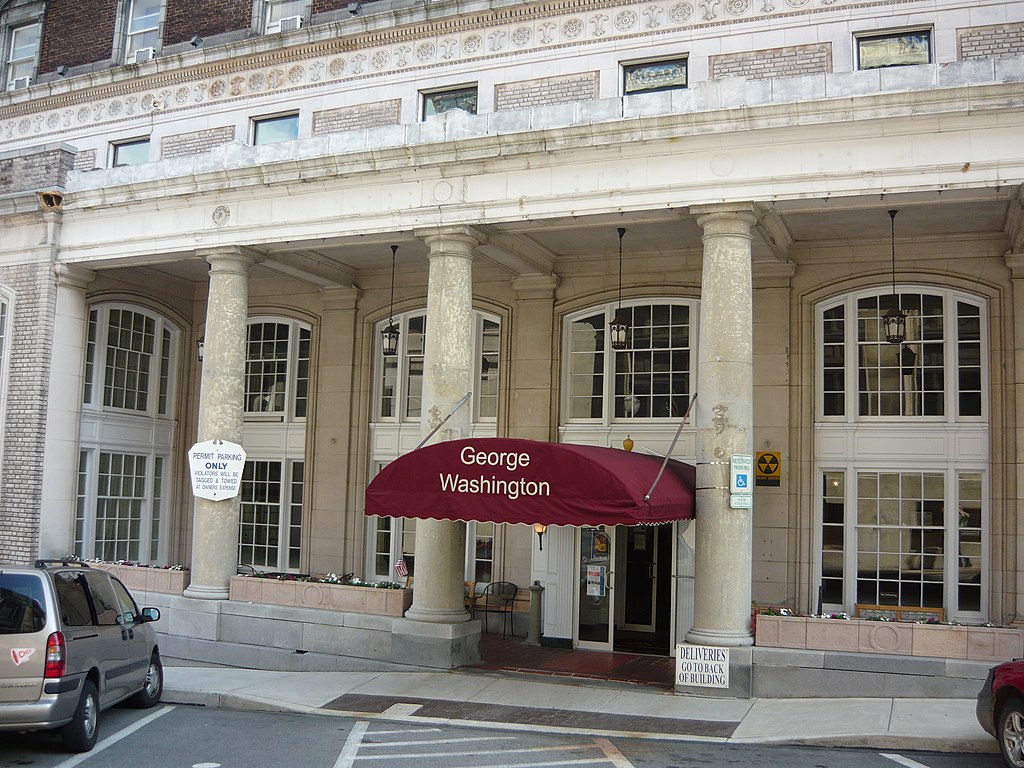
Entrance of George Washington Hotel in Washington, PA, where Holden and Debbie exit (Wikimedia Commons)

Also in the first episode, Holden has a drink with another instructor at an unnamed bar near Quantico. We only know that it is south of Quantico, because Holden later tells his future girlfriend Debbie that he worked “up the road.” Reading too far into it, one might assume the bar would be fictionally set in Fredericksburg near where he lived. The exterior location of the bar in question was filmed at the George Washington Hotel in Washington, Pennsylvania, just south of Pittsburgh where many other scenes for the series were shot. 

So the next time you are in the “Steel City” and its surrounding bedroom communities, take a look and think about that show where Kristoff from Frozen is naked a lot and basically becomes a serial killer/sociopath by the end of the second season. You know, just normal thoughts we all have in quarantine, right?

Images courtesy of Atlas of Wonders/Filming Locations. 

Footnotes:

  1. Ra Moon, “Filming Locations Guide: Where was Mindhunter Filmed?” Atlas of Wonders, October 2017. Accessed March 3, 2021, LINK.
  2. Bob Bauder, “Pittsburgh closing in on acquisition of former VA hospital in Highland Park, Trib Live, July 14, 2020. Accessed March 3, 2021, LINK.

Categories
Matthew Eng northern virginia

Top 10 Unusual and Macabre Locations in Northern Virginia

By Matthew T. Eng, Offbeat NOVA

Memories are tricky. They can evoke past moments, which have the power to elicit smiles and triumph, or grief and sadness. Often these memories are tied to people and places. But what happens when the people and the memories have faded, but the places still remain? 

Here are our current top 10 unusual and macabre locations around Northern Virginia.

1. Franklin and Armfield Slave Office (Alexandria, VA)

Franklin and Armfield Office (Wikimedia Commons)

Some buildings are left standing to remind us of the darkest parts of American history. Located near the heart of Old Town Alexandria, the former Franklin and Armfield Slave Office is a prime example of the importance of understanding our scarred and painful past. 

Interior of Slave Pens, Civil War-era (My Genealogy Hound)

The building was the headquarters of the largest domestic slave trading firm in the United States, Franklin and Armfield. Isaac Franklin and John Armfield became the largest traders of enslaved African Americans between 1828 and 1836, selling between 1,000-2,000 people each year. Slaves from the Chesapeake Bay were sold in the southern states to markets in places like Natchez, Mississippi, and New Orleans in what many called the “Second Middle Passage.” Slave traders owned the property until the Union Army occupied the city in 1861. The building included horrific slave pens, which were later torn down after the end of the Civil War. 

The building, now a National Historic Landmark, currently operates as the Freedom House under the National Park Service. The Freedom House educates visitors of the harsh realities of the American slave trade and Alexandria’s role in it through first-person accounts of enslaved men and women and the surviving details of Franklin and Armfield’s business. 

If you go: The building and its historical marker are located at 1315 Duke Street, Alexandria, VA. Currently, the museum is closed due to COVID-19, but virtual tours are available online. 

Source:
NPS, Franklin and Armfield Office, LINK.
Historic Alexandria, Freedom House, LINK.
My Geneaology Hound, Vintage Photos of Franklin and Armfield Slave Pen, LINK.

2. Lorena Bobbitt 7-ELEVEN (Manassas, VA)

7-Eleven where John Bobbitt’s penis was not part of a combo meal (Offbeat NOVA)

On June 23, 1993, Lorena Bobbitt, an Ecuadorian nail stylist, cut the penis off of her husband and ex-Marine John Bobbitt with an 8-inch carving knife. He remained in bed, too drunk to realize what had happened while she left in her car. She threw the penis in a hook shot arch into a grassy field next to a 7-Eleven while driving down the road in Manassas, VA. When the police finally found John Bobbit’s missing appendage, they ran to 7-Eleven convenience store and placed it into a hot dog container on ice, where it was transported to the hospital and reattached on John. The rest is history.

I’ve said this before, but I’ll say it again: do you know what its like to eat a hot dog at the same place where mortified policeman put a severed penis on ice? Well, here’s your chance. Bon Appétit. 

Read our full Offbeat NOVA story on Lorena Bobbitt in Manassass.

If you go: The 7-11 is down the street from the Bobbitts’ former residence at 8174 Maplewood Drive in Manassas. The hot dog stand is there, but it’s currently self-serve due to COVID-19. 

Source:
Offbeat NOVA, “Lorena Bobbitt Revisited: Examining NOVA Dark Tourism in Manassas,” LINK.

3. Bunny Man Bridge (Clifton, VA)

Bunny Man Bridge (Offbeat NOVA)

If you read list of haunted or creepy locations in Virginia, the Bunny Man Bridge is almost guaranteed to be on it. Located in Clifton, VA, the bridge’s legend stems from a variety of incidents in legend and lore dating back to the early 1970s. Both involve a crazed maniac wearing a white bunny suit and attacking unsuspecting travelers with a hatchet. Most of these incidents occurred in or around the bridge. The bunny suit-clad individual is oddly enough best known for appearing on several occurrences off Guinea Road in Burke, nearly seven miles away on Colchester Road. 

It is also one of the few roads that I have seen that Google Maps did not record. Check Google Maps. You can’t see it—in fact, you can’t go beyond the yellow sign that reads “Dead End.” 

The bridge in question is actually known as the Colchester Overpass, which was built in 1906 near the site of a former station of the Orange and Alexandria Railroad. The spot is a frequent destination for ghost hunters and general fans of the weird and macabre, especially around Halloween.  

If you go: The road is incredibly narrow at the bridge point in Clifton, VA, and surrounds several private (wealthy) residences. There is no place to park, so you will need to drive through it or get out and take pictures quickly, as it is known to be patrolled by local authorities, especially during the Halloween time period. 

Read our listen to our cross-post with the Uncanny America podcast HERE.

Source:
Offbeat NOVA, “I am Rabbit. I can be anywhere: The Legend of the Bunny Man in Northern Virginia,” LINK.

4. Fort Hunt (Alexandria, VA)

Memorial to P. O. Box 1142 at Fort Hunt Park (Wikimedia Commons)

Located 11 miles south of the Washington, D.C., Fort Hunt began as a way to defend fortifications around the capitol sometime around the late 19th century. Today, its an open air park where you can play with family and friends and have a relaxing barbeque. If you look deeper, though, a more sinister history exists in plain sight.

During the Second World War, it was the location of a top secret intelligence station known simply as “P.O. Box 1142.” At this location, members of the American Military Intelligence Service interrogated prisoners of war, over 4,000 of which came in and out of the camp for the duration of the war. One notable prisoner, German U-Boat commander Werner Henke, was shot when he tried to climb a fence at the complex. The camp was found in violation of the Geneva Convention due to the failure of the Red Cross to be notified of the location of the prisoners. Veterans of the camp insist that no torture was used. 

If you go: Fort Hunt Park is located off George Washington Parkway a few miles up from Mt. Vernon. Go to the NPS website to plan your visit. 

Source:
Washington Post, “Fort Hunt’s Quiet Men Break Silence on WWII,” LINK.

5. Congressional Baseball Game Practice Field Shooting (Alexandria, VA)

Simpson Field (Photo Credit: Louise Krafft)

On the morning of June 14, 2017, twenty-four Republican congressman gathered at Eugene Simpson Stadium Park in the Del Ray neighborhood of Alexandria, VA to practice for the upcoming annual Congressional Baseball Game for Charity. While they practiced, a man approached them and asked them if they were Republicans or Democrats. After they informed the man of their political persuasion, the individual left. That person was likely James Hodgkinson, who proceeded to open fire with a SKS semi-automatic rifle and 9mm Smith & Wesson handgun on the politicians and Capitol police officers playing on the field. 

The ten-minute firefight left several individuals injured, including U.S. House Majority Whip Steve Scalise, who was at second base when the shooting began. He was shot in the hip and he tried to drag himself off the field in the dirt while the shooting raged overhead. Although critical, Scalise survived after several surgeries. Without the quick thinking of the police on hand, it could have been a bloodbath, according to Senator Rand Paul. 

The kids playing baseball there probably have no idea that a mass shooting and assassination attempt was made in such a quiet upscale neighborhood as Del Ray. 

If you go: The baseball field is located on 426 East Monroe Avenue in the Del Ray neighborhood of Alexandria. 

Source:
Alexandria Times, “One Year Later: Alexandria Leaders, Residents Remember Simpson Stadium Shooting, LINK.

6. George Lincoln Rockwell Death Spot (Arlington, VA)

George Lincoln Rockwell Death Spot (Offbeat NOVA)

It’s hard to think of Arlington, Virginia, one of the wealthiest and most expensive cities to live in the United States, as a hotbed of hate. For a time in the 1960s, however, it was the epicenter of the Neo-Nazi/white power movement in the United States. The man leading it was George Lincoln Rockwell, a former World War II naval aviator who build a hermit kingdom of bigotry and hate at the top of Upton Hill Regional Park in a large house he affectionately called “Hatemongers Hill.” 

Rockwell was assassinated by a disgruntled former member of the American Nazi Party, John Patler, in the Dominion Hills Shopping Center on August 25, 1967. Rockwell was planning to do his laundry at the EconoWash laundromat when Patler shot him from he roof of the building while he sat in his 1958 Chevrolet. The car was parked in front of a barber shop. 

Today, very little evidence of the assassination exists and the facade of the buildings in the Dominion Hills center have completely changed. However, as late as 2017, a small group of supporters gathered at the site of his death to offer the requisite “sieg heil” salute in his honor. 

Read the full Offbeat NOVA story HERE.

If you go: The location is at 6035 Wilson Blvd in Arlington, VA. Upton Hill Regional Park is just down the street. The former building was built near where a gazebo is located today. 

Source:
Offbeat NOVA, “All You Fascists Bound to Lose: The Assassination of George Lincoln Rockwell, LINK.

7. Amy Baker Exit Cold Case (Springfield, VA)

Location of Amy Baker Murder off Exit 166 (Google Maps)

On the night of March 29, 1989,  an 18-year old was driving south on Interstate 95 when her car started experiencing trouble. She pulled off from the road, abandoned her 1970 Volkswagen Bug, and began walking up the exit ramp to Backlick Road and the nearby Exxon Station at what is now Exit 166 today. It was then that an attacker forced her into the woods near the exit ramp, where she was sexually assaulted and strangled. Her body was later found two days later covered by leaves. 

Amy Baker (Inside NOVA)

This has remained one of the top cold cases in Northern Virginia. Over three decades later, the case remains unsolved, even with DNA available from the case. 

If you go: The wooded area is located within the loop of Exit 166 on Interstate 95. It is not advised to pull off the road.

Source:
Fairfax Underground, “1989 Homicide of Amy Baker,” LINK.

8. Weems-Botts Museum Haunted House (Dumfries, VA)

Weems-Botts Museum (Wikimedia Commons)

The Weems-Botts house began as a vestry for the nearby Quantico Church. It is named after two individuals who lived in the house, Mason Locke “Parson” Weems and Benjamin Botts. 

Weems, the first owner of the home, was a clergyman who wrote George Washington’s first biography—which also contained the famous cherry-tree tale. Botts, who bought the home in 1802, was an attorney who defended Aaron Burr during his treason and conspiracy trial. He  later died in the 1811 Richmond Theater fire, which killed over seventy people. The house is now within the Historic Dumfries collection of museums and historic places. 

The home went into various phases of disrepair and restoration in its long history. According to lore, spirits have entertained the household since the colonial period. There have been dozens of recorded sightings in recent years. One director of the museum said in an interview that guests heard the sound of horses during one particular ghost walk. Others smell an “overwhelming scent of a violet-type incense.” The site is a hotbed for local and national paranormal investigative groups. The house was also featured on a Biography Channel show “My Ghost Story” in 2021. 

If you go: The museum is located at the corner of Duke Street and Cameron Street in historic Dumfries, VA. Visit their website for information on hours and availability. 

Source:
Potomac Local News, “A Dumfries House Full of History, and Chilling Experiences, LINK.

9. Stoney Lonesome Cemetery (Lorton, VA)

Stoney Lonesome Cemetery (Atlas Obscura)

A small cemetery was built in 1910 across from the former Lorton workhouse prison complex for the burial of male and female inmates that died while imprisoned there. The spaces were reserved for those who had no friends or family to claim them or provide a proper burial. The earliest graves included men and women who died from fatal injuries and diseases like the 1918 Spanish flu epidemic. 

According to the Fairfax County Library website, the cemetery is situation within a 100-foot by 30-foot stand of trees along the south side of an access road to a fishing pond. The rows all have grave depressions with approximately 50-100 total burials there. The depressions in the ground are chillingly eerie. There are no grave markers to designate who is buried there. The only thing there within the gated cemetery is a small sign that reads:

Stoney Lonesome Cemetery
Occoquan Workhouse  
1910-1997

Visit at your own discretion. 

If you go: This land is on private property. Visit at your own discretion. The nearest address would be 9414 Ox Road on the other side of the street. The cemetery is just up from Workhouse Road and the current Workhouse Arts Center. 

Source:
Atlas Obscura, “Stoney Lonesome Cemetery, LINK.
Fairfax County Library, “Stoney Lonesome Cemetery, LINK.

10. Gunston Manor (Alexandria, VA)

Gunston Manor (Google Maps)

Charles Severance unsuccessfully ran for Mayor of Alexandria in 1996 and 2000 as an Independent. He also ran for Congress for the 8th district in 1996 to no avail. He was known to be “a bearded eccentric” at his campaign events, often becoming loud, outspoken, and violent. In a 1996 forum with Representative Jim Moran, Severance pointed the spiked finial of an American flag at him before running out of the building. In reality, he was an early outspoken predecessor to the unhinged paranoia that has taken hold of the followers of Qanon today. 

Charles Severance (Northern Virginia Magazine)

After his political career was over, Severance focused on murder, killing three people in the span of 13 years: realtor Nancy Dunning in 2003, transportation planner Ron Kirby in 2013, and teacher Nancy Lodato in 2014. All of them were shot in broad daylight at their front doors after responding to a knock. Investigators later found writings of Severance that detailed his methods, which he called “Knock. Talk. Enter. Kill. Exit. Murder.” 

His murders all took places within the same area of Del Ray, Alexandria, near his two-bedroom townhouse at 3452 Gunston Road. He called it “Gunston Manor.” The murder spree was likely caused by a lengthy and ugly custody battle of his child with his girlfriend, who lived with him at Gunston Manor. 

Severance was sentenced to life in prison plus 48 years. The townhouse remains today as a poignant reminder of the unbridled rage that once festered inside its walls. 

If you go: The townhome at 3452 Gunston Road is a private residence.