Ah, yes. Thanksgiving. The unofficial start of the holiday season. For many of us in the United states, it is that time-honored day when friends and families come together to share stories and a wonderful meal. Political arguments are forcibly made. An invisible 38th Parallel of maturity is drawn once the kids table is set out downwind of the adults. Somebody’s uncle gets drunk. Everyone eats enough carbohydrates to easily pass out on the couch in the early evening while the opening credits to Willy Wonka & the Chocolate Factory comes on the television screen for the children who ate their body weight in sugar-soaked pies.
Magical.
Well, that was all before COVID. 2020 is a different year altogether, for a variety of reasons we don’t need to get into. With the pandemic reaching some of its highest numbers in Northern Virginia to date, hopefully most around the beltway will stay safe and hold their family meals in virtual form.
Even without COVID, there are some who do not have the option to head home to break bread with friends and family. For members of the United States military, having a meal at home is a luxury reserved for few individuals. The United States Marine Corps, an organization headquartered in Washington, D.C., but regionally centered thirty miles down I-95 in Quantico, have historically eaten their Thanksgiving dinners in locations all around the world in conditions we can only dream of. Whether it be on the tropical island of Guadalcanal in the Solomons in 1942, the frozen mountain landscapes of Chosin Reservoir in 1950, or the deserts of the Middle East, Marines have always made the best of whatever situation they encounter, especially during the holidays. They are the embodiment of their unofficial slogan,“Semper Gumby,” or “always flexible.”
But what do Marines eat stateside in Quantico? This year, the Clubs at Quantico and Crossroads Events Center is holding a special Thanksgiving brunch for families on base that want to have their meal taken care of. The menu includes all the trimmings, plus champagne for adults and even omelette station for those who shy away from the usual fare. Thinking about the hardships endured by Marines eating their special meal on the front lines, I find it hard to believe that there would be an omelette station back then.
Luckily, vintage copies of Thanksgiving menus exist thanks to the diligent work of historians and archivists. There is a menu from a Thanksgiving dinner held by the First Signal Company in Quantico on Thanksgiving 1937 that speaks to what Marines ate long ago.
Thanksgiving in Quantico, 1937 (USMC Archives/Flickr)
Looking through the menu, there are several items that stick out as either unusual or a remixed version of what is classically placed on tables today. The first (and most obvious) is the roast young turkey, a smaller version to the much larger male version (roast tom turkey). Oyster dressing has an interesting connection to military history, specifically with the Navy and Marine Corps. Oyster dressing was a common menu item on U.S. Navy menus throughout the 1920s-1940s. It’s origins in America dates back to the 18th century when oysters were the most commonly eaten shellfish in America. Oysters were stuffed inside turkeys as an inexpensive source of protein. Other dressing options for similar menus during the time period included caper dressing or giblet gravy. Snowflaked potatoes were a special form of mashed potatoes made with sour cream and cream cheese. According to the New York Public Library website “What’s on the Menu,” snowflake potatoes were included in restaurant menus between 1928 and 1954. The mince pie, a British-inspired sweet fruit pie, were traditionally served to service members throughout the 1930s and 1940s at the start of the holiday season. The “hot rolls” were most likely a mimic of the famous parker house rolls, a staple across all military branches since the early twentieth century.
There is one item missing from this 1937 menu that was often included during that time period: cigarettes or cigars served during the dessert course.
The following year, Quantico served similar fare, but switched up the young turkey for the “roast Maryland turkey” with oyster dressing. From what I have gathered, a “Maryland turkey” is cooked and served with roasting vegetables. Some other menus found on the NYPL website have the turkey served among the cold dishes. The mince pie was swapped for the marble cake, a far better choice.
If you are interested in tracing the culinary history of Marines and Thanksgiving, the USMC Archives Flickr page is an excellent resource. I also did something similar in a different life for U.S. Navy menus (of course, not specific to Northern Virginia) back in 2014 for the Naval Historical Foundation.
Happy Thanksgiving from Offbeat NOVA. Wear a mask.
When I first came upon the story of the Fairfax Butt-Slasher I thought, this has to be some kind of blown-out-of-proportion urban legend.
We had stories like that where I was from—the Pembroke Mall Leg Slasher or the Lynnhaven Mall Car Stalker. In the Pembroke Mall variation, a person—usually a man—would hide underneath a car. When the owner of the car, almost always a woman, returned her car with her hands full of shopping—almost always Christmas shopping—the man under the car would slash at the woman’s legs, leaving a series of gashes that would require stitches. In the Lynnhaven Mall variation, the victim would be leaving the mall late at night and would be the owner of the only car left in the parking lot. Like the other story, the victim would be juggling shopping bags and be preoccupied with getting home. Of course, someone—almost always a man in these stories as well—would be lurking nearby the car or sometimes IN the car, waiting to attack. We told these stories so much as kids, I can’t remember if they actually happened or not.
Supposedly, the “Mall Slasher” trope has been in vogue since the late 1970s and has some similarities to actual events, but most of these stories have been reduced to urban legend status.1 I think I can be forgiven for thinking the Butt-Slasher was another one of these outlandish stories reduced to middle-school whispers or high-school bathroom conversation.
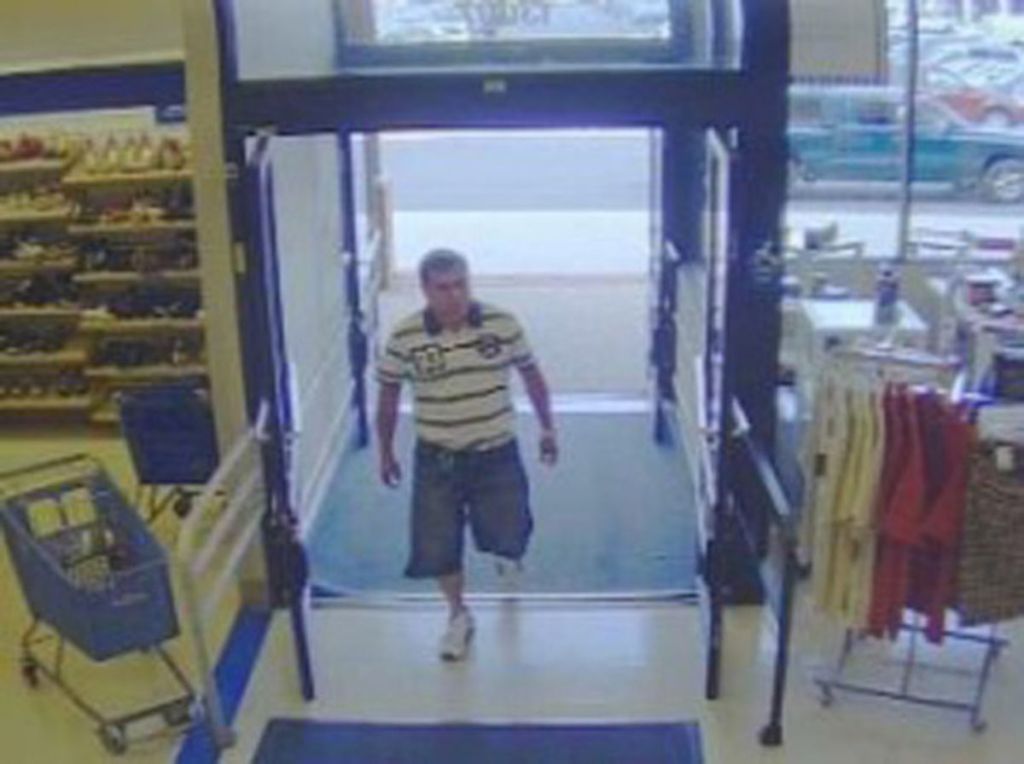
Turns out, the Fairfax Butt-Slasher was not a punchline—it was totally real. The Butt-Slasher was responsible for a series of attacks on young women during most of 2011.
Johnny Pimentel (ABC News)
The first victim of the Butt-Slasher was a pregnant woman in her 20s. She was leaving Fair Oaks Mall in Fairfax, Virginia, in February 2011 when she noticed someone behind her:
I’m pushing the door open, and then all of sudden, he’s right there behind me, and I felt a pinch on my bottom and I thought he just grabbed me and I was like, ‘Hey, you just cut my leggings,’ and he was like, ‘No, no, no. It was my bag.’ He was carrying a little, yellow bag.2
At first, the victim said, she didn’t even know she was cut. However, the cut was deep and she ended up with a permanent scar.3
The attacks continued: one on March 11 at the Tyson’s Corner H&M, and another on May 16 at the Fair Oaks Mall Ann Taylor. On June 8, a 21-year-old woman was shopping at the T.J. Maxx at Fairfax Towne Center in when she felt a pinch on her buttocks. The woman did not realize that she had been the victim of an assault and did not report the attack to police until later.4
It’s hard to gauge the mood of Fairfax at this time, but perhaps it is best summed up in this 2011 tweet:
(Twitter/kaltizer)
By this time, the police had put a profile together: according to the victims, the suspect was a heavyset, 5-foot-6 Latino man in his late 20s. He was using a box cutter or a razor to slice at women’s buttocks shortly after distracting them.5 Some experts speculated that he may have had a rare sexual disorder known as piquerism.6 A Psychology Today article from 2015 cites Dr. Anil Aggrawal’s definition of the disorder: “sexual arousal from penetrating another person’s body with sharp objects (such as pins, razors, knives, etc.).”7 Though the article names the Fairfax Butt-Slasher as an example of piquerism, is it clear by the other examples that the Butt-Slasher’s case was downright mild.
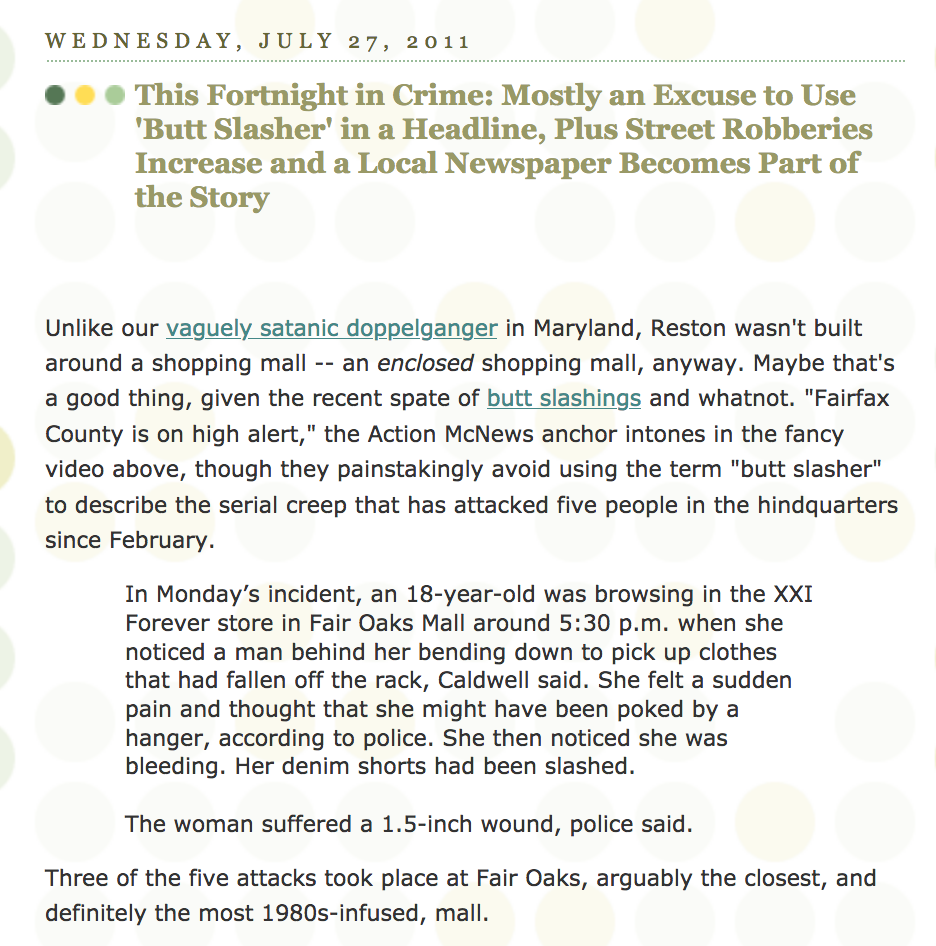
On June 18, the slasher struck again at the Tyson’s H&M, followed by another attack at a Marshall’s in an area called the Greenbriar Towne Center. All of the attacks followed the same pattern: distracting a young woman, slashing her with a sharp object, then disappearing. On July 25, he attacked an 18 year-old shopping at Forever XXI. She was distracted by a rack falling, then, as the Herald Sun in Australia reported, “felt a ‘sharp pain’ in her backside which she dismissed as a coat hanger. Later she realised her behind was cut and bleeding and her denim shorts had been slashed. The wound was about an inch and a half (4cm) long.”8
(Post from the Restonian Blog)
The news had reached as far as Australia, where the suspect was known as “the serial bum-slasher.” In late July, following the Forever XXI attack, the Restonian blog made a half-serious, half-joking post about the phenomenon. Though the blog is slightly tongue-in-cheek, the August edition of the Fairfax Connector took a more serious turn:
However, said police spokesman Lucy Caldwell, ‘Women shouldn’t feel this is isolated just to Fair Oaks Mall. This type of behavior could happen anywhere’ . . . police ‘don’t want women to feel unduly afraid to go shopping. But if they feel at all uncomfortable in a store, they should report it to store security. There’s no reason to believe it won’t happen again, so women should stay alert . . . they should also consider shopping with a friend,’ she said. ‘Actually, these are general safety tips women should always use — these incidents just highlight them.’
Being a woman is grand in 21st century America.
Eventually, the slasher was identified as 41 year-old Johnny Pimentel, a former day laborer. The police were able to identify him via an anonymous tip.9 By September, the news reported he had fled Northern Virginia. Eventually, in January 2012, he was arrested near a shopping mall in Peru. One article mentioned that it was unclear how he got to Peru, and it was also unclear whether he could be brought back to the United States to stand trial.10 Eventually, almost an entire year later, he was extradited to the United States in December 2012. He remained in jail, plead guilty to the charges against him, and was sentenced on September 6, 2013. At the hearing, he was reported as saying, “I’m very remorseful for all the things that are occurring, and I ask you to pardon me.”11
However, he was sentenced to 20 years in prison, and the judge suspended all but 7. That would make this year the year of his release, but I couldn’t locate any up-to-date information on him.
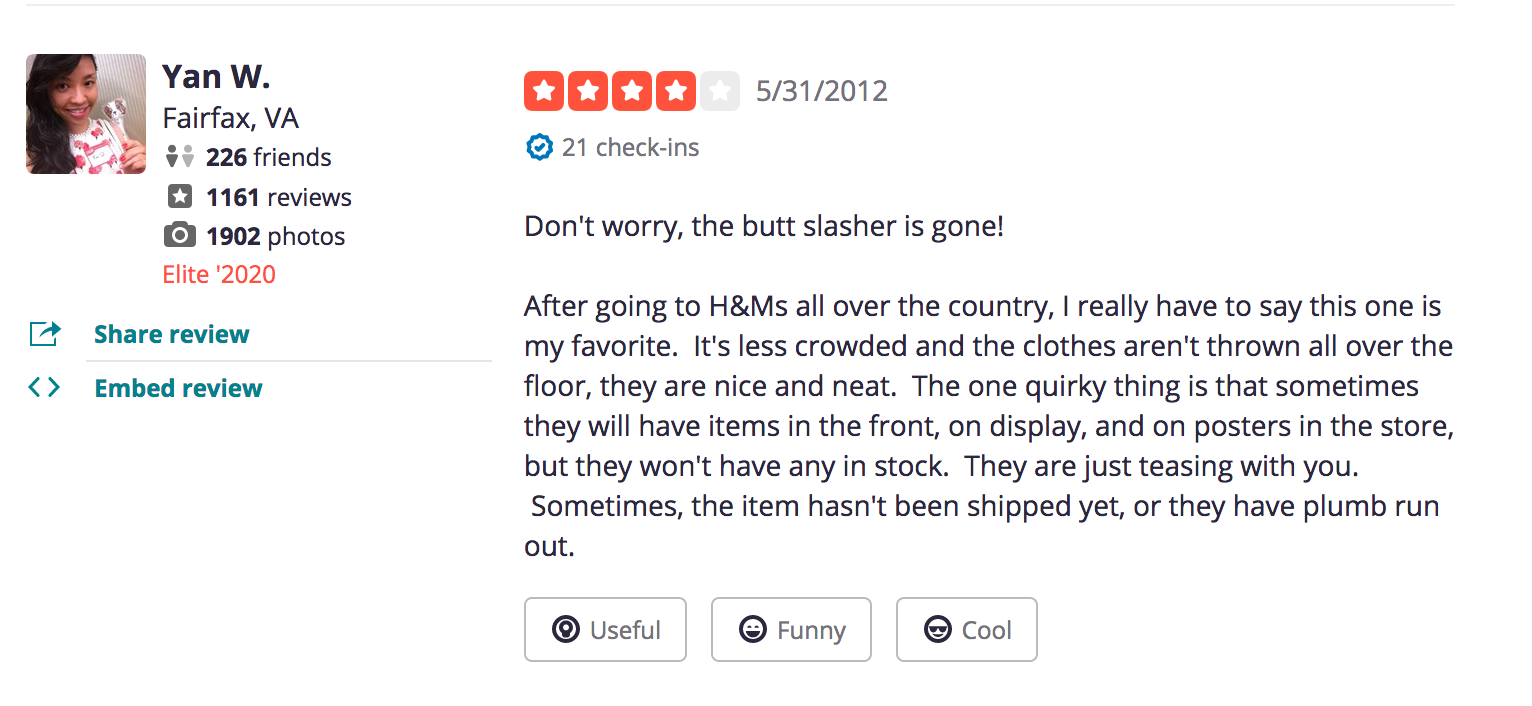
Perhaps a fitting end to the story is at the start of this 2012 Yelp review of the Tyson’s Corner H&M:
(Yelp)
If folklore experts examine stories as cultural artifacts and search them for clues about the attitudes, fears, and beliefs of the cultures they come from, it would be easy to dismiss the stories I heard from my hometown as stories about women’s fears of being vulnerable, or even dismiss it as some kind of anti-capitalist tale.
But the more I read about this story and the attitudes surrounding it, I had to wonder—what happens when the urban legend is true?
Footnotes:
Peter Kendall, “URBAN YARN OF `MALL SLASHER` JUST WON`T DIE,” Chicago Tribune, September 2, 2018. Accessed October 25, 2020, LINK.
Matthew Stabley John Schriffen, “Butt-Slashing Victim: ‘I Didn’t Even Know I Was Cut at First,’” NBC4 Washington, July 29, 2011. Accessed October 25, 2020, LINK.
Stabley and Schriffen, “Butt-Slashing Victim.”
Reshma Kirpalani, “Serial Butt Slasher Blamed for 6 Assaults in Virginia,” ABC News, August 3, 2011. Accessed October 24, 2020, LINK.
Kirpalani, “Serial Butt Slasher.”
Ibid.
Mark Griffiths, Mark, “Life on a Knife Edge.” Psychology Today, Sussex Publishers, 1 Jan. 2015. Accessed October 24, 2020, LINK.
Christina Caron, “Serial Butt Slasher Suspect Is on the Lam From Virginia Cops,” September 8, 2011. Accessed October 19, 2020, LINK.
NBC4 Washington and the Associated Press, “Serial Butt Slasher Located, Police Say,” NBC4 Washington, June 17, 2013. Accessed October 20, 2020, LINK.
NBC4 Washington and the Associated Press, “Virginia ‘Butt Slasher’ Sentenced to 7 Years in Prison,” NBC4 Washington, September 6, 2013. Accssed October 20, 2020, LINK.
We have been lacking a little in the content lately. Fortunately, there’s a reason: we bought a house!
The new Offbeat Nova HQ (Matthew Eng Photo)
Both Angela and I are very excited about this. It’s something we have talked about for a very long time, for sure. If we are going to be exploring northern Virginia history for the indefinite future, it made sense to truly put down our roots in the area.
So, instead of exhausting ourselves trying to put something out that we might not be completely happy with, we decided to let everyone know what is in on the short list for upcoming posts. Enjoy.
The Fairfax “Butt Slasher” (Fairfax County) For six months in 2011, a man known as the “Butt Slasher” terrorized women in northern Virginia in shopping malls. Women were warned to “keep track of their behinds” while shopping and pay close attention to their surroundings.
Bunnyman Bridge (Clifton) You may have heard about it. Is it an urban legend, real, or just a joke? We take a look at the “Bunnyman” of Clifton and the bridge where he supposedly hanged his victims. This will be a collaborative post with Uncanny America.
Top Golf Alexandria (Fairfax County) It was the first Top Golf in America. Now it sits abandoned and derelict near a busy shopping area in Fairfax County. We explore the history and complicated business plan of Top Golf Alexandria.
Offbeat Eats: Egg Foo Young in Suburbia (Gainesville) This new segments explores some of the best food off the beaten path. Our first segment will showcase a small and unassuming Chinese restaurant in Gainesville, VA, and the incredible egg dish with a unique connection to American history.
Offbeat Eats: Steak and Ale’s “Kensington Club” Recipe (Alexandria) If you’ve traveled anywhere near the Mark Center in Alexandria, chances are you have seen the abandoned Steak n’ Ale restaurant with its iconic sign. We look at the restaurant itself and recreate one of its signature steak recipes to taste test.
All You Fascists Bound To Lose (Arlington) We revisit the site of the murder of George Rockwell, leader of the American Nazi Party, in a small Arlington strip mall. Just in time for the election.
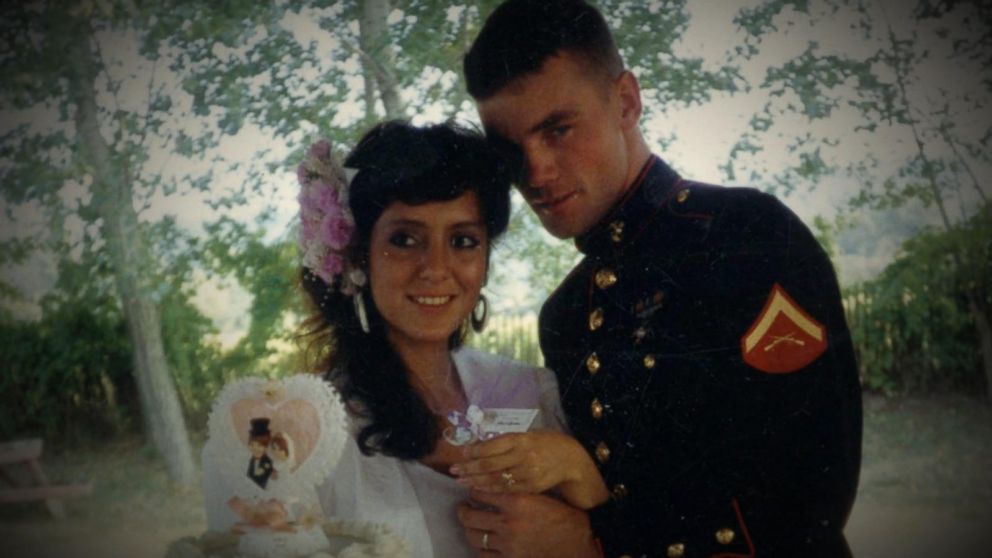
On June 22, 1993, John Wayne Bobbitt and his wife, an Ecuadorian immigrant named Lorena, discussed the possibility of divorce. The couple had issues. Many of these issues stemmed from the ex-Marine’s abusive behavior towards his young bride. She went to the police that day in hopes of obtaining a restraining order on her husband. Unfortunately, the process dragged and she left.
John Wayne Bobbitt and Lorena (Amazon Prime Documentary/ABC News)
That night, John and a friend went out for a night of heavy drinking around their home in Manassas, Virginia. The two returned, late and drunk, to the couple’s second floor apartment near Route 28 and Old Centreville Road. John stumbled into the bedroom and raped Lorena before falling asleep in a drunken stupor. That was enough. As Lorena went into the kitchen to get some water just before 4 am, she brought an 8-inch carving knife into the bedroom and cut her husband’s penis off. He was drunk enough to not immediately wake up or notice the large pool of blood that collected around him.
Lorena got into her 1991 Mercury Capri with the weapon and penis still in her hands and drove off out of the complex down Maplewood Drive. At the intersection of Maplewood Drive and Old Centreville Road, she finally realized her husband’s severed penis was still in her hand and tossed it out the window across from a 7-Eleven in a grassy field in front of the Paty-Kake Daycare Center. Shocked and scatterbrained, she drove to the only place she thought of going — her work, a nail salon approximately four miles away in the Old Centreville Crossing shopping center. Nobody was there, so she deposited the bloody knife into the trashcan next to the nail salon and proceeded to her boss’s house. Once there, her boss, Janna Bisutti, called the police. She divulged to authorities where the missing appendage could be found. The police eventually found it, brought the small measure of manhood into the nearby 7-Eleven, and placed it into a hot dog container on ice where it was transported to the hospital and reattached on John. The rest is history.
Henry David Thoreau once wrote that he went into the woods of Concord, Massachusetts, to “live deep and suck the marrow out of life,” and “cut a broad swath and shave close.” He did not pontificate how close he shaved in his time in solitude next to the pond. I don’t think he had John Bobbitt in mind when he wrote Walden, but it was for this reason that I, armed with the “essential facts of life,” ventured into the interior of Manassas to pique my newfound curiosity in one of Northern Virginia’s premiere sites of dark tourism.
Truthfully, I didn’t know much about the Lorena Bobbitt case—besides all the jokes wrapped in fragile masculinity and fear that gave comedians months of content in the early nineties. It wasn’t until the Jordan Peele Lorena documentary came out last year that I fully understood all the facts about the case, the biggest of which was that it occurred nearby where I lived in Northern Virginia. The documentary centered on three main places that Lorena visited on the early morning of June 23, 1993: her home, the field across from the 7-Eleven, and her place of business where she deposited the weapon.
I decided to visit these three places in 2020 and retrace her steps from that night. Although I took several pictures of these places during the day several weeks ago, I wanted to go back at night and retrace the steps Lorena did 27 years ago. The first thing I had to do was figure out the starting point: her apartment.
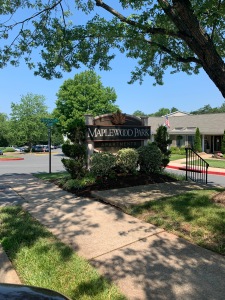
Maplewood Park Apartments
Looking through old newspaper articles, as well as the recent video taken for the documentary, I was able to piece together her location in the Maplewood Park apartments off Route 28 in Manassas. She lived on the second floor of a front facing apartment at 8174 Maplewood Drive. The complex, both during the day and at night was always crowded with cars and activity. It’s a far cry from the dilapidated state often written about in stories. The area is well-kept, even if its location is flanked by countless liquor and vape stores off the main road. It’s as if the idea of John Bobbit’s douchebaggery blanketed the surrounding area like some deadly airborne pathogen of Axe body spray laced with Aristocrat vodka and menthol cigarettes. Looking into the second floor apartment at night, I couldn’t help but run through the sequence of events in my head and reflect on the courage it took for her to act against her aggressor.
It’s only a short drive down the street to the 7-Eleven. I got to the stop sign at the intersection where she threw the appendage up and over her car into the grassy field and chuckled. Based off of the images of the location where it was found, it was a hell of a throw. Good for you, girl. It looks like they are clearing the area for a construction project at that corner location. Soon, the location will turn into something entirely different, so I feel fortunate to record the area before any new buildings spring up.
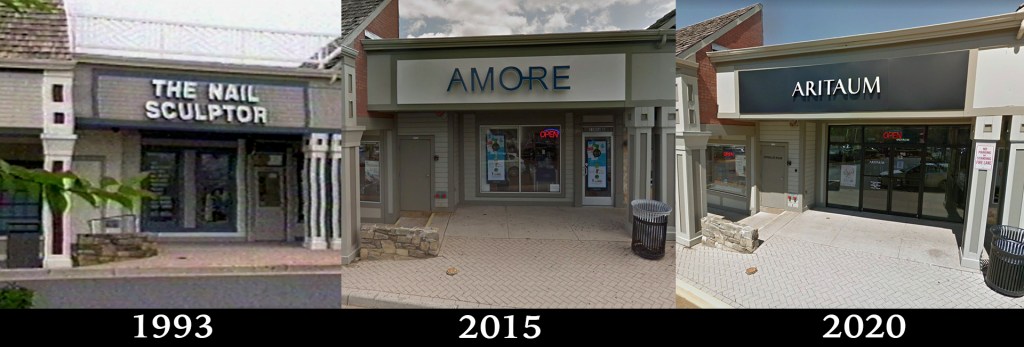
The hardest location to find was the nail salon she went to after ejecting the penis out her driver side window, the Nail Sculptor. Put simply, the location as it was in 1993 and in the documentary does not exist anymore. Simple Internet searches yielded me similar results. They always talked about the salon and the city it was located in, Centreville. But that was it. No address could be found anywhere. So, once again armed with a business name and location, I went on DOBsearch and reverse engineered the information to give me a physical address. The location is in the middle of the Centreville Crossing Shopping center roughly four miles away from her former apartment in Manassas.
The Nail Sculptor over the years (Google Maps/Eng Photo)
When I drove there at night, I carried a screenshot I took from the documentary in my phone. Sure enough, all the details matched up, including the stone sitting area on a small slope right in front of the shop. The location seems to have been a revolving door of beauty salons and establishments since Bisutti left sometime in the 1990s. The location was something called Amore until 2015 when it turned into what it is still today, a Korean makeup retailer called Aritaum. I don’t know if it was intentional or not, but there is a trash can still right next to the shop — the same location where Lorena dropped her bloody knife on top of a KFC fried chicken container in 1993. Intentional or not, I thought it was a nice touch.
But that’s not all that I did in my visit to Lorena’s greatest hits. Don’t worry. I saved the best for last.
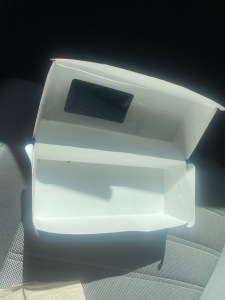
How many of you know what it’s like to eat a hot dog at the same place where mortified men put a penis on ice? My guess is not many of you. But I had to know. So I went recently got one at that exact location, eating it a few feet from where Lorena alley-ooped her abusive husband’s dismembered member out the window onto a grassy field with a Kareem Abdul-Jabar hook shot. The experience was surreal to to say the least.
“Hot Dog Bag” (Eng Photo/Offbeat NOVA)
The 7-Eleven itself looked like any other one you’ve walked into. I immediately started thinking about the officers that carried John’s penis into it, frantically looking for ice and anything to hold it in. I can imagine them looking straight at the hot dog rollers and put two and two together before pleading to that poor employee to hand them one. No big bite for the officers. They would take theirs to go.
So I got a hot dog in honor of Lorena and ate it in the parking lot. It tasted like any other 7-Eleven hot dog you’ve had before. I had to stop thinking about why I was there to enjoy it as much as I could.
I love everything about spies and spy movies. I love the cool gadgets, fast cars, faster women, and scarred villains that stand between our heroes and world destruction.
Of course, every well-known popular culture spy is attractive, physically perfect, and has infinite money, skills, and abilities. We think of the Adonis-like figure of Daniel Craig stepping out of the water in Casino Royale, Jason Bourne throat-chopping Russian operatives, and Ethan Hunt blowing up a helicopter with bubble gum at the end of Mission Impossible.
Of course, that’s popular culture’s version of a spy. In reality, they look like Robert Hanssen, John Anthony Walker, Jonathan Pollard, Harold James Nicholson, and perhaps the most heinous American spy working for a foreign country, Aldrich Ames.
(Matthew T. Eng)
Ames is both the polar opposite of pop culture’s rendition of a spy and the perfect amalgamation of its reality. It’s as if you are showing a picture of James Bond to your mom, who sees it and replies that you have double agent spies at home. Yes. He is the Great Value version of a name brand spy. James Bland. Ethan Hunt’s Ketchup to Heinz. THAT is Aldrich Ames.
Yet the more you look at him, the more you see the cold deadness in his eyes. The lack of remorse. They are the lifeless doll’s eyes of a shark that Quint talks about right before he is eaten by one in Jaws. He might not look it, but he is a cold-blooded assassin; one that dealt death with secrets, not force. He looks like somebody you’d see passing the checkout line of a convenience store, and wouldn’t know that he was the perpetrator of one of the worst betrayals in U.S. history — one that culminated with a nearly decade-long mole hunt that ended near a home he purchased with blood money in a quiet upper class neighborhood in Arlington, VA.
Aldrich Ames was born in River Falls, Wisconsin, in 1941. He spent his childhood traveling with his father before settling near the CIA’s Langley headquarters in McLean. He later began his full-time career there in 1962.
Ames and his wife Rosario (Paul Davison Crime)
On paper, Ames’ career and service at the CIA checks all of the boxes of somebody teetering the line between instability and the abyss. He had a lifelong struggle with alcohol and was financially ruined through a divorce between he and a fellow CIA agent. He was also placed in increasingly sensitive posts throughout his career. He met is second wife, Rosario, in Mexico City in the early 1980s. Despite several hiccups in his performance, he was nonetheless elevated to the chief of the Soviet branch of counterintelligence at the CIA. His job focused on the recruitment of foreign agents, the very people he would turn on in due time.
In 1985, he sold the names of KGB officers working for the United States to a Soviet Embassy official for the amount of $50,000. He offered up more names for intelligence officials and military officers working against them in return for money. A trend developed in his routine at work. He continued to spy over nine years from Rome in the late 1980s to headquarters in Langley from 1990 to 1994.1 Many of these agents he exposed were captured by the Soviets and KGB and imprisoned. A handful were confirmed to be executed by USSR authorities shortly after their arrest and mock trial. In all, Ames betrayed at least twelve agents working for the United States within the Soviet Union and bloc countries in the 1980s and early 1990s.
Why did he do it? In an interview after his arrest, Ames said he did it for reasons only known to him. If you asked former Director of Central Intelligence, R. James Woolsey, the “warped, murdering traitor” did it because he “wanted a bigger house and a Jaguar.”2
Aldrich Ames House, 2512 North Randolph Street, Arlington, VA (Bigwig Digs)
And that’s exactly what he got for his troubles. Unlike the spies we see in Hollywood, Ames was careless with his spending habits. According to one report of evidence put together by the FBI, Ames and his wife Rosario spent nearly $1.4 million between April 1985 and November 1993.3 By the time of his arrest the following year, he had amassed a fortune totaling $2.5 million for nearly a decade of Soviet-financed espionage. The most egregious of his expenses came on August 1, 1989, when he bought a home in the Country Club Hills section of North Arlington on 2512 North Randolph Street. According to author Peter Maas, it was the first place that the realtor showed him. It was truly a brick and mortar representation of the new wealth he felt he so duly earned for his services. As Maas stated, “the immediate surroundings said upper middle class in capital letters.”4
Ames bought the house outright and paid in cash. The seller first asked the realtor to ask for $540,000 and “negotiate down.” But Ames did not hesitate, offering the full amount up front. At first, the realtor thought they had perhaps gotten the money from drug-related activities because Rosario was from Colombia. Without taking out a mortgage on the house, he explained the unexplainable simply an inheritance. And just like that, Ames and his wife were instantly elevated amongst the doctors, lawyers, senior businessman, and government bureaucrats that lived next to him.
Most popular culture spies are mobile, and you never really see where they live. Does James Bond own a toaster oven? We’ll never know because he is too busy putting armageddon on a temporary pause. Not Ames. He had it all and didn’t care about the optics. The North Randolph Street house was a statement. Rosario quickly put in renovations to the spacious five bedroom house to the tune of $95,000. The house had a spacious library and large living room. The best part was that there was no backyard access for anyone to see their activities because of a steep grade that led up to the houses on top of a large slope. Ames felt comfortable enough to build a large deck and hot tub. He made an in law suite downstairs for Rosario’s visiting family from Colombia. Along with the house came the fancy cars, clothes, and accessories, all of which he bought at a rate that far exceeded his paycheck. Either careless or naive, Ames carried on like he would never be caught. Until he was.5
CIA Mole Hunt Team (CIA)
All of these transactions made by Ames were quickly checked by a small team of CIA agents, working closely with the FBI, ultimately finding hundreds of thousands of dollars in deposits in Swiss bank accounts. This “mole hunt” team was created in 1986 after the first Soviet asset disappearances, was led by career CIA agent Jeanne Vertefeuille along with four other agents. By 1989, a lead came about pointing to Ames as the culprit. How did they know? As a friend of Ames, Diana Worthen noticed how far he and his wife were living beyond his means. The biggest giveaway was their luxurious house. After more digging and surveillance help from the FBI in 1992, they noticed a large spike in Ames’ accounts that would always come directly after his work-related rendezvous with Soviets. As a leader in the CIA’s Soviet/East Europe Division, it happened often. The FBI took over the case from there in 1993, gaining more information for his ultimate arrest, which came in February of the following year, ironically on President’s Day.
During that holiday weekend, Ames was preparing for a trip to Moscow, no doubt to divulge more information on assets. The FBI asked his boss Dave Edgers to call and ask him to leave his house and come in to discuss something on the morning of Monday, February 21, 1994. They wanted him out of the house and separate from Rosario when they arrested him. Thankfully, Ames bought into it and told him he would be there at Langley momentarily. The FBI already knew that his typical work route meant leaving his driveway and the curve on North Randolph before turning right on North Quebec Street where he turned a left at the Nelly Custis intersection.6
Several minutes after he hung up, Ames appeared in his Jaguar sedan with a cigarette in his mouth as he left his house and headed toward Quebec street, where he was approached by FBI agents and arrested. The nine-year manhunt was finally over. He later admitted in a television interview that he was completely shocked that he had been caught.
Arrest Location of Ames, 1995 vs. Today (FBI/Google Maps)
There’s one photo in particular used by the FBI to document Ames’ arrest. You can see from the photo Ames being escorted by FBI agents into a sedan. Using several sources, I discovered that the photo was taken near the intersection of North Quebec Street and Nelly Custis Drive, a short distance from his house. It looks much quieter today. I’m sure the residents of this upper middle class neighborhood feel much safer knowing the Ames’ aren’t there, even if he spent half a decade hiding in plain disguise as a Soviet-bought imposter.
Ames was convicted of espionage in 1994 and is currently serving a life sentence without the possibility of parole in the Federal Correctional Institution in Terre Haute, Indiana. His wife Rosario received a five-year sentence for tax evasion and conspiracy to commit espionage. She was clearly a co-conspirator in her husbands activities, as it was found she had as healthy a spending habit as Aldrich. When the FBI searched their house after the arrest, they found more than 500 pairs of shoes, sixty purses, and 165 unopened boxes of pantyhose.7
There is a small silver lining to all of this. In 1995, Ames’s prosecutors presented a check in the amount of $549,000 for the victims of his crimes. The check included the price of the Randolph Street house as well as the other assets seized by the government, including his 1992 Jaguar sedan and property ranging from expensive suits to silver. According to the Washington Post, the sum only represented a fifth of the $2.7 million that Ames received for spying on behalf of Moscow.8
So where does the house stand today? According to public records, the home was last sold for $401,000 in April 1995. Today, the estimate of the household is listed at $1,184,351. Houses in the Country Club Hills neighborhood run from just under a $1 million on the low end to nearly $3 million.9 The median estimate for price in the neighborhood is just below this at $1.167 million. Take that against the median value for a house in Arlington, which is $751,000, still at the higher end in the entire country. You can see why Ames selected this particular neighborhood as his home base. According to one website, Arlington’s cost of living is 53% above the national average.10
Former Residence of Aldrich Ames Today (Matthew Eng)
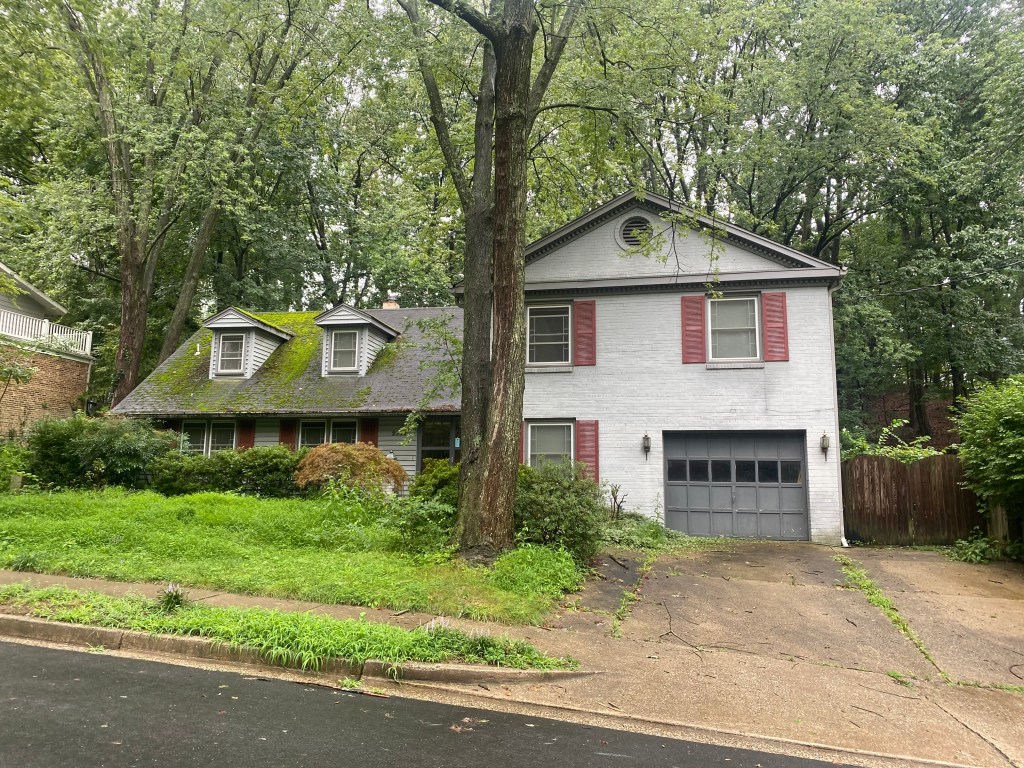
Looking at this house on North Randolph Street today, you would hardly guess it fits that description of domestic opulence. Driving through the neighborhood, Ames’ former residence sticks out like a sore thumb. The front yard appears overgrown and unkempt. Grass is growing between cracks in the driveway. The siding on the house is dirty and disheveled. Moss grows in sections on the roof near the second floor windows. The colors are altogether muted from its former heyday.
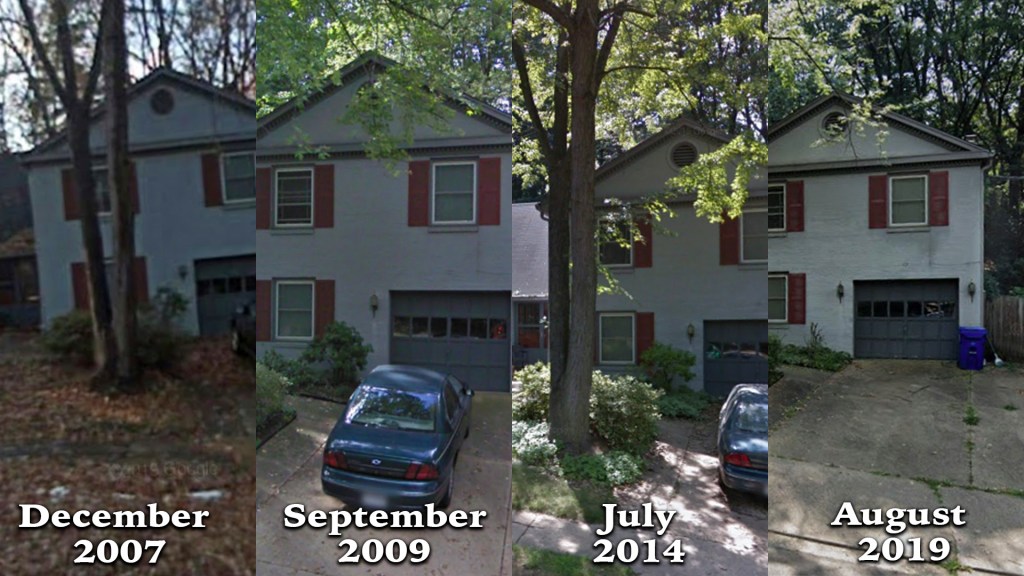
Composite of Former Ames Household Over Twelve Years (Google Maps)
It wasn’t always that way. Thanks to Google Maps, there is a record of what the house looked like on four separate occasions: December 2007, September 2009, July 2014, and August 2019. You can see the slow decline of the look and feel of the house over time. It’s hard to tell if anyone is currently occupying the house. A traitor’s house does not deserve light and love. Perhaps it should remain this way — nearly derelict and devoid of charm or character. It stands as a reminder of the cost of secrets and information and the faustian bargain one must make to achieve an unearned status of wealth and prestige.
Footnotes:
Tim Weiner, “Why I Spied; ALDRICH AMES,” The New York Times, July 31, 1994.
Weiner, “Why I Spied.”
Senate Select Committee on Intelligence, An Assessment of the Aldrich H. Ames Espionage Case and Its Implications for U.S. Intelligence, November 1, 1994. Accessed September 1, 2020, LINK.
Peter Maas, Killer Spy: The Inside Story of the FBI’s Pursuit and Capture of Aldrich Ames, America’s Deadliest Spy (New York: Warner Books, 1995), 104-105.
Maas, Killer Spy, 105.
Maas, Killer Spy, 213.
Maas, Killer Spy, 222-223.
Charles W. Hall, “Aldrich Ames’s Spying Booty Shifted To a Good Cause.” Washington Post, September 1, 1995.
Zillow, 2512 N. Randolph Street. Accessed September 4, 2020, LINK.
Education Loan Finance, “10 Most Expensive Cities to Live In for 2020,” March 2, 2020. Accessed September 4, 2020, LINK.
I’m a commuter. I pass by the same landmarks and historical places every single day, and I don’t even know it.
Well, I was a commuter, before COVID. The alarm would blare incessantly at 5 am, and I would reach over in a blind haze to hit snooze just to get a couple of precious seconds of extra sleep. By 6:45am I’d be headed to the metro for my trip to DC.
One of my favorite parts of the metro ride is crossing the bridge into the city. A few times, if I was lucky, I could catch a plane roaring right over me, headed either to some unknown destination in the clouds or coming in for a landing at National Airport. I’ve got a weird fascination with planes—I’ve got a pretty healthy flying phobia, but I love to look at them.
Sometimes my mind works in weird ways. The planes dip so low when they descend, and climb so steeply when they ascend. The pilots steer those planes through the air with an expert hand; they take off and land with an ambient dexterity, no matter how bumpy the landing. So more than once while I crossed over the Potomac, I wondered if there had ever been an accident at National Airport.
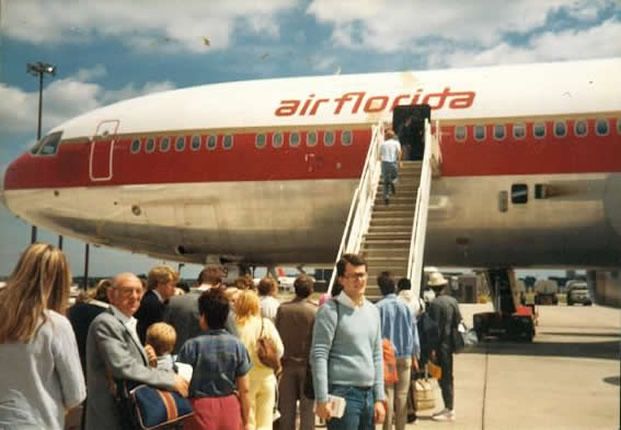
It turns out, there was a pretty notable accident at National Airport in 1982: the crash of Air Florida Flight 90.
Air Florida Airlines (Aviation Explorer)
Air Florida was a carrier based out of Miami throughout the 1970’s and 1980’s. It began as an intrastate operation, but soon expanded to the east coast and, eventually, international destinations. On the afternoon of January 13, 1982, Air Florida Flight 90 was scheduled to fly from Washington D.C. to Fort Lauderdale, Florida, with a stop in Tampa. The plane was supposed to depart at 2:15 pm, but takeoff was delayed due to heavy snowfall in the area. The airport closed from approximately 1 pm to 3 pm, so Flight 90’s departure was delayed about 1 hour and 45 minutes.
During that time, American Airlines personnel were deicing the aircraft. The National Transportation Safety Board report stated that the “deicing process used was inconsistent with recommended practices” so the plane was not deiced properly. In fact, the plane had visible snow on the wings and the fuselage at the time of takeoff. The Safety Board also noted that the Captain and the first officer did not inspect the outside of the plane before leaving the gate. This oversight was the first of many from the crew that contributed to the accident.
The crew continued to make mistakes throughout the taxiing process. The report continued, “the flight crew’s failure to turn on engine anti-ice was a direct cause of the accident” and suggested the accident may have been avoided had the crew turned it on. The report also notes that the plane’s proximity to another aircraft while taxiing turned the snow on the plane to slush, which then froze in several critical areas. The instruments were not working correctly, which the first officer noted, but the captain brushed him off.
Though all of this, I can’t help but wonder what the 79 passengers aboard were thinking. They had been boarded between 2:00 and 2:30 pm. They had been stuck on the plane for close to two hours. Were they nervous to fly in these conditions, or just dreaming about the sunny weather that awaited them in Florida?
Joe Stiley, one of the survivors, was an experienced pilot. In an ABC News article following the crash, he said he knew something was not right while the plane hurtled down the runway: “You could see out one side, but not really the other side. I wanted out in the worst way.”
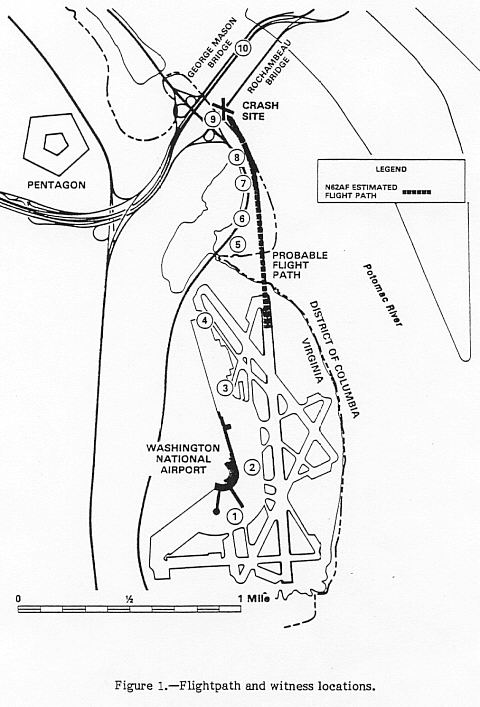
Air Florida Flight 90 Flight Map (NTSB)
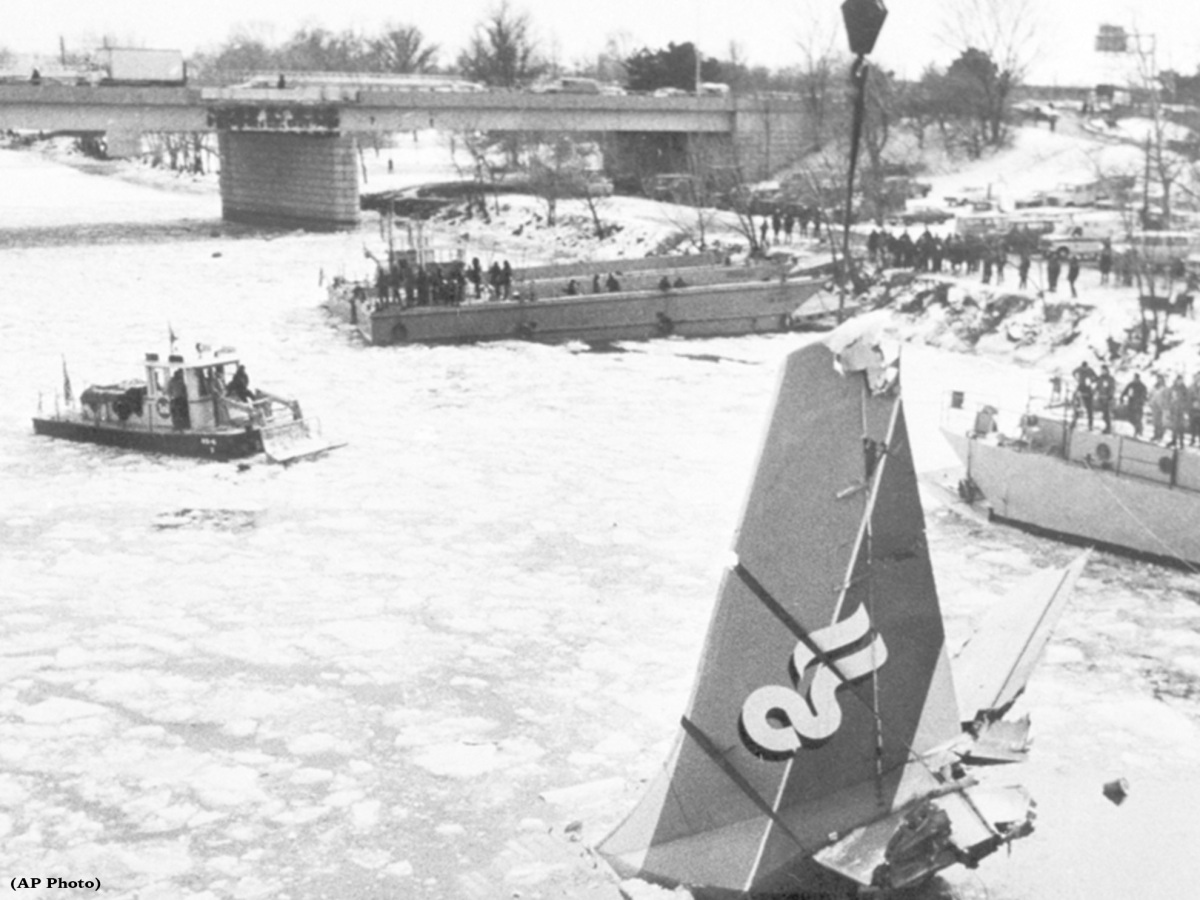
The plane took off and struggled to maintain altitude. It began to descend after reaching between 200 and 300 feet. One eyewitness, a driver on the 14th Street Bridge that day, stated that the plane’s nose was up and the tail was down. The right wing hit the bridge span first as the plane descended, leaving a trail of debris. The point of impact was only approximately 4500 feet from the end of the airport runway. The rest of the plane slammed into west side of the bridge and sank into 25 to 30 feet of water between the 14th Street Bridge and the George Mason Memorial Bridge.
The National Transportation Safety Board report later noted that the “cabin separated from the cockpit and broke into three large sections and many smaller pieces.” None of the cabin floor remained intact; most seats were extensively damaged and separated from the floor. The only part of the plane that held together was the rear of the cabin by the flight attendant’s jump seat.
Air Florida Flight 90 Survivors: Joe Stiley, Nikki Felch, Kelly Duncan, Priscilla Tirado, and Bert Hamilton
In all, there were five survivors: Joe Stiley, his coworker Nikki Felch, flight attendant Kelly Duncan, Priscilla Tirado, and Bert Hamilton. Duncan was only 22 at the time of the crash. According to a New York Times Magazine article, “After hours of delays, when the plane was finally ready to push off, she took her seat, as required, at the back of the plane . . . no one from the front of the plane survived.” In an interview after the crash, Duncan said, “My next feeling was that I was just floating through white and I felt like I was dying and I just thought I’m not really ready to die.” She, along with Stiley and Hamilton, were rescued from a lifeline thrown from a helicopter.
One bystander, Lenny Skutnik, was able to rescue Priscilla Tirado from the icy waters after the rescue helicopter’s failed attempt to tow her to shore. Tirado was 22 and traveling with her husband and 2-month old son. Both her husband and son died in the crash; Other survivors remember hearing her scream for someone to find her baby as they all flailed in the water. Felch was lifted out of the water from rescue personnel aboard the helicopter.
The temperature of the river that day was only 34 degrees Fahrenheit. For comparison, the temperature of the water the night the Titanic sank was 28 degrees. The water in the Potomac that day was only six degrees warmer.
Arland D. Williams, Jr. (Toronto Star)
Initially, there was a sixth survivor that day—46 year old Arland D. Williams Jr. Williams was “trapped in his seat in the partially submerged rear section of the plane by a jammed seat belt.” Though the helicopter’s lifeline came to him several times, he passed it to other survivors. When all the other survivors had been rescued, the helicopter went back for him. However, he was gone. The coroner determined that he had drowned; the only victim of the crash to do so.
In 1985, the 14th Street Bridge was renamed the Arland D. Williams Jr. Memorial Bridge in his honor.
To me, that bridge was always the 14th Street Bridge. I never knew that it actually had a name until now—or that it was named after an incredible man who gave his life so selflessly only a few feet from where thousands of commuters cross into DC every day. There are no markers or plaques commemorating him. I can’t even recall seeing any other name for the bridge other than 14th Street.
Though I wish there was more recognition of the bridge’s true name, I’m grateful I know it now. At least the next time I commute into the city I can reflect on his bravery instead of impending disaster.
National Transportation Safety Board, “Aircraft Accident Report: Air Florida, Inc. Boeing 737-222, N62AF, Collision with 14th Street Bridge, Near Washington National Airport, Washington, D.C., January 13, 1982,” National Transportation Safety Board Aviation Accident Report, accessed August 29, 2020, https://www.ntsb.gov/investigations/AccidentReports/Reports/AAR8208.pdf. Pages 2-3.
A long time ago, Justin Timberlake once described my hometown of Virginia Beach as “a desolate area of the world” with “nothing but strip malls and Chick-fil-A’s.” Personally, I take great offense to that. There weren’t that many Chick-fil-A’s in Virginia Beach when I grew up.
It’s true that Virginia Beach has a seemingly endless stream of retail and shopping centers along its main thoroughfare, Virginia Beach Boulevard. From the main artery of the boulevard, retail veins spring from all directions, including the most important to my childhood, Lynnhaven Parkway. About a half mile up the road from my main childhood mall and shopping area stood Toy Castle, standing alone like a mansion on a hill in a valley of mediocre retail and chain restaurants.
Since standalone toy stores have vanished in favor of small sections in larger retail stores like Wal Mart and Target, it’s hard to find a modern day comparison. When I was a kid, my mom would take me there every so often. I would go in, my ActionToy Guide in my hand, ready to pick out the latest and greatest action figure.
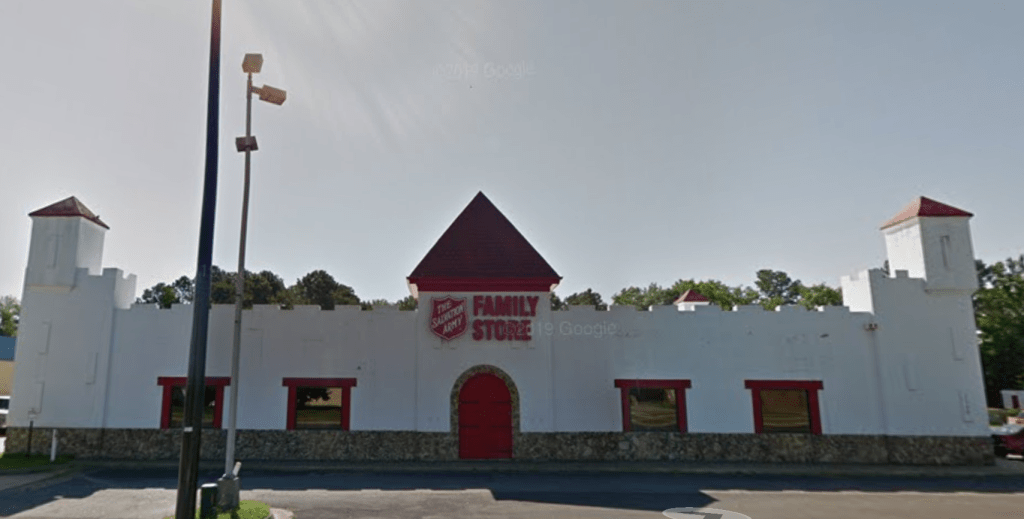
Formerly Toy Castle, Virginia Beach (Google Maps Screencap)
Toy Castle was definitely a place reserved for special occasions. Toy stores in the late 1980s were a paradise, and visiting one was a special treat reserved for accomplishments, like A’s on math tests. Toy Castle, however, was extra special. The large standalone building looked exactly like an old school Playmobil castle. The yellow exterior was flanked by two large turrets on either end of the building. The bottom of the structure was covered in rocks, giving the effect that the parking lot was a giant asphalt moat. The icing on the cake was the drawbridge door that led you into into its great hall of retail.
But the magic wouldn’t last. When I was a teenager, Toy Castle closed and became something entirely different: a craft store. Paul’s Arts and Crafts stayed there for a number of years until it eventually became a Salvation Army, which is still there today. Remarkably, the turreted building never drastically altered its appearance. Sure, it’s had a few paint jobs over the years, but the structure’s bones have remained intact.
This idea of retail rebirth is something that has always sparked my fascination. Businesses and restaurants close down. New businesses open, but the remnants of past establishments remain. If you look closely, you can see instances of this phenomenon all over the place. Wendy’s restaurants become a cash advance. Extinct department stores become grocery stores. Later, the extinct grocery store becomes a fitness center.
Toys R US/Aldi, Alexandria VA (2018/2020)
Fast forward to the present day. I have lived in northern Virginia for almost seven years, and in that time I have already seen a bevy of businesses change hands, leaving the shell of their former selves to molt and emerge from their cocoons as something entirely different. It would be an interesting project to document these businesses. Although the buildings may not hold the mythical grandeur that Toy Castle once held in my heart, it’s important to tell the story of the changing landscape of the area. It’s also a great way to get feedback from viewers reading this who know of a place that has undergone such a restoration. Surely there are hundreds of places in the area that have closed down and reopened as something else. We would love to hear your feedback.
We are starting this new series on our Instagram, so make sure to check it out and check back often. Although we are documenting these buildings now, they might give us ideas for future posts of Offbeat NOVA. We are always looking for new ideas, and the list is ever-expanding.
Follow us as we update content in the next week and beyond with the hashtags #offbeatnova and #NOVAcancy. The first few we will debut this week are naturally in our neck of the woods in Fairfax County, but we’d love to hear what you have to say. Drop us a line in our Instagram DM or email us at offbeatnova@gmail.com. Enjoy NOVAcancy!
I have a confession to make. It’s going to be a hard one to admit to fellow music lovers. Here it goes.
I wasn’t into Nirvana until much later in life. I know…I KNOW.
I was very young when “Smell’s Like Teen Spirit” became the Seattle earworm that congested radio and television airwaves in the early 1990s. When Nevermind was released in 1991, I was only seven years old. My experience with music up until then had been whatever my dad listened to. If you wanted to mosh to some Dan Fogelberg, James Taylor, or Jackson Browne in the early 1990s, I was your guy. I knew all the words to “Somebody’s Baby” and “Run for the Roses” long before I committed the mantra-like meanderings of the band’s biggest hit inside a poorly-ventilated high school gymnasium to memory.
My first real exposure to Nirvana came just before the end the band in 1993 for the televised Unplugged in New York concert on MTV. They played it on the station so much afterwards that I had plenty of time to sneak into our room above the garage to watch it. The entire concert blew me away. What impressed me the most, though, was their drummer, Dave Grohl. I didn’t know anything about him seeing him on stage for that televised concert. Throughout the concert, Grohl played an acoustic drum kit and sang backup vocals perfectly. He even picked up an acoustic bass for one of the songs. How could he be so good at more than one instrument? I had to know more. By the time I did my research about Grohl and the rest of the band (which in the early 90s meant combing through magazines at the local bookstore), Nirvana was over. Cobain died by suicide in April 1994 and the band broke up forever shortly after. Would I ever see my newfound musical hero again? As it turns out, I would.
Grohl recording Foo Fighters (Photo by Michel Linssen/Redferns)
Unbeknownst to me, Grohl had been secretly recording his own songs while he played drums in Nirvana. Not only was he good at drums, singing, and bass, he was a hell of a guitar player. He could do it all. Six months after Cobain’s death, Grohl booked six days in a local Seattle studio to record what would become the first Foo Fighters record. Besides a few guest appearances, he recorded every instrument and sang every word.
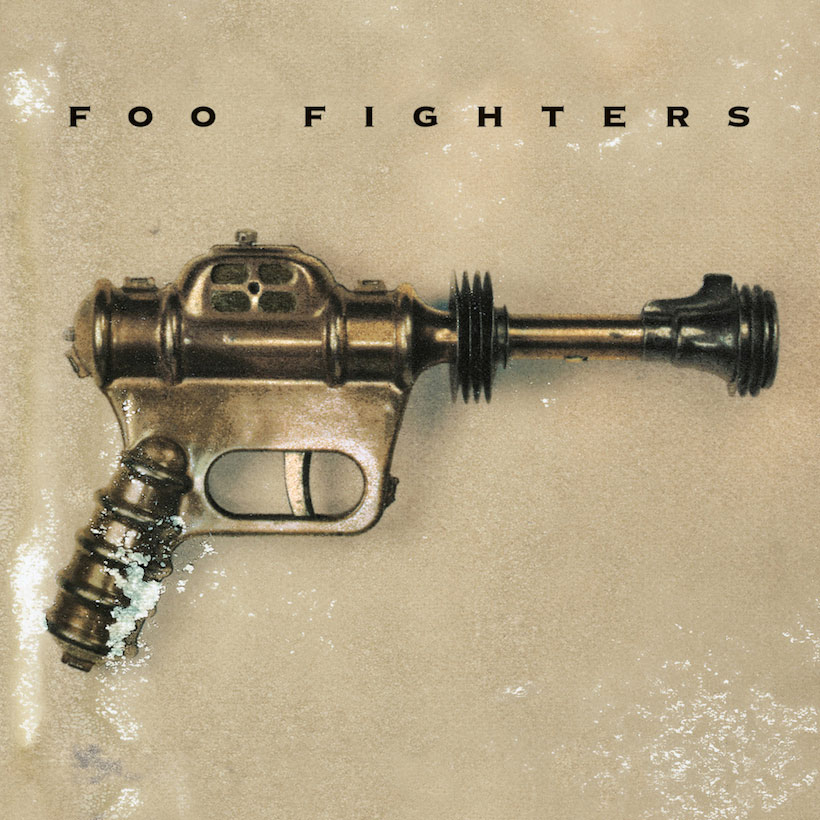
Foo Fighters was released on Roswell Records on Independence Day, 1995. When I heard about the release with my friends, all of which were now enamored with Grohl and grunge music culture, I begged my dad to go to the local music store to get it. He eventually acquiesced my request, and we went to Planet Music in Virginia Beach. I can remember bringing my SONY discman with me so I could listen to it immediately after ripping off the impossibly-hard-to remove shrink wrap encasing the compact disc.
Keep in mind, Foo Fighters would not be my first grunge music purchase at that point. I had several already in my collection by July 1995, including Pearl Jam’s Ten, Soundgarden’s Superunknown, The Smashing Pumpkins’ Siamese Dream, and of course, Nirvana’s Unplugged in New York. I had never been more excited up to the point getting a record than when I did with Foo Fighters. “This is a Call,” their first single, released on the radio a few weeks before, and I was in love with the overall sound. It sounded like Nirvana, but more polished. It was punchier and faster paced. One might say it had the existential qualities of punk rock music, a genre I would also embrace less than two years later. But for 1995, it was all about this release.
Foo Fighters (Roswell Records/1995)
The first couple of songs were fantastic off the bat. To this day, there are very few first tracks that hit harder than “This is a Call.” The next two songs, which also became singles and iconic music videos to boot, still resonate with me. It’s the middle of the album that I continue to go back to, with one song in particular. Standing up among a three song set exploring some differing styles such as eighties post-punk nostalgia (“Good Grief”) and grunge-drenched shoegaze (“Floaty”) is the two minute and forty-six second brain melt that is “Weenie Beenie.”
“Weenie Beenie” was the first song I ever heard that felt truly aggressive to me. The aggression felt good, even for a middle class kid with a b-plus average. The song starts loud and ends louder. Grohl’s characteristic scream is put on display there for the first time. The drums are open ended with plenty of hi hat filling the empty space between the drones of bass and guitar. The snare hits like hammers on your ear drums. The guitars are tuned down and turned up to a nearly uncomfortable level. In the immortal words of Nigel Tufnel, the amps “go to eleven.” It’s a sound I would identify with for the rest of my life. Just because a song sounds angry, doesn’t mean it IS about anger. Without sounding too nostalgic, the song is an emotional one. Every music lover has a genesis to their obsession. Mine happens to be “Weenie Beenie.”
My first experience with music, c. mid 1990s.
I couldn’t play a single instrument when the eponymous release came out in 1995, but it undoubtedly spurred me to pick up my first, a black and white bass guitar, for my birthday in 1996. I still own and cherish that bass to this day. Over the course of middle and high school, I made it a goal to learn all the instruments Dave Grohl could play. I can play all of them now, in varying degrees of precision (or lack thereof).
It wasn’t until I was in college at James Madison University that I found out through some old archived interview that “Weenie Beenie” was named after a northern Virginia fast food stand nearby where Grohl grew up. I had to go. But geography, my lack of vehicle, and my studies (…right) kept me from making a pilgrimage to this fast food holy grail. After a while, I simply forgot about it, even if I continued to make that album part of my rotation throughout my high school years and beyond.
It’s been twenty five years since Foo Fighters was released. What better time to FINALLY go to this iconic northern Virginia establishment than now? Once we started the Offbeat NOVA project, it was the first thing I wrote down. We had to finally go. I was not disappointed.
Weenie Beenie is located just north of the Shirlington neighborhood in Arlington. The small restaurant, offering walk-up service only (no doubt a great boon for business in the currently pandemic) sits unpretentiously in a small parking lot across from a park. The restaurant is the last remaining of a chain of restaurants created by notorious pool shark Bill Staton and his uncle Carl in 1950. According to the Arlington Public Library, Staton funded the first stand alter collecting nearly $30,000 in earnings from a profitable gambling trip in Arkansas. The namesake of the establishment became the nickname of the pool player for the rest of his life.1
The food tasted amazing (Angela H. Eng Photo)
I asked Angela to put the song on as we drove down Shirlington Road. where the restaurant was located. After twenty five years, I had finally arrived.
When I looked it up, Google said it was known for “BBQ sandwiches and hot dogs.” I wasn’t feeling a hot dog on a hot summer day, so we decided on grubbing on a pair of barbecue sandwiches and fries. As we ordered, our daughter Zelda charmed all of the waiting customers around us. It was so unbearably hot and humid that day (nearly 100 degrees), that all of us waiting for our food attempted to hang out in the small amount of shade the tiny orange eaves the restaurant provided from the direct sunlight. After about fifteen minutes, we finally received our hot bag of food. I brought it back to the car and cranked the air conditioning before eating my sandwich. The first thing I noticed was the bun. Normally a soggy afterthought to barbecue sandwiches, the bun was thick and toasted, holding all of the seasoned meat and cool coleslaw together.
I took my first bite of the barbecue sandwich as Dave growled into the chorus of the song inspired by the place I was finally eating at. The meat was warm and well seasoned, with just a hint of spice to it. It also had a tang to it reminiscent of the North Carolina-vinegar style I love so much. The coleslaw was not unlike the restaurant itself, simple and unpretentious. The sandwich reminded me of a better version of a famous drive-in restaurant I grew up eating at in Norfolk, VA, Doumars. Whereas those sandwiches were small and soggy, the one dished up at Weenie Beenie was large, crispy, and filling.
Zelda and I patiently wait for our food (Angela H. Eng Photo)
But I’m not finished. I haven’t talked about the fries yet. I don’t have a picture of the fries because we ate them too fast. Weenie Beenie serves large, wedge-cut fries with an addicting seasoned coating on them. Complimented by the sugary, umami taste of ketchup, they were crispy and perfect. By the time the song was over, we were halfway through our entire meal. It was gone completely in another two minutes. We drove away from Weenie Beenie still sticky with sweat but full and content with delicious food. It’s definitely not a meal you can have all the time, but surely worth waiting nearly thirty years for. Eating there closed a very important chapter of my life, when music was new and exciting.
I highly recommend giving this local business your patronage. When you roll up on the unassuming establishment in your car, don’t forget to crank the seventh track on the first Foo Fighters album while you do.
Footnotes
Arlington Public Library, “The Weenie Beenie,” Link.
(This is the last edition of a three-part series on Alexandria’s historic Wilkes Street Tunnel. Read PART I | Read PART II)
Matthew Eng, Offbeat NOVA
PART III: Out of the Dark and Into the Light
The Wilkes Tunnel, once a fixture of the local newspaper in the mid to late 1900s, lost its journalistic spotlight at the dawn of the twentieth century. The tunnel never made large headlines again and retreated to the minutiae of daily life. Minor repairs were done at the turn of the century, such as new safety signals in 1899 that regulated the speed of the incoming trains to a more respectable five miles per hour. Public opinion remained unchanged into the new century. By 1905, citizens still lodged ineffective complaints against the tunnel, particularly the east end. Under the headline of “A Dangerous Trap,” a May 12, 1905, article pulled out all the old theatrics of Alexandrians nearly two generations ago. “Sooner or later some careless child or nurse will precipitate a baby carriage and its occupant to the railroad track below, or a pedestrian tumble down the incline in the night, when a damage suit against the city will follow,” the article mused. Not long after that article was written, a young child happened fulfill the complaintive prophecy and fall into the tunnel. A young boy named Norton, a resident of tunnel town, fell into the tunnel just in front of his home off Wilkes Street in early September 1907. He as in fact the second child to fall in the tunnel that year. It became such an issue that the city Mayor at the time, F.J. Paff, to create a fence around the Western entrance. It was never confirmed if a fencing was put in place, as the complaints continued in the first decade of the new century.
A collection of articles from the early 20th century about the Wilkes Tunnel (Alexandria Gazette)
Vagrants were caught playing poker in the concealed light of the tunnel’s entrances. Other children continued to jump on railcars and use the tunnel like some long-gone fortification to throw stones at railcars and pedestrians passing by. On April Fool’s Day 1911, the Gazette reported a prehistoric skeleton of a mastodon was “unearthed” from the east end of the runnel where the railroad company was making repairs. It was enough news for a small crowd of excitable residents to congregate at the tunnel the next morning, only to find the ruse a product of the mere changing of a calendar page and a forgetful public gullible enough to belief such a ruse.1
During the First World War, the tunnel was deepened to accommodate higher boxcars for the war effort. A recent archaeological investigation by the Office of Historical Alexandria unearthed a second rail line curving at Union Street and converging at the eastern end of the Wilkes Tunnel near a recent park construction. According to Archaeologist Garrett Fesler, the track was built between 1921 and 1941 before ultimately disappearing by 1964.2 Four years later in 1968, the Wilkes Tunnel was included in the first state-wide survey conducted by the Historic American Engineering Record (HAER). The sketches reside on the Library of Congress’s website. By this time, the surveyor sketching the drawing noted that the tunnel now lied “abandoned in the heart of Alexandria.”
The tunnel continued in use until 1975 when the tracks were removed, this time for good. The tunnel was soon repurposed as the pedestrian and bike pathway as it stands today. Somewhere between then and today, a historical marker was placed forward of the eastern entrance, detailing the history and legacy of the tunnel. That faded sign, like the tunnel, has also seen its better days. Plaques on the western end of the tunnel tell more of the tunnel’s history and connection to the once influential railroad that traversed through it. It’s hard to tell if anyone notices beyond the casual tourist or the jogger taking a short breather.
The closure of the tunnel was likely due to the decline of industrial activity on the Alexandria waterfront. The Old Town area has only increased in popularity in the years since the tunnel’s closure, becoming a Northern Virginia showpiece of new posh ships, stores, and restaurants still showing a feint veneer of the city’s past. The heart of this area is the regal intersection of King Street and Union the very road where the former Orange and Alexandria track once passed through before curving into the Wilkes Tunnel a half mile later.
Nearby Hoof’s Run Bridge, on the National Register since 2003 (Matthew Eng Photo)
The tunnel is not currently listed in the National Register of Historic Places. Alexandria is a city where you can’t throw a stone without finding the rounded bronze plaque bequeathed by the Department of the Interior. In all, there are forty-nine properties and districts listed under the National Register in the city of Alexandria. That includes six National Historic Landmarks (like the Historic District itself or Gadsby’s Tavern). The Wilkes Tunnel does not apply to either. Interestingly enough, the only other surviving portion of the Orange and Alexandria Railroad present down the street from the tunnel, the Hoof’s Run Bridge, has been on the National Register since 2003. In the nomination form for the bridge, the author references the “tunnel in Alexandria” on multiple occasions but treats it as the lesser of two surviving structures to the now-defunct railroad. Perhaps those deep-seeded misgivings of the residents of “tunnel town” were too much after all.3
That doesn’t mean the tunnel has left the public eye in recent years. In the Internet information age, the tunnel has made a resurgence of interest in travel websites, biking blogs, Yelp reviews, and Flickr pages. It’s a popular place for local couples to take wedding or engagement photos. If they only knew the irony of those photos given its history and connection to unchecked domestic violence. Less than a mile away from the Old Town Alexandria Ghost Tour hub on King Street, the tunnel has made its rounds among the macabre musings of several amateur writers such as this humble entry into the historical/pop culture lexicon. If anything, the tunnel is photogenic and short enough for light to pass through your camera lens, making it eerie, but not eerie enough.
Define Irony: Taking engagement photos in a tunnel where a jealous husband tried to kill his younger, spendthrift wife (Google Image Screenshot)
Looking at Google Maps, the overhead satellite map shows the curved road where the track from Union Street bent sharply into the Wilkes Street Tunnel. That is where the high-priced townhomes are located today, standing guard like affluent sentinels standing guard over their not-so historic landmark. How many have actually contemplated the tunnel’s history before passing through it?
High-priced condominiums nearby the tunnel’s eastern entrance off Union Street (Matthew Eng Photo)
A small park called Windmill Hill just over the bluff where Fairfax Street passes over the tunnel, providing the bookend to the overpriced homes of the city’s nouveau riche on the right of the eastern entrance. There is a spacious basketball court and playground where kids play; no doubt they are local to the area. One would highly doubt they refer to themselves as residents of “tunnel town” today as they did so long ago.
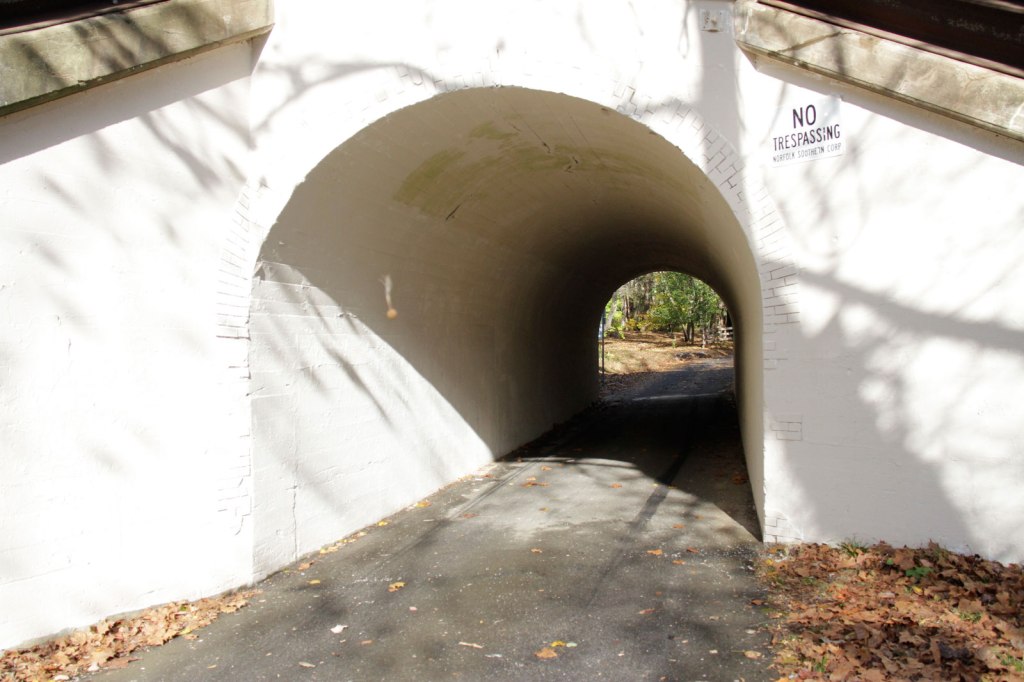
Walking through the tunnel, you don’t feel any “cold spots” that some bloggers love to pontificate about in their content. You can still see the simplistic vaulted sandstone walls as you walk into it. The farther you walk in, the more you take in the landmark’s dank, mossy bouquet, especially on a warm day. At the tunnel’s center point, approximately half of the one-hundred-and-seventy-foot distance, it is very dark, even in the daytime. Your mind does wonder if you are standing at the exact point where Private Scotten was murdered. Where they dragged the dead body to be crushed by a passing train during the Civil War. And, of course, where Mollie McKinley struggled with her violent husband before being shot four times. You walk in the same blood-soaked path she did in near darkness before she sought help out into the daylight. You don’t feel an otherworldly presence while you are in the tunnel, but your mind will at least wander with its strange and complex history carefully in tow.
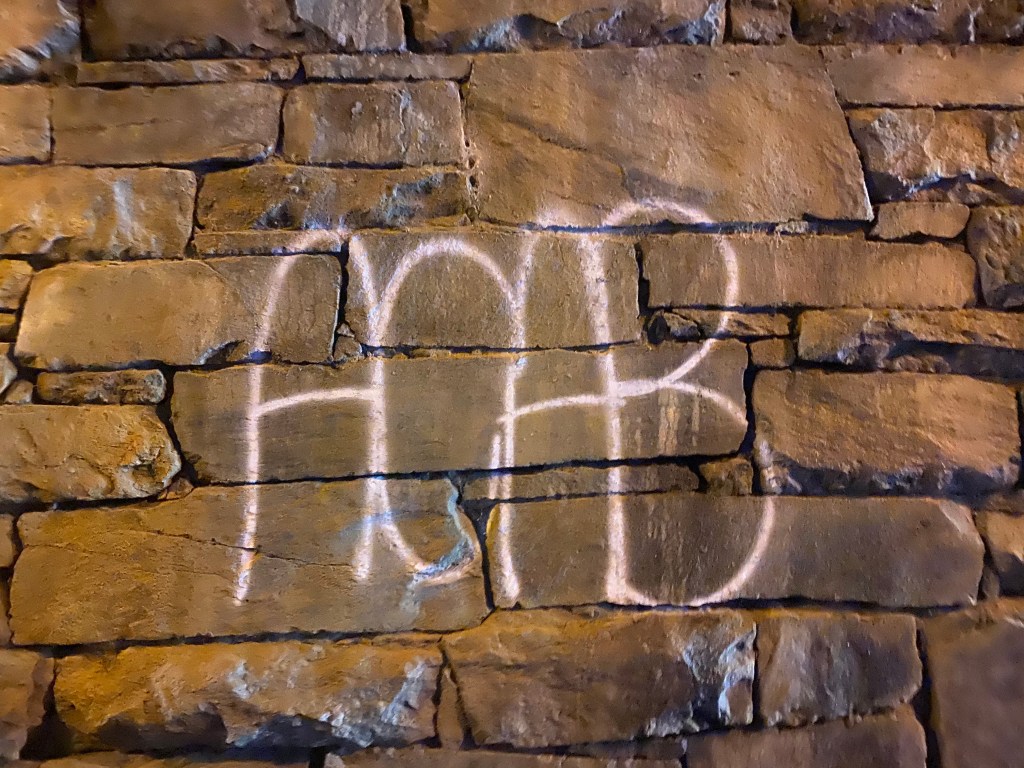
Graffiti inside the tunnel (Matthew Eng Photo)
Very little else of the historic track remains in Alexandria. But then again, Alexandria is no longer the type of city that sustains railroads, foundries, and tanneries as it did in its commercial and industrial heyday. The tunnel once attracted anything form concerned parents, drunkards, vagrants, to the occasional murderer. Nowadays, it’s a breezeway for runners and bicyclists’ daily workout regimen. The tunnel, in many cases, is one of the few remaining pieces of that city’s history untainted by gentrification and modern conveniences. The city that exists around it today is much different. Alexandria, for better or worse, has evolved into tunnel town’s polar opposite. “It wasn’t always high-priced townhomes, archaeologist Garrett Fesler once said. “It was a working, thriving city.” Whatever tiny part the Wilkes Tunnel played in that narrative; it kept its working class literally on track.
Footnotes
Alexandria Gazette, September 4, 1907; Alexandria Gazette, April 1, 1911.
Evan Berkowitz, “Construction Unearths 20th-Century Railroad Tracks,” Alexandria Times, July 20, 2017. Accessed 12 July 2020, Link.
Virginia Department of Historic Resources, “Orange and Alexandria Railroad’s Hoof’s Run Bridge,” PDF Upload (April 2018), Accessed 11 July 2020, Link.
Have you ever traveled down a road and wondered if it was named after a certain person or place? That question led me down a rabbit-hole of Northern Virginia history, culminating in a search for nineteenth-century ruins and long-forgotten gravestones.
While my husband and I were driving through Springfield one day, not long after moving to Alexandria, we ended up on a long stretch of highway called Old Keene Mill Road. We noticed that the name “Keene Mill” seemed to have significance: the name showed up on a school, several shopping centers, and apartment complexes.
“I wonder if there really was a mill here,” my husband mused.
The short answer: yes. There was, in fact, a Keene’s Mill.
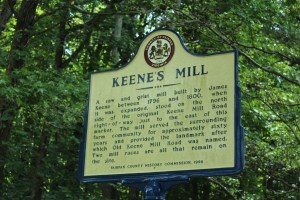
Keene Mill Historial Marker on Huntsman Rd. in Springfield (Matthew Eng Photo)
Keene’s Mill was a saw and grist mill that stood approximately at the intersection of Pohick Creek and Old Keene Mill Road. I found the historical marker for the site online; it states that the mill was built “by James Keene between 1796 and 1800, when it was expanded, stood on the north side of the original Keene Mill Road right-of-way.”1 What caught my attention was the final line on the marker: “Two mill races are all that remain on the site.”
From then on, I had two goals:
Find out more about Keene’s Mill, and
Find out what a mill race was and try to find them.
History of the Mill
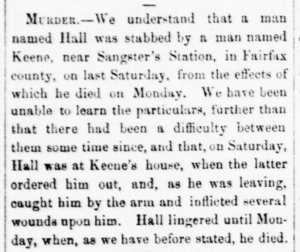
Alexandria Gazette, November 1, 1855
As I searched for information about the mill, I learned something quite shocking: William H. Keene, James Keene’s grand-nephew and owner of the mill from 1849 until 1855,2 was in jail for murder. An Alexandria Gazette article from November 1, 1855, stated that “a man named Hall was stabbed by a man named Keene . . . on last Saturday, from the effects of which he died on Monday.”3 Two days later, on November 3, the Gazette revealed that Keene was in jail. Keene did not appear again in my searches until April 4, 1856. The Gazette briefly mentioned that “Wm. H. Keene, confined in the jail of Fairfax county, for the murder of Lewis Q. Hall, escaped on Wednesday.” Further in the paper was a description:
He is about 45 years old, 5 feet 1C or 11 inches high, broad shoulders and stout made, long hair and bushy whiskers, high cheek bones, large nose turned up and spreading at the end, and depressed about the centre, small grey eyes, and very bad countenance.
Alexandria Gazette, April 4, 1856
It seems, though, that Keene’s freedom was short lived—he was caught the next day and returned to jail. His trial commenced in November, and in a Gazette article on November 15, 1856, he was found guilty of murder and sentenced to hang in January 1857.
Jack Hiller, a Northern Virginia historian, took an interest in Keene’s case in the late 1980s. He meticulously combed through archives and court records to find out exactly what had happened between William Keene and “the man named Hall.” One document he found was an inquisition, held at the house of a woman named Maria Sutherland.4 The inquisition stated that “Lewis Q. Hall came to his death by William Keene on the 27th day of October 1855 by means of a knife in the hands of said Keene.”5
Another document, a statement Lewis Q. Hall signed before his death, gave a few more details: he was accompanied by a man named John Barker, and he was looking for a woman named Maria Hall. He continued, “when I left his door yard followed by said Keene and proceeded at two steps toward his mill he threw his arm around me and inflicted the wound.” He told Barker that he had been cut. A third document, Barker’s testimony, stated that he saw Keene take out the knife and stab Hall; Keene then invited Barker for a drink and Barker accepted, but since Keene could find no liquor and Hall followed, Barker took Hall to Maria Sutherland’s home. The cut was quite bad; Barker said, “the bowels had come out through the cut.”6
Hiller puzzled over this turn of events, asking why Keene would attack Hall for no reason, or why Barker would accept the invitation for a drink, even when he knew Hall was wounded. Hiller suggested that none of them were “rational,” and it turns out he was correct. Hiller recounted several letters from Keene’s family members and acquaintances, all lending their own extra details: drinking may have been involved, “Maria Hall” was a red herring, and it was all an accident.7 One letter even said that one of the jurors had been pressured by the other jurors to give a guilty verdict.8
In light of this evidence, the governor of Virginia at the time, Henry Wise, postponed Keene’s punishment twice. Eventually, Wise commuted Keene’s punishment to ten years in prison. In 1857, Keene went to the Virginia State Prison in Richmond; he was forty-seven at the time. Keene’s fate after that is unknown; any prison records that may have existed were destroyed in the Civil War.9
Keene Mill property drawn by Jack Hiller (Jack Hiller)
The property was sold in 1857, and records indicated that by 1869 the mill was no longer standing.10 Since then, the land had changed ownership several times. Portions of it were abandoned and others developed. One account of the Old Keene Mill Road development read, “What is now Old Keene Mill Road was originally called Rolling Road No. 2. It was built by William Fitzhugh to transport his tobacco to market in Alexandria. In the 1920s, the rise of the automobile led to confusions between the two Rolling Roads. As the Keene Mills had ceased operation, Rolling Road No. 2 was renamed “Old Keene Mill Road.”11 However, I could not locate any other sources or information about it, though Hiller mentioned that Old Keene Mill Road, once two lanes, was converted to four lanes in 1979.
Currently, the land is that contains the mill races is part of the Fairfax County Park Authority.
Searching for the Mill Races
When I began my research, I had no idea what a mill race was. However, I was intrigued that such an odd part of history still had some visible traces, and I wanted to find them. I found out that mill races were man-made channels that essentially run water to and from mill wheels, so we’d be looking for ruts in the land, essentially. One other person had looked for—and found—the mill races in the winter of 2009 and provided photos, so I was convinced we’d be able to find them.12 The same person also noted that a Keene family graveyard was nearby, in a subdivision.
I’d underestimated how tough it would be to find the mill races in the summertime. Also, the day before we’d had tropical-storm-level wind and rain, so the ground was soft, wet, and extremely muddy. Nevertheless, Matt and I entered the Pohick Trail one hot afternoon. The trail ended as fast as it began. From the end of the trail on, there was a carpet of green and fallen branches with no indication of where to go. Matt forged ahead, though, and moved deeper into the woods.
“What direction should we go?” he asked.
“The guy in the article said he walked in the direction of Pohick Creek,” I answered. So we moved on. Nothing resembling what we’d seen in the photos was visible. I tried to remember that the photos were taken over a decade ago and in the dead of winter, so they’d definitely look different by now. Our feet squished in the earth and thorns ripped at our jeans. I walked into multiple spiderwebs, which reminded me I was definitely not an outdoorswoman.
I did, however, feel an appreciation for the history that had happened on this land. Somewhere nearby, Lewis Hall and William Keene had gotten into a fight. Hall had died and the course of Keene’s life had changed forever—and the mill for which the road was named would only exist another ten or so years.
We eventually came upon the creek. It was a pretty, quiet space. The water ran clear, an indication that human hands hadn’t meddled with it too much. However, the beer cans nearby suggested that we weren’t the only ones who had ventured this far into the woods. We both recalled Hiller’s hand-drawn map of the mill races, and walked up the creek trying to find one of them.
Possible section of mill race off Pohick Creek (Matthew Eng Photo)
Eventually we came upon a small rut in the earth that fed into the creek. If our map calculations are correct, this was one of the mill races. We decided to walk further down along the creek and see if we could find the other one. We found piles of hand-cut stones, and, after consulting the map and a couple of other sources, surmised that they may have been pieces of the original Old Keene road.13
We blundered around for a bit and thought we may have found the other mill race, but as we walked, we realized it was just a man-made runoff. Along the way, we found a large rusted-out car, more beer cans, and deer tracks.
Keene family plot, Fairfax County (Matthew Eng Photo)
When we emerged from the woods, a storm was threatening. There was no way we could venture back in, so we decided to review our photos when we got home. We did, however, track down the Keene graveyard. It sat right in the center of a townhome complex about a mile and a half away—a small fenced-in plot with two visible gravestones, one of which read “Addison Keene.” A couple of yards away, a kid played on a basketball court and watched us with a wary eye.
Conclusion
I met both the goals I set for myself. I did find out more about Keene’s Mill—most notably that the final Keene that owned the mill was tried for murder, found guilty, sentenced to hang, escaped from prison, and eventually had his death sentence commuted. I do have to wonder if anyone who named the road, the school, the shopping centers, and the residential complexes knew of this history. It’s a subtle reminder that roads and other places could be named after people or events with a dark past.
As for the mill races, I’m not completely sure we found one. However, having the opportunity to hike through the woods and experience something I wouldn’t have otherwise was a treat—mosquito bites and all.
Footnotes
“Keene’s Mill Historical Marker,” HMdb.org: The Historical Marker Database, last modified July 29, 2016, Link.
Hiller, Jack. “Murder at the Mill: My Search for William H. Keene,” Online PDF. According to Hiller, Keene turned the mill over to a Fairfax attorney in 1855 and gave him the power to sell it pay off legal and personal debts.
Alexandria Gazette, Nov. 1, 1855.
Hiller, “Murder,” 57. The house where Barker took Hall after the stabbing.
Hiller, “Murder,” 55.
Hiller, “Murder,” 56.
Hiller, “Murder,” 58-60.
Hiller, “Murder,” 61.
Hiller, “Murder,” 78.
Hiller, Murder,” 77.
John Pasierb, “Was There Ever a Mill on ‘Old Keene Mill’ Road?” accessed on August 1, 2020, Link.
Andy99. “Suburban Archaeology 1: On the Trail of Keene’s Mill,” March 22, 2009, Link.























 Offbeat NOVA