Categories
Alexandria blog Matthew Eng

Beyond a “Ruinous Condition:” Alexandria’s Historic Wilkes Street Tunnel (PART II)

(This is the second of a three-part series on Alexandria’s historic Wilkes Street Tunnel. Read PART I)

Matthew Eng, Offbeat NOVA

PART II: The Curious Case of Mollie McKinney

Naturally, the track fell into disrepair during the Reconstruction period, adding insult to the already dilapidated condition of the tunnel. At one point, there was a resolution that instructed the Committee on Streets to take steps to have the problematic east end of the tunnel walled in and filled. The resolution never gained any speed and was soon forgotten.1 

After the Panic of 1873, the railroad consolidated into the Virginia Midland Railway, one of the many times the tracks under the tunnel would change corporate hands before ultimately meeting its end as a rail tunnel over a hundred years later. The tunnel became a popular place for young boys and aspiring prepubescent vagabonds to congregate, arousing the suspicions of the citizens of tunnel town. The police reported several instances of vagrancy for these boys, who had the habit of jumping from the top of the tunnel onto the passing cards below. “This is an exceedingly dangerous practice,” said one concerned citizen, “and should be put a stop to by police before some of these bold children are crushed under cars.” Meanwhile, the tunnel continued to be as one person put it, “not only unsightly, but dangerous.” The people of tunnel town and Alexandria would soon find out how dangerous it could be on an unusually cool day in the late summer of 1882.2 

Alexandria Gazette, August 17, 1882

Twenty-two-year-old James Cliff walked with his young wife Mollie McKinney on the morning of August 16, 1882, to the Potomac Ferry Company Wharf. Mr. Cliff’s sixteen-year-old bride fancied a trip to Washington, D.C. Money was tight for the young couple. Mollie had allegedly come up with funds for a nice trip into the big city. At the time, the couple had only been married for about five months. Three months after they were married, Mr. Cliff was let go from his job as a tinsmith due to poor health, draining their cash flow considerably. Although he protested her trip that morning, he insisted on escorting his wife. Mr. Cliff suggested they take a shortcut to the ferry on King Street through the Wilkes Street tunnel. Midway through the tunnel, at its darkest and most concealed point, James slapped his wife and drew a small caliber pistol and proceeded to fire several shots at her. Mollie was hit in four places: on her right ear, on her head above the ear, in the fleshy muscle of her right arm, and her left hand. Ms. McKinney’s screams were heard by several people in the neighborhood, yet nobody seemed to detect foul play at first glance. Two young boys who happened to be walking through the tunnel at the time of the struggle had a visual on the struggle in question. Upon hearing Mollie’s cries, they approached the helpless woman before being told by Mr. Cliff to turn around and leave, who reportedly fired two shots at them. Mrs. Cliff emerged from the tunnel moments later, visibly weeping and covered in her own blood. Mr. Cliff followed close behind his wife, carrying himself cool and calm as if the recent burst of violence were merely a lover’s quarrel.3

Mr. Cliff stopped to chat with several parties in attendance nearby, admitting to them that he had in fact shot his wife. “So great was the surprise at his action,” the article stated, “that no one attempted to arrest him.” He proceeded to walk casually down Royal Street in the direction of the canal. Several women encountered the gravely wounded Mollie McKinney on the corner of Royal and Wilkes and escorted her home. After nearly passing out from blood loss, the helpful women brought her back to life until a doctor arrived to remove what projectiles he could out of her body. The doctor removed the balls from her hand and arm but waited to remove those in her ear and head until she had “calmed down.” The wounds were serious, but not fatal, thankfully.4 
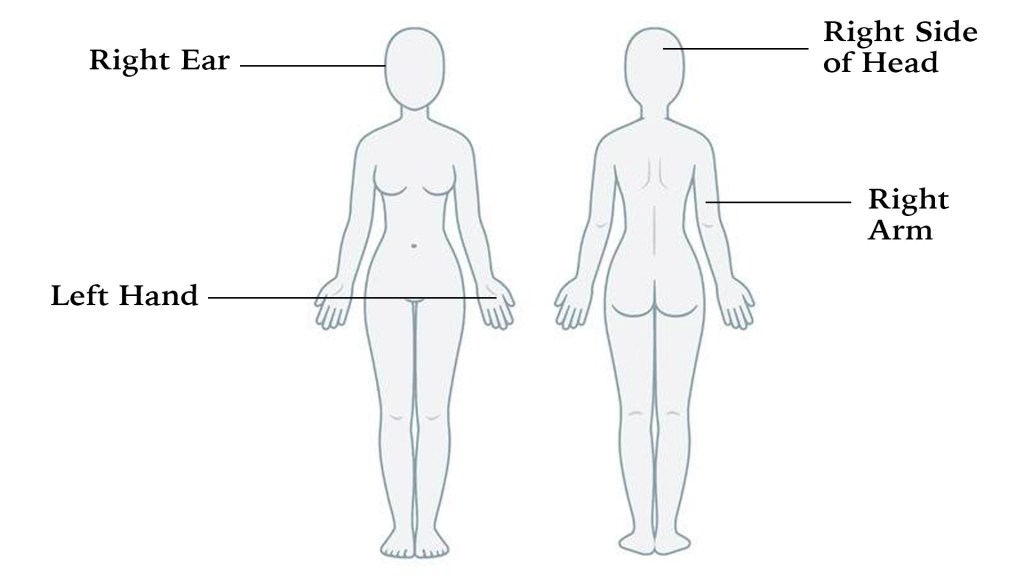
Mollie was hit in four places on her body by her husband, James Cliff.

A crowd soon formed around the house of Mollie McKinney. Oddly enough, it took a great amount of time before anyone in the vicinity began to search for the husband who had walked away from the crime scene so calmly and casually. What kind of man was he, and what possessed him to make an attempt on his wife’s life? 

James Cliff had spent the better part of two months sick with consumption, which forced him out of his job, unfit and unable to work. Mollie, not one to shy for the finer things of life, asked for fine clothes, food, and companionship, which her husband answered with jealousy, physical abuse, and emotional abuse. This was all well documented by those that knew the couple. Neighbors reported that Mr. Cliff was known to “whip” his wife, but not in a manner that would suspect further efforts of deeper foul play. His friends said he was possibly insane. Yet in the realm of Gilded Age romance, Mr. Cliff and Mrs. McKinney had forgivable differences. Mollie’s habit of seeking “lively company” made Mr. Cliff insanely jealous, which was likely the prime motive for the attempted murder. Such behavior is never an excuse, however distasteful it may be to a sick husband strapped for cash at the beginning of an unhappy marriage, for murder. For all intents and purposes, he casually walked away from the city unmolested.5

After the altercation, James Cliff took the Washington Road outside the Alexandria jurisdiction where he waited until evening when he returned to the city feeling too weak from his illness to move further. He went directly to his sister’s house on Duke Street. His sister proceeded to call for the police who took him into custody. The Alexandria Gazette reporter met with Mr. Cliff in his jail cell the following morning to speak to him about what happened. When the reporter arrived, Mr. Cliff was reading the very report on the incident published that morning. He then preceded to tell his side of the story, correcting the report’s ostensible misinformation “in a very indifferent manner.”6 

Much of the offender’s account played out like the article from the previous day. Mr. Cliff insisted that it was his wife’s own idea to go to the wharf for the express purpose of borrowing money for a trip to Washington. Mr. Cliff stated that his wife had not secured money for a tryst in the big city quite yet. How she would get it was up for speculation. The tunnel route, in his eyes, was her idea. He also said that he had a very loving marriage with Mollie until he got sick. It was only after this that she “would never stay with a consumptive man, hoping God might paralyze her if she did.” He continued his tale of sorrows for several more lines, regaling the reporter with a litany of jealous notions and suspicious of infidelity. To him, whatever had happened in the previous morning, was justified. Meanwhile, down the street in their home, Mollie rested from her serious injuries, with one of the balls in her ear still lodged firmly in place. Sadly, the article summarizing the second day of the event ended on a somber note indicative of the time period:

“Mrs. Cliff, it is understood, does not want her husband punished for his crime, and is willing, like a woman, to blame herself entirely for the affair.”7

Alexandria Gazette, August 18, 1882

It was an ominous warning of things to come. If not prophetic.

Two months went by before there was a conclusion to the Cliff assault case. In the middle of October 1882, the Commonwealth set out to convict the prisoner James Cliff, who had the “intent to maim, disfigure, disable, and kill” his wife. Neither party had apparently seen each other since the incident in August, but circumstances that played out would prove that to be highly unlikely. After taking time for the selection of jury, witnesses were called, including Mollie McKinney herself. In a shocking turn of events, she refused to testify in court against her husband, giving no reply when asked about the events on the 17th of August. When she did finally speak up later on during questioning, she merely said that “she had nothing to tell” and objected to other leading questions that would have assuredly convicted Mr. Cliff. All the prosecutor could get from the witness after several attempts to get her to tell the truth was a smile. The smiling grew infectious, and soon laughter was heard in the courtroom. When asked if she had been talked to or influenced before the trial, she responded with a submissive and inaudible “yes.” She then refused to say anything else on the matter of the trial, which forced the prosecutor to send his star witness to jail for contempt of court for the evening. The trial reconvened on the follow day, October 16, 1882, with the witness in a hopefully better position for testimony. She agreed to “tell part, but not all” of her story. Whatever she said must not have been compelling as the end of the trial neared. Other witnesses were examined, playing into the hands of the defense, who asked for a plea of transitory insanity before the jury retired.8 

Sometimes, things do not go like you think they will, especially during the Victorian Era. (Alexandria Gazette, October 16, 1882)

A verdict was reached later that evening after a short deliberation. Foreman Joseph Kauffman presented a verdict of not guilty. James Cliff, now a free man, left the court room with his wife “arm in arm, as loving as if nothing has ever happened to disturb their domestic relations.” Applause could be heard audibly in the court room after the verdict was delivered. It was said that the insanity plea put up by the defense “was worked with a success in this case that even the family of the prisoner did not anticipate.” Who would? Such was the time and delicate circumstances that let a jealous man with anger issues get away with some of the worst instances of domestic abuse. It was the unfortunately product of the time period. The vehicle for that violence was eerily enough the Wilkes Street tunnel, which provided Mr. Cliff with the perfect location to strike her in a jealous rage. The Gazette later reported that Mr. Cliff met his end later on in the Wilkes Tunnel, but that could not be confirmed at present. 

If you or someone you know are being abused domestically, call the National Domestic Violence Hotline at 1-800-79907233. If you cannot speak safely, log onto thehotline.org or text LOVEIS to 22522.

Footnotes:

  1. Alexandria Gazette, November 29, 1871. 
  2. Alexandria Gazette, April 21, 1876. 
  3. Alexandria Gazette, August 17, 1882. 
  4. Ibid.
  5. Ibid.
  6. Alexandria Gazette, October 16, 1882. 
  7. Ibid.
  8. Alexandria Gazette, October 17, 1882. 
Categories
Angela H. Eng blog Civil War

A Holy Dispute: The Alexandria Gazette Burning of 1862

Angela H. Eng, Offbeat NOVA

It’s not hard to grab a newspaper in the Old Town section of Alexandria, Virginia. Stroll down King Street and you’ll see a number of newspaper and circular boxes: pamphlets for things to do and see in Old Town, ads for ghost tours, copies of the Alexandria Times and the Zebra. However, at the intersection of King and Union Street is a lone newspaper box for the Alexandria Gazette Packet.  The Gazette is an unassuming, small paper that averages about 15 pages per issue and costs a quarter. It also has the distinction of being one of, if not the, longest-running newspaper in the United States. 

Alexandria Gazette Newspaper Box on Union Street, Alexandria. The box sites nearby the location of its post-fire offices. (Eng Photo)

Alexandria’s history of printing dates to 1784. The city’s first printing plant belonged to George Richards and Company, and it stood at the intersection of Princess and Fairfax Street.1  This plant produced Northern Virginia’s first paper, titled The Virginia Journal and Alexandria Observer.2 The present-day Alexandria Gazette can trace its origins to this first paper. 

The year 1800 marked the arrival of Samuel Snowden to Alexandria. Snowden, a New Jersey native, began a paper that same year with another collaborator and called it the Alexandria Adviser. However, Snowden soon bought the Columbian Mirror and Alexandria Gazette,from William Fowler in December of 1800.3 Snowden initially called this combined paper The Alexandria Advertiser and Commercial Intelligencer, he changed the name multiple times before settling on the Alexandria Gazette sometime between 1826 and 1828.4 Snowden continued to run the Gazette until his death in 1831; Snowden’s 21 year- old son, Edgar Snowden, resumed  ownership of the paper. 

In 1860, the United States was on the brink of war. Lincoln was elected President in November. Not long after his inauguration in March 1861, the Civil War began with the firing on Fort Sumter on April 12. A little over a month later, on May 23,Virginia seceded from the Union. On the morning of May 24, Union soldiers marched to Alexandria from Washington, D.C. and occupied the city. At the time, Snowden and his son, Edgar Snowden Jr., were running the Gazette. There was one rival newspaper, The Virginia Sentinel, which had begun the previous year.5 It is unclear whether the editors of the Sentinel disbanded or fled, but when the Union occupation began, the Gazette was the only remaining paper in Alexandria.6 

Edgar Snowden, Jr. (sparedshared3)

Under Union occupation, the Gazette did not thrive. Snowden and Edgar Jr. continued to print the paper, but “telegraph communications were denied the publishers and Alexandria had become stagnated economically.”7 By the summer of 1861, the paper had disappeared. However, that fall, Edgar Jr. began a small paper called The Local News. It was a “small non-committal sheet with almost no editorials.”8 Overall, it had varied content: news stories, advertising, current events—it could even report on the crimes of Union soldiers, such as fights and break-ins.9

The Local News ran smoothly and without incident until February 1862. Then, on Sunday, February 9, an event occurred that caused Snowden to publish—what was for the time—an inflammatory editorial. 

“ARREST OF A MINISTER WHILE AT PRAYER IN A CHURCH—GREAT EXCITEMENT”

The headline of the first column in the February 10 edition of the Gazette hints at a wild story to follow. However, the story is recounted in an objective, straightforward manner. St. Paul’s Episcopal Church, founded in 1808 and currently at 228 South Pitt Street, was the site of a disturbance between Union soldiers and Alexandrians. The Reverend K.J. Stewart conducted Sunday services at the church, and at the services on February 9, he began to read the litany. However, several Union soldiers in the congregation, including Captain Elon Farnsworth, noticed that the Reverend did not recite the prayer for the President of the United States. The soldiers demanded he read the prayer, but he ignored them. Farnsworth then decided to arrest the Reverend, so “the prayer book was taken from Mr. Stewart’s hand, he was seized and conducted out of the church, followed by bis little daughter who clung to her father, and was held by one of the soldiers.”10 Michael Lee Pope’s account of the event adds a bit of flair: when soldiers removed the Reverend’s prayer book, he continued to recite the litany from memory. Also, as the Reverend was dragged out the church door, a lady in the choir gallery threw a book at a Union soldier.11 A history of the church on the St. Paul’s website also acknowledges, “ a warning was issued to ‘females and others,’ threatening arrest for offensive remarks and demonstrations prompted, no doubt, by the actions of several St. Paul’s ladies, including one who is said to have dropped her prayer book from the gallery onto the head of an offending officer.”12

The Local News (February 10, 1862)

The Reverend was taken through the streets of Alexandria, in his clerical robes, to Farnsworth’s quarters. The General Montgomery was summoned from the services he was attending at the nearby Christ Church to deal with the situation. He later released Reverend Stewart at the direction of government in Washington, D.C. 

However, the column on the far right of that paper’s edition tells the same story—with less objective details. The editorial describes the event as never having “a parallel among civilized nations, certainly not in the history of this country.”13 The story continues, “an interruption occurred of the character which the law designates as ” brawling”—that is, the intervention of noise and tumult by certain persons, who had come to the church with the intention of interrupting the service should it not proceed according to their wishes.” When the Reverend refused to read the prayer for the President, Farnsworth “undertook to officiate in prayer (if prayer it can be called) by reading the prayer for the President of the United States.” Then he demanded the arrest of the Reverend and called him “a rebel and a traitor.”14 The column continues to deplore the actions of the Union soldiers and declares, at the end, “It will, however, be well to state that Mr. Stewart only insists upon the right of all ambassadors to communicate with their King, untrammeled by civil or military interference.” 

So incensed from the event was Snowden, that he ends the column with a listing of prominent men present in the church and states that they will “testify to the facts as above stated.” He then ends the column with a statement that copies of the paper have been sent to the President and George McClellan, the Commanding General of the Union forces. 

Though the event ended peacefully, the Union unrest was far from over. 

Gazette House Burning Detail, 310 Prince Street, Alexandria, VA (Eng Photo)

That evening, the offices of the Alexandria Gazette at 310 Prince Street caught fire and burned. How the fire began remains unknown. Several sources call the fire “mysterious,” but other sources claim that the fire was started by Union soldiers as retaliation for the editorial.15 Regardless of origin, the scars from the fire remain on the side of the building to this day, a testament to the historical event that occurred on this spot. 

On May 13, 1862, Edgar Snowden Jr. revived the Gazette from the ashes. The paper’s offices were moved to 104 King Street, over a local bookstore. The May 13th edition of the paper states it as “a continuation of domestic annals commenced by the Alexandria Gazette in 1799, and, together with the sheets of ‘The Local News,’ completes the connection between the sixty-second and sixty-third volumes of the Gazette.” The text describes the summaries as  “necessarily brief” and “without details.” The first item listed is the fire on February 10: “The Alexandria Gazette office burned, and further issue of “The Local News” suspended.” In the opposite column, in a brief yet somehow triumphant fashion, the last item reads: “May 13.—Alexandria Gazette resumed.”

And resume it did. The Alexandria Gazette runs to this day. While hunting for the location of 104 King Street, I spied the old, battered newspaper box in front of Mia’s Italian Restaurant with a plain sticker plastered on the side: Alexandria Gazette Packet.18 I jumped out of the car and ran to see if there were any old copies inside. Lo and behold, I pulled out a July 16, 2020 edition of the Gazette. While we were never able to pinpoint exactly where 104 King Street sat, it crossed our minds that the newspaper box sits the closest it can to the original office. 

At the top of the paper, in small letters, is a brief and powerful tagline: “Serving Alexandria for over 200 years.”

Footnotes

  1. Anderson, Robert Nelson. “A History of Printing in Arlington (Alexandria) County.”  Arlington Historical Magazine Vol. 1 Issue 3 (1959): p. 11, http://arlingtonhistoricalsociety.org/wp-content/uploads/2016/02/1959_2Printing.pdf 
  2.  Anderson, “Printing,” p. 11.
  3.  Rawson, David. “Samuel Snowden.” Index of Virginia Printing, http://indexvirginiaprinting.org/bio/393/. Rawson notes that Fowler had the publication for only two months and it was financially troubled.
  4.  Rawson, “Index.” The name Alexandria Advertiser and Commercial Intelligencer only lasted until 1803. The succession of names included: Alexandria Daily Advertiser, 1803-1808; Alexandria Daily Gazette, Commercial and Political, 1808-1812; Alexandria Gazette, Commercial and Political, 1812-1817; Alexandria Gazette and Daily Advertiser, 1817-1819; Gazette and Daily Advertiser, 1819-1821; Alexandria Gazette and Daily Advertiser, 1821-1822; Alexandria Gazette and Advertiser, 1822-1824; and Alexandria Phenix Gazette, 1825-1833. At some point between 1833 and 1834 the “Phenix” portion of the name was dropped.
  5.  Cappon, Lester. “The Yankee Press in Virginia, 1861-1865.” The William and Mary Quarterly. Vol. 15 No. 1 (1935): pp. 81-88. The Sentinel only lasted from 1859-1861. Cappon describes it as “pro-secession and radical.” 
  6.  Cappon states the paper “disbanded,” but Anderson, citing a different publication by Cappon, states that the editors “escaped” to Warrenton, Virginia. 
  7.  Anderson, “Printing,” p. 18.
  8.  Cappon, “Yankee Press,” p. 81.
  9.  Tuyull, et al. “Sic Semper Tyrannis: The Alexandria Gazette under Union Occupation.” Journalism in the Fallen Confederacy (New York: Palgrave, 2015), pp.18-41. 
  10.  The Local News, (Alexandria, VA) February 10, 1861.
  11.  Pope, Michael Lee. Wicked Northern Virginia (Charleston: History Press, 2014), p. 107.
  12.  “St. Paul’s History.” St. Paul’s Episcopal Church, n.d., https://stpaulsalexandria.com/start-here/#1540312179561-b3069e59-ff71
  13.  The Local News, (Alexandria, VA) February 10, 1862.
  14.  Interesting side note: Captain Elon Farnsworth later died at the Battle of Gettysburg on July 3, 1863.
  15.  Anderson and Pope claim that Union forces set the fire, as does the historical marker at 310 Prince Street. However, Jeremy Harvey (author of Occupied City: Portrait of Civil War Alexandria, Virginia) states the fire began under “mysterious circumstances.” https://www.hmdb.org/m.asp?m=41832 
  16.  Anderson, “Printing,” p. 18.
  17.  Alexandria Gazette, (Alexandria, VA) May 13, 1862. 
  18.  Mia’s address is 100 King Street. We could not locate 104 King Street, but we assume it was on the second floor (since Anderson points out it was above a bookstore) and probably absorbed into the restaurant space. 

Categories
Alexandria blog Civil War Matthew Eng

Beyond a “Ruinous Condition:” Alexandria’s Historic Wilkes Street Tunnel (PART I)

(This is the first of a three-part series on Alexandria’s historic Wilkes Street Tunnel.)

Matthew Eng, Offbeat NOVA

There is an ordinary looking tunnel one-half mile away from the heart of Old Town Alexandria’s bustling King Street waterfront. The tunnel, approximately one hundred and seventy feet long, extends between South Royal and Lee Streets, passing under Fairfax Street. Long ago, the citizens that lived in its proximity referred to the area as “tunnel town” after the aforementioned structure. Nowadays, it’s better known by the name of the street it passes through: the Wilkes Street tunnel. The street and its tunnel are named after John Wilkes, a radical English statesman who championed the cause of the American colonies against King George III.

The tunnel’s connection to the city and Northern Virginia is not unlike the structure itself, with beaming rays of light peaking at either end amidst long periods of murky gloom and blackness. After awakening some of its past ghosts, maybe this in depth look at the troubled history of the Wilkes Street tunnel will coax others out of the darkness and into the light. 

PART I: Tunnel Town 

To tell the story of the Wilkes Street tunnel, you have to start at the creation of the Orange and Alexandria Railroad, the first set of tracks to pass through the tunnel’s arched walls. The Orange and Alexandria Railroad Company chartered the railroad in 1848. This first incarnation ran from the Potomac River docks at the far end of Union Street in Alexandria to Gordonsville in Orange County. At its peak just before the American Civil War, the railroad extended to an expanse in the Commonwealth nearly one hundred and fifty miles from Alexandria to Lynchburg.1

Bridge on Orange & Alexandria Railroad (Library of Congress Image #LC-DIG-ppmsca-33468)

T.C. Atkinson, Chief Engineer of the railroad, put a notice in the local newspaper in February 1850 for Alexandria’s portion of railroad construction, including a tunnel “about 360 feet in length with support walls, bridge, and culvert masonry.” According to former Alexandria City Archaeologist Pamela Cressey, the local firm of Malone and Crockett won the contract and soon began work in earnest.2 George H. Smoot, then President of the Orange and Alexandria Railroad, stuck a shovel in Wilkes Street between Fairfax and Lee (then-called Water Street), which became the first work done for the tunnel. By April of the following year, the American Telegraph reported that the tunnel was proceeding “with vigor” and would soon be completed. By that time, the company had already laid the rails for the Orange and Alexandria railroad on Union street.3 

On May 6, 1851, the first locomotive was placed on the track for the Orange and Alexandria Rail, traveling “from the north end of Union Street to the tunnel on Wilkes Street.”4 The news snippet reported that “the performance was good, and gave general satisfaction.” The dutiful work of Malone and Crockett, however, decreased in quality after the initial victories of the tunnel design. It deteriorated so much that they were eventually taken off the project, according to chief engineer Atkinson. It was not until October 1855 that the Gazette reported that the railroad company, now in charge of construction, planned to complete the eastern end of the tunnel overlooking the Potomac River. By early July 1854, locals hoped for a speedy conclusion to the tunnel’s initial construction, as “it should not be suffered to remain in its present condition any longer.”5 

The tunnel was officially completed in 1856, over budget and over schedule. The tunnel’s original intended purpose was as a route service and major connector to the railroad carrying supplies and goods from wharfs and warehouses on the Alexandria waterfront to all points south. A nearby large depot and roundabout house was located up the track in the present-day Carlyle/Eisenhower business district. The tunnel’s sandstone vaulted walls stretched to nearly sixteen feet in height at the top of its brick arch. The western end of the tunnel featured a long ramp with brick wall sides. Architecturally, it is known as a “cut and cover” bridge, a common technique later popularized by the highly unpopular Washington Metro Area Transition Authority in Northern Virginia, Maryland, and Washington, D.C.

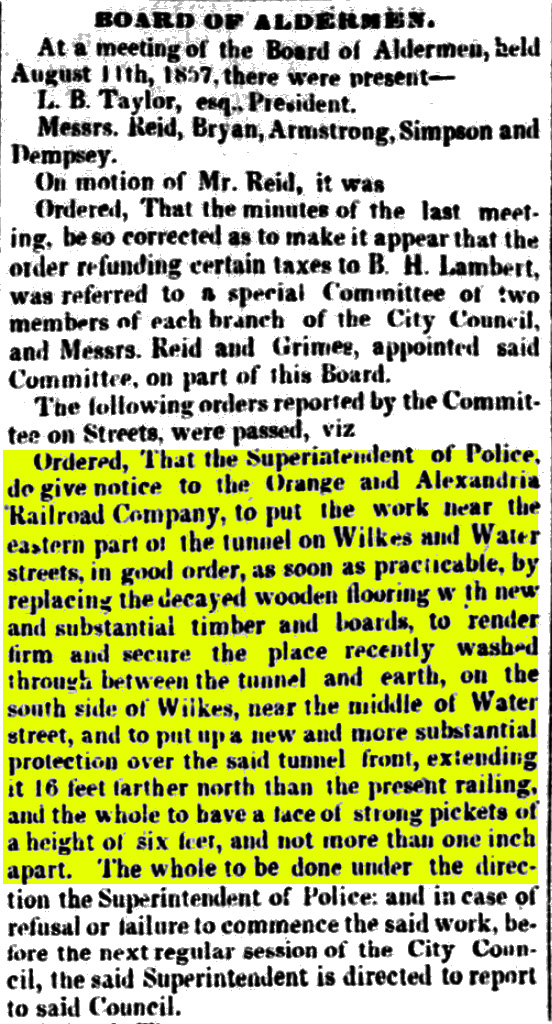
Order for the Superintendent of Police to enforce improvements on the Wilkes Street Tunnel (Alexandria Gazette, August 14, 1857)

Problems with the tunnel’s “completed” construction began almost immediately. In 1857, the Alexandria Committee on Streets reported in the Gazette about the poor condition of the tunnel, particularly the drainage and its already decaying eastern end that faced the Potomac River and Union Street.6 The tunnel’s condition became a pressing issue that continued well into the summer of 1857, coming to a head in August. The shoddy craftsmanship came up once more in a Board of Alderman meeting proceedings in the August 14, 1857, issue of the Gazette. The Superintendent of Police had given notice to the Orange and Alexandria Railroad Company to “put the work near the eastern part of the tunnel on Wilkes and Water Streets, in good order.” The work to be done included the replacement of decaying wooden flooring with new timber and better protection on the tunnel’s front. The same order was later published in the newspaper in November and April of the following year, so it is unclear when the work was actually finished, if at all. 

Alexandria’s location to the proximity of Washington, D.C., made it an important political stop for many candidates seeking victory in the hotly contested election of 1860. Locals came out to support then-Presidential candidate and Alexandria native John Bell and the Constitutional Union Party in a torch-light procession and meeting on September 28, 1860, less than two months before election day. With a large sign emblazoned with an eagle declaring, “The Constitution, the Union, and the Maintenance of the Laws,” a train carrying Bell traveled through the Wilkes Tunnel on its way to the White House amongst a throng of “Tunneltown boys” carrying big bells and cheering huzzahs and other garish exultations. This is the first instance that you see a newspaper refer to the area around the Wilkes passageway as “tunnel town.” The article ended with a conclusive “assurance” that Alexandria would “speak for the Union in November next, in thunderous tones.” It was hardly thunderous. Bell was embarrassed in the election, and Alexandria voted to secede in 1861 at the start of the American Civil War.7

During the war, Alexandria was a city with Confederate sympathies that quickly fell back into the watchful eye of the Union across the river on May 24, 1861, remaining in Federal hands until the end of the conflict. During that time, the Union Army made the city a major center for troops and supplied being sent to the front lines. Wounded soldiers were brought back to local hospitals in the area, like the Lyceum and, perhaps most famous, Mansion House Hotel depicted in the short-lived PBS series Mercy Street. The Orange and Alexandria Railroad, like so many others at this time, were also taken under control by the Union Army for the war effort, which included the use of the Wilkes Tunnel. 

It was not until this brief period of Federal occupation that we begin to see the dark history connected to the tunnel. The Alexandria Gazette, a paper that decidedly leaned its journalistic integrity towards the Confederacy, included several stories of odd occurrences and malfeasance by Union soldiers in the dark tunnel. After the first major battle in Manassas (Bull Run), the newspaper reported that a woman threw rocks collected in her apron at “panic-stricken” Union Zouave soldiers as they escaped through the tunnel onto awaiting gunboats along the Alexandria waterfront. It was the first “baptism of fire” for these men, but hardly the last casualty in Alexandria during the war.8 

Under the heading of a “SERIOUS ACCIDENT,” the Gazette reported on the first major incident involving the tunnel in occupied Alexandria on August 26, 1862. According to the brief writeup, a soldier’s right leg was cut clean off above the ankle after lying on the railroad track at the eastern entrance to the Wilkes Tunnel the previous night. He was undoubtedly under the “influence of liquor” and, in an attempt to cross the track, fell with his leg across the rail as a locomotive passed over it, too drunk to move out of the way in time. He was later taken to a hospital and treated for his injuries. It was never reported on the condition of the soldier afterwards. It’s clear from this incident and other snippets from the paper that the Federal occupying force were adept at finding new ways of causing trouble as time dragged on and idleness set in. The newspaper also reported on the necessity to clear out Union stragglers around the city “who had thronged the streets” outside of their encampments.

Some time later in 1864, it was also reported that some “fiends” who murdered an individual put his dead body on the tracks near the western end of the tunnel. The corpse’s head was crushed as an oncoming train on the rail passed over it. It was never specified if the individuals responsible were Union soldiers or local citizens.9 

Pvt. Scotten walked into this entrance and never walked out. (Matthew Eng Photo)

The most heinous and unsettling event of the war period occurred two years later in March 1864. On Friday, March 11, 1864, James Scotten of Company G, 4th Regiment, Delaware Volunteers, walked into the Wilkes Tunnel at around six o’clock in the evening and never walked out. According to the report, Scotten was approached by an individual and stabbed in the back of the neck five times. One cut severed his jugular and made a “considerable incision” in his windpipe. One cut from the autopsy report showed the instrument entering the spinal column, which ultimately killed him. Despite his windpipe being cut, one civilian near the tunnel was able to hear Scotten’s pain-stricken groans. By the time he arrived, he was dead. 

Scotten was seen walking into the tunnel with another individual who became the prime suspect, John Rush of the 72d Regiment, New York Volunteers. Scotten had just received four months’ pay on the day he was murdered, with very little money found on his person at the time of his death. Rush was arrested on suspicion of murder where he awaited examination. “The victim wore new clothes and there was every reason to suppose he had enlisted in order to procure several hundred dollars bounty,” the report noted. According to Army records, Rush later mustered out of the war several months later on June 8, 1864, in New York City with the rest of his battle-hardened unit. It is safe to say he was never convicted of any wrongdoing. A perpetrator of the crime was never found, and Scotten is listed as “murdered” on Delaware Civil War veteran logs and online registers today.10 

Private John Rush was mustered out of the military in June 1864, indicating he was never convicted of a crime. (Matthew Eng Image)

Life continued on for the city after these two incidents in 1862 and 1864, respectively. Complaints included in the local newspaper also continued for the sake of safety after a child fell through a set of broken blanks in the tunnel and was considerably hurt. By the time the war ended, the Gazette was back to reporting on the “ruinous condition” of the tunnel that was becoming more dangerous with each passing day.11 

Footnotes

  1. Pamela Cressey, “Wilkes Street Tunnel is Important Piece of Past,” Alexandria Gazette Packet, October 19, 1995. Accessed July 11, 2020, Link.
  2. Ibid.
  3. The American Telegraph, April 14, 1851.
  4. Alexandria Gazette, May 7, 1851. 
  5. Alexandria Gazette, July 1, 1854. 
  6. Alexandria Gazette, June 1, 1857. 
  7. Alexandria Gazette, September 28, 1860.
  8. Alexandria Gazette, March 31, 1922.
  9. Alexandria Gazette, March 10, 1909.
  10. Alexandria Gazette, March 12, 1864.
  11. Alexandria Gazette, September 24, 1864; Alexandria Gazette, January 10, 1865. 
Categories
blog Matthew Eng

Don’t Run Away, It’s Only Me

Matthew Eng, Offbeat NOVA

When the COVID-19 quarantine began in the middle of March, Angela and I were faced with a number of new realities:

  • How do we entertain a 4-year-old while still maintaining a relatively normal work schedule for telework?
  • How do we maintain our sanity stuck at home for weeks on end with said 4-year-old who wants nothing else to do but go outside, see family, and play with others?
  • What will we do with everything in between that will feel like fun, teach our daughter a few things, and keep us from going insane?

We could only do so much at once, so we spent most of March and April working on the first two of those problems. I will be the first to admit that it was very hard at first. It was hard for everybody. But we persevered after stumbling through the first few weeks to establish a good rhythm to our daily work schedule. But how would we control our “off time,” when we’re at home 24/7?

We did watch a lot of television at first. In some ways, it was nice to catch up on shows we either forgot to watch or always wanted to. Naturally, we watched Tiger King like everyone else. We took the opportunity during the episode where it was clear that Carole Baskin killed her husband to down a bottle of wine together. That was the first time that we allowed ourselves to relax during the entire quarantine. It felt good, but we knew it wouldn’t last. Watching lots of television got old real fast.

(imgur)

One of the other shows we watched during this time of quarantine was Mindhunter. I actually started it almost a year ago, but stopped after four episodes once Angela discovered that I had straight up Netflix-cheated on her. She wasn’t happy, but I remedied the situation, using the opportunity in quarantine to get Angela’s trust back. We started watching it in early May and blew through both seasons within a week and a half. The show got both of us thinking about what strange events and occurrences happened around our area. But how could we search those out in quarantine?

The one way we took back some of the freedoms we used to have without being an entitled asshole who thinks life should go on regardless (if you’re one of those people, thanks for reading but you’re a huge selfish asshole) was to get in our car and drive around. It’s something we both agreed would be both productive and let us “stretch our own legs” in relative safety. Most of the time, we would go into Washington, D.C. Angela loves to drive around the city and people watch. Only there weren’t many people to watch from our car. Once the tragedy of George Floyd happened at the end of May, much of the district was restricted (either by closed roads or a punk-ass wall around the White House). We had to look for other options.

We spent most of June driving around our neck of the woods in Northern Virginia. With such a big territory to cover (over 1,300 square miles), we had to start planning where we were going, so Angela sought out sites that drew her interest. I did the same. We found two or three places that each of us that we wanted to go, packed up our car with our daughter, water, and snacks, and hit the road.

With a car, we could go essentially anywhere to look for whatever clues we could about the area’s past. At first, these targeted drives were a sheepishly fun act of mild historical voyeurism. It was only when we got home that things really started to connect. At night, I would think about the places we went to our weekend drives, wondering how they might fit together in a story or video. When I stayed up at night looking at my phone, I was not chatting with good friends or being sociable. I was feeding my curiosity and secretly filing them away in Google Chrome tabs and scattered notes on my tiny 6.1-inch iPhone screen.

It turns out Angela was doing the same thing. This was the beginning of Offbeat NOVA.

Here’s what you can expect from Offbeat NOVA in the near future:

  • A local legend that doesn’t get nearly enough credit for how creepy it is.
  • There’s a tunnel in the heart of NOVA’s gentrified mecca with a dark and mysterious past filled with intrigue, abuse, and murder.
  • What is it like getting a soda and Cheetos at the same 7-11 where police put John Bobbitt’s dick on ice in a hot dog container?
  • Did you know that Northern Virginia had its very own theme park one hundred years ago?
  • Just how many dead bodies are found in local area motels? It turns out…a lot.

Stay tuned.