Categories
Arlington Matthew Eng Podcast

The Washington Luna Park Assault Case (Part III)

This is the last of a three-part series on the an assault case that happened in the opening year of Washington Luna Park in 1906. Read the first article HERE. Read the second article HERE.

By Matthew T. Eng, Offbeat NOVA

Offbeat NOVA · (S1E3) The Washington Luna Park Assault Case (Part III)

The facts continued to repeat in the newspapers. Ms. Gooding failed to identify the prisoner when she first saw him in the lineup. This was corroborated by four officers who saw her pick another man. The man she identified had been in jail since January of that year. She was also the only person to testify of the assault because Forrest Gooding had run away to the park gate for help. She also claimed to have throat bruises, but no physician was ever called to testify to that condition, and she appeared otherwise normal, if not a bit frazzled.1 

“Do these facts seem to justify an impartial, unbiased mind in reaching a conclusion of guilt and fixing the punishment at death? Was not the alibi proved by a preponderance of testimony, or was it not certainly sufficient to raise in the minds of the jury a reasonable doubt of the prisoner’s guilt, and was not the failure to identify at once, at first sight, a fatal obstacle to the prosecution’s case?”2


Evening Star, November 14, 1906. 

Clements fully believed in the man’s innocence. He wasn’t the only one. With the appeal put in place, the only thing to do was wait. 

The answer came in the second week of December, just one week before Wright was sentenced to hang on the following Friday. On December 11, 1906, James Clements received a writ of error from the Virginia Supreme Court of Appeals. That in the least postponed the hanging from happening the following week. The writ claimed that new evidence had been found and that the verdict was circumstantial and largely due to public clamor than actual evidence. The case went under review once again because of Ms. Gooding’s inability to recognize the individual at first and Wright’s strong alibi on the night of the alleged incident. The liveryman’s testimony that Wright returned to the stable around the same time of the incident made it very difficult to connect the two. Wright was hopeful he would get a new trial.

The case was argued before the higher court on January 10th of the following year, with no decision made after the first week in February. Throughout this, Wright continued to proclaim his innocence. A decision was finally made by the Court of Appeals in Richmond in mid-March, which affirmed the decision of the lower court on a decision of three to two.4 
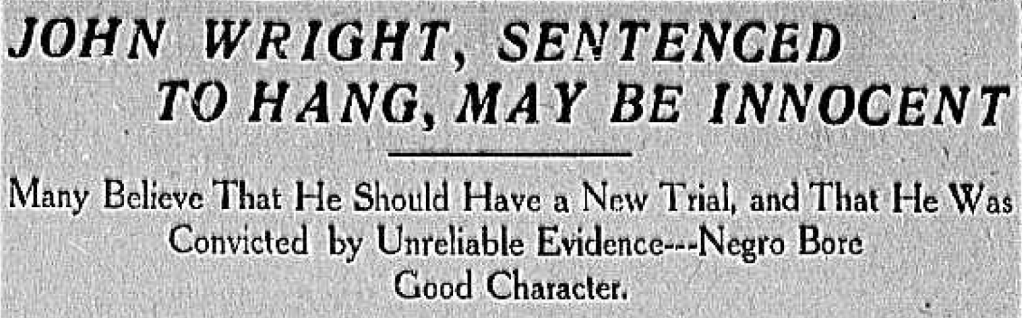
Richmond Times-Dispatch, March 22, 1907

The next day, the Richmond Times-Dispatch ran with the headline “Court Divided, But Wright Must Hang.” The verdict could not be reversed in a case like this unless it was found that new evidence was insufficient to warrant the finding of the jury. The decision also stated that no new trial would be granted. The article ended with a haunting and foreboding warning for trials of its kind to come in the future:

“It is further stated that the guilt of the accused is purely a question of fact, and that if the witnesses for the Commonwealth were worthy of credence, of which the jurors were the exclusive judges, there can be no question that the verdict is neither contrary to the evidence nor without evidence to support it.”5 

Richmond Times-Dispatch, March 15, 1907

John Wright was a dead man walking. Wright was sentenced to hang on May 31, 1906. 

Interest in the case continued to grip the local community. Clements continued to fight for Wright. He went to work and prepared another petition to the court of appeals for a rehearing. More revelations came out regarding the other crime Wright was accused of, the murder of Jackson Boney. According to one report, a woman named Anna Green, a woman of “debased character,” accused Wright of murdering Boney when she herself was with Boney on the night in question near the Long Bridge that connected Virginia to the district. The details she offered authorities was “beyond belief,” and put Wright nowhere near either incident. Her testimony would have undoubtedly spread doubt to Wright’s conviction. Yet these facts and information were summarily dismissed from appearing at the case.6  

In the midst of these appeals, it was reported in the Alexandria Gazette that Forrest W. Gooding had gone missing on April 26, 1907. Mrs. Gooding noted in the article that Gooding had been in a nervous condition since the conviction of Wright and that Black individuals in the neighborhood had “threatened to kill him.” No mention in the news was ever made of his reappearance.7 

A small community movement began towards the end of May 1907 to present Virginia Governor Claude A. Swanson with a request to overturn the execution by hanging. Governor Swanson put another stay in the execution until August 30th so he could fully absorb all details of the case. It was decided by Governor Swanson on that date that he would commute the sentence, and instead give Wright a life sentence in prison. With all the facts laid before him, Swanson had in his official statement “a serious doubt as to the identity and guilt of the prisoner.”8 

Wrongfully accused or not, Wright escaped the gallows but was resigned to live his life as a prisoner, not a free man, for a crime he undoubtedly did not commit. 

THE END

The park continued to run for nearly another decade before it met its untimely end in 1915. On April 9, 1915, a fire destroyed the roller coaster. According to the Washington Post, “the origin of the fire is thought to have been from sparks from a blaze in the woods adjoining the park.” The closest fire stations were in Washington and Alexandria, so the park’s premier attraction was a total loss, even if very little else was taken by the flames. Regardless of this fact, the park was closed and dismantled later that year.9 
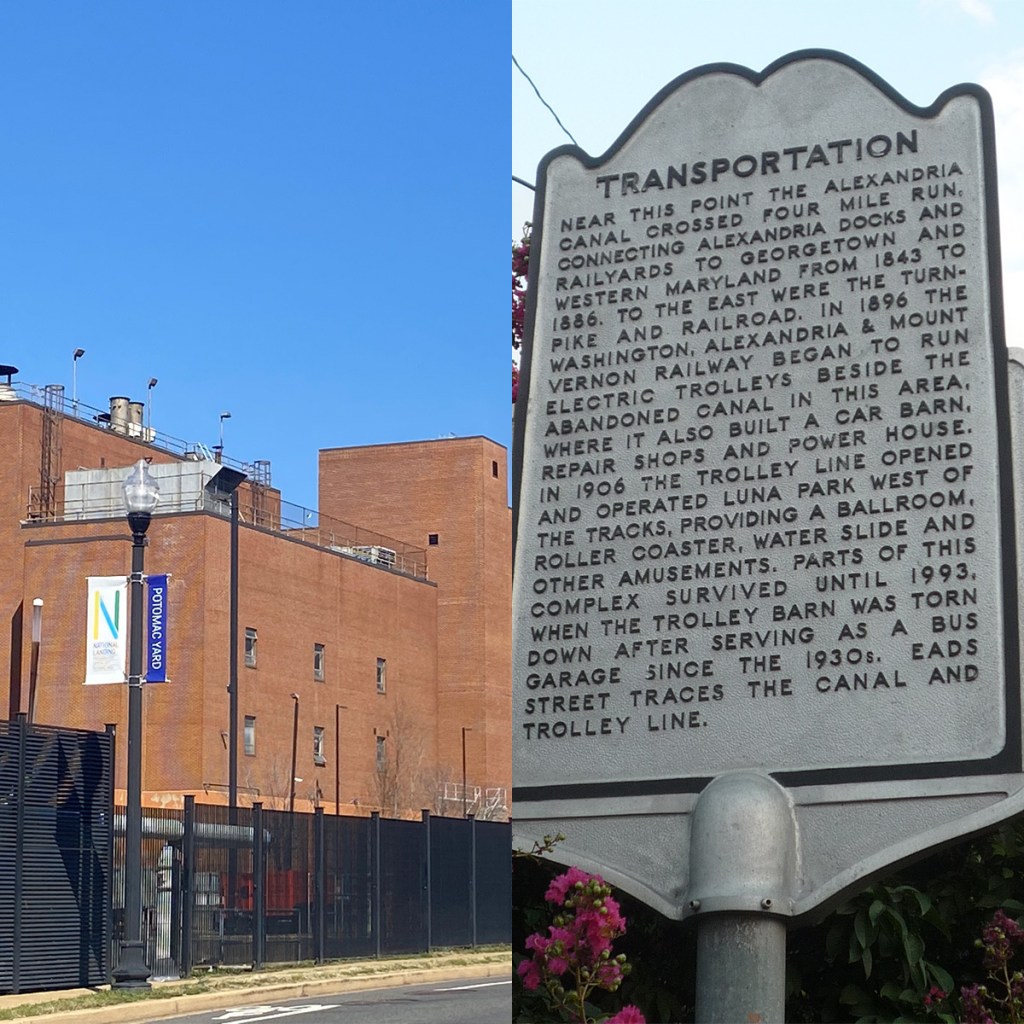
The site of Luna Park today is the Arlington County sewage treatment facility. Nearby on the corner of Glebe and South Eads is an unassuming transportation marker hidden in a tree. (Matthew Eng/Offbeat NOVA)

Today, the land on the corner of Glebe Road and South Eads St. near Four-Mile Run is occupied by the Arlington County sewage treatment facility. No evidence of the park exists. Only a small transportation marker for the Washington, Alexandria, & Mt. Vernon Railway exists behind a gate and an overgrown tree. I couldn’t help but think how close I was standing to the incident with John Wright and Mable Risley on a warm evening in the later summer of 1906. 

I wanted to come out of my research on this once beautiful park with sanguine thoughts and waves of nostalgia. Instead, I have very mixed emotions about the park’s legacy. In the wake of the racially motivated violence we have witnessed in recent memory, I take pause and think about how many of these incidences have occurred in American history. Too many. 

How many like John Wright were lucky enough to narrowly avoid the gallows? How many more were lynched without the benefit of a trial? There are multiple examples in the area when mob mentality won out at the turn of the century. It’s sobering to think how little some things have changed over the course of one hundred years. With so much progress, society continually lags in the pack. All you have to do is read the news. It would be at least comforting to say incidents like that of Mr. Wright were unprecedented. But the world sadly does not work that way. Not then. Not now.

Forest S. Gooding Death Notice (Ancestry)

I don’t know what happened to John Wright at this moment in time. There are prison records in Richmond, but that will take time to find out at this time. Life was easy for the Goodings, however. Census records show that the couple settled in Wheaton, Maryland, in Montgomery County, shortly after the yearlong trial and commutation process ended for Wright. By 1910, the two had two children, including a newborn son named James. When the 1920 census was collected, the Gooding’s had four children. Forest Gooding died on September 23, 1929. Mabel remained a caretaker beyond her husband’s passing, dying in 1976. 

But what happened to John Wright?

Should I look up Joseph Thomas or his more common alias, John Wright? These are questions I will ask myself self in the future when it’s safe to venture out and research more intimately. Rest assured, I want to bring some sort of closure to this story. I think John would want that — a slice of freedom he was never given. His story, like those both known and unknown by the public today, matters. His life matters. Especially since the only life he got was one attached to a sentence from a broken system. 

Footnotes:

  1. Evening Star, November 14, 1906. 
  2. Evening Star, November 14, 1906. 
  3. Richmond Times-Dispatch, December 12, 1906. 
  4. Alexandria Gazette and Virginia Advertiser, March 14, 1906.
  5. Richmond Times-Dispatch, March 15, 1907. 
  6. Richmond Times-Dispatch, March 22, 1907. 
  7. Alexandria Gazette, April 27, 1907. 
  8. Virginia Citizen, August 30, 1907. 
  9. “Luna Park – 1915,” Arlington Fire Journal & Metro D.C. Fire History, June 24, 2009. Accessed April 24, 2021, LINK.

Categories
Arlington Matthew Eng Podcast

The Washington Luna Park Assault Case (Part II)

This is the second of a three-part series on the an assault case that happened in the opening year of Washington Luna Park in 1906. Read the first article HERE.

By Matthew T. Eng, Offbeat NOVA

Offbeat NOVA · The Washington Luna Park Assault Case (Part II)

Forrest W. Suddenly Gooding took the stand on Halloween in John Wright’s trial at the Circuit Court of Alexandria county. He identified Wright, the defendant, as the one who assaulted them on the 9th of September. Gooding retold his side of the story to the jury and Commonwealth’s Attorney Crandal Mackey, whose job it was to prove Wright’s guilt. Mackey would later make fame in Arlington and Alexandria as a champion of prohibition.   

Crandal Mackey was the district attorney in charge of convicting John Wright of assault against Ms. Mabel Risley on September 9, 1906 (Offbeat NOVA)
Crandal Mackey (WETA/Boundary Stones)

It was noted in the Alexandria Gazette article that the two had been married in the month and a half since the incident. 

A variety of other witnesses took the stand that day. Ms. Risley’s sister, Mamie L. Sullivan, took the stand to testify that she had, despite being happily married, been in “ill health ever since the occurrence.”1 

Mabel Risley, now Mabel Gooding, took the stand in the late afternoon until almost six in the evening. She also identified Wright as the assailant who committed the crime. She also testified that Mr. Wright had jumped out of the underbrush, knocked Mr. Gooding unconscious with a club in one hand and a pistol in another before choking her, assaulting, and robbing her. Hannah Thomas, the common-law wife of Mr. Wright, testified that he had taken her out for a drive that Sunday afternoon, returning the horse and buggy to a livery stable between 8 pm and 9 pm.2 

Testimony opened up on the first of November with Captain Edward S. Randsell of the Washington District jail. Randsell testified that the couple came to the jail on September 22nd to identify Wright. According to him, when given a lineup of Wright and five or six other individuals, she pointed to another African American man named Henry Johnson, alias “Alabama Joe.” A police officer with her let her know that that was not the correct person, and she correctly identified Wright as the accused after some gentle persuasion by the policemen, Officer Wood. Yet Randsell testified that Wright was not correctly identified first and that it was “not done properly.”3 

More corroborative testimony happened that day in the defense of Wright. A total of four officers at the jail, James Corrigon, William A. Sword, Thomas S. Hope, and Captain Randsell, all stated that Mabel Gooding identified Henry Johnson as the responsible individual, and kept her eyes on him most of the time.  The warden of the jail testified to not taking an active interest in the case, yet told Mr. Mackey that Mr. Wright should not sign papers presented by Mr. Mackey. He felt it was in the best interest of John Wright to seek counsel before signing anything presented by a Commonwealth’s Attorney. He was absolutely right. A cross-examination from Mrs. Gooding yielded little results.4  

At 3 pm, Wright took the stand. He denied all charges, accounting for his whereabouts that evening. As corroborated in his wife’s testimony, Wright declared that he was driving when the crime took place. He denied ever owning a pistol. He noted that the policemen Wood directed Ms. Gooding toward Wright, asking her “Is this the man” after incorrectly picking him out in the lineup. She only identified him after he spoke. Wright also denied ever being near Luna Park. The Evening Star included a play-by-play of his testimony, going further into the allegations made against Officer Wood: 

“He stated that he was arrested by Policeman Wood of Washington, and that the officer said” ‘I have got $100 on you.’” 

Evening Star, November 1, 1906

The jury was then sent away to deliberate after the evidence and testimonies wrapped up around 8:30 pm.5 

If you opened up the newspaper on November 2, 1906, you would see one of the local headlines read: “Joseph Thomas, Alias Wright, Sentenced to Be Hanged.” 

John Wright trial verdict in the Luna Park Assault Case (Offbeat NOVA)
Evening Star, November 2, 1906

At midnight that night before, the jury indicted John Wright for criminal assault on Mabel Risley, now Ms. Gooding. The deliberation only lasted forty-five minutes. The punishment was death. When asked if he had anything to say, Wright said nothing. The sentence was to be carried out on December 14, 1906, between 6 am and noon. The article noted that Wright “did not apparently realize the gravity of the penalty imposed.”6

A motion was put forth by Wright’s attorney, James E. Clements, to set aside the verdict and grant a new trial. This was immediately overturned by the judge in charge, Judge Charles Edgar Nicol. Clements moved for a stay of execution for forty days to allow counsel for the defense to prepare an appeal to the state supreme court. The judge reiterated that Wright had received a fair trial before “an intelligent jury.” At that point, the death penalty had not been conducted by Alexandria County authorities since 1873.7 

One of the other attorneys for the defense argued that there should be some consideration as to whether a crime was actually committed, as it was shown that no rape has been committed. He arraigned Commonwealth Attorney Mackey for not trying Mr. Wright on the murder of Jackson Boney, something that was completely tossed out through the course of the trial. Mackey surmised that attempted rape was “punishable by death, and he asked that Wright be sent to the scaffold.”8

circuit court alexandria john wright offbeat nova
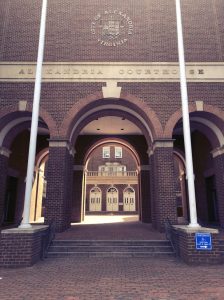
Circuit Court in Alexandria today (Library of Congress)

A reported for the Evening Star contacted defense attorney James E. Clements a week and a half later, asking him about the progress of Wright’s case. It was noted that the sheriff and Crandall Mackey had all but secured a guarantee for a December 14, 1906, hanging. Clements stressed he still had room for an appeal to Judge Nicol, and was in preparation to send the necessary papers to Richmond at the court of appeals of Virginia. He also said that he had not understood that “it was a part of the duty of a commonwealth’s attorney to personally assist in hanging a man he had prosecuted.” By then, the public in Alexandria County was well aware of the trial, asking if the swift verdict of a death penalty justified by the case’s shaky evidence? Why the haste?9 

Footnotes:

  1.  Alexandria Gazette, November 1, 1906. 
  2.  Alexandria Gazette, November 1, 1906. 
  3.  Evening Star, November 1, 1906. 
  4.  Evening Star, November 1, 1906. 
  5.  Evening Star, November 1, 1906.
  6.  Evening Star, November 2, 1906. 
  7.  Evening Star, November 2, 1906. 
  8.  Evening Star, November 2, 1906. 
  9.  Evening Star, November 14, 1906. 
Categories
Alexandria Arlington Podcast

The Washington Luna Park Assault Case (Part I)

This is the first of a three-part series on the an assault case that happened in the opening year of Washington Luna Park in 1906.

By Matthew T. Eng, Offbeat NOVA

Offbeat NOVA · (S1/E1) The Washington Luna Park Assault Case (Part I)

I love amusement parks. I love the smell of fried food, the ambient crescendo of screams heard on roller coasters, and the sounds of laughter amongst the tightly packed crowds. As a father, I try to give my daughter the same wonderful experiences I had as a kid in amusement parks. Some of my best memories were spent in places like Walt Disney World, Busch Gardens, Kings Dominion, and Six Flags.

When I found out that an amusement park once existed in the immediate D.C. metro area, I had to learn all about it. The initial reviews of Washington Luna Park were promising. 

I wanted to know everything about a location that once declared itself the “greatest amusement resort west of famous Coney Island, New York.”1 Just a ten-minute trolley ride south from Washington, D.C., the park’s creators chose an ideal place to attract citizens from the entire region to have fun in the summer sun. 

Unfortunately, pictures of Washington Luna Park are relatively scarce. I could only tell the story of the park through the newspaper reports. Thankfully, the Alexandria Gazette was a great place to start combing through the history of the park, from its opening day on May 28, 1906, to its demise nearly a decade later. 

What was Luna Park? 

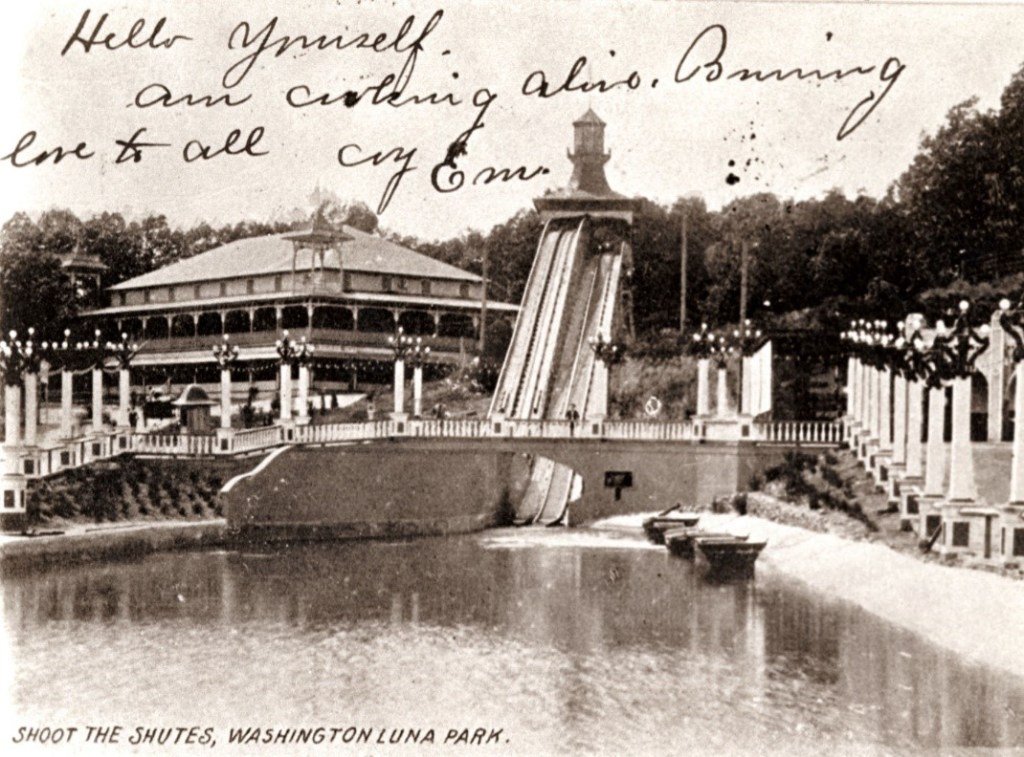
Washington Luna Park
Washington Luna Park (Arlington Historical Society)

The Washington Luna Park was one of many similar establishments built around the country at the turn of the century. The park was the brainchild of Frederick Ingersoll, a well-known jack-of-all-trades who excelled in business, building design, and invention. The Luna Park theme parks were a wildly popular and lucrative model for entertainment complexes around the United States. The best example that still survives today is Luna Park in Coney Island, New York City. 

The January 15, 1906, edition of the Alexandria Gazette included an article on a “Proposed Park” that would offer residents of Northern Virginia and Washington, D.C. a “new place of summer amusement, in the way of a magnificent park.” Washington Luna Park was built and designed by Ingersoll, fresh off the success at Luna Park in Cleveland. He envisioned a new 40-acre park located “midway between Washington and Alexandria, near the Four-Mile Run powerhouse.” The park was estimated to cost $300,000 and would include approximately 75,000 electric lights, still a novelty for the era.2 It was designed to serve as a “trolley park,” meaning the patch of land it rested on along the Four Mile Run crossing ran straight past the electric-powered Washington, Alexandria, and Mount Vernon Railway that skirted the old water route of the Georgetown-Alexandria canal. The short trip between Washington and Alexandria meant visitors had a high potential of stopping at Luna Park for a day or afternoon of diversion.3 

Alexandria Gazette, May 15, 1906

Opening day for the “Coney Island Near Washington” was set for May 28, 1906. The park offered scenic views of the river, daily concerts of big band music from a free outdoor hippodrome, a large outdoor picnic area for several thousand people, Japanese tea gardens, and saltwater taffy.4 No alcohol was permitted on the site. The lagoon in the park boasted 350,000 gallons of water. The biggest draw for the park were the rides. Although there were a total of thirty attractions throughout the trolley park, several stand out. The park had a figure-eight roller coaster, circus arena, and, most notably, a chute-the-shoots slide, a ride concept still in existence today at Kennywood in Pennsylvania.5 The ride had a 350-foot incline on it before it plunged into the large lagoon of water. Washington Luna Park was “a city in itself…equipped with the best gifts of nature.”6

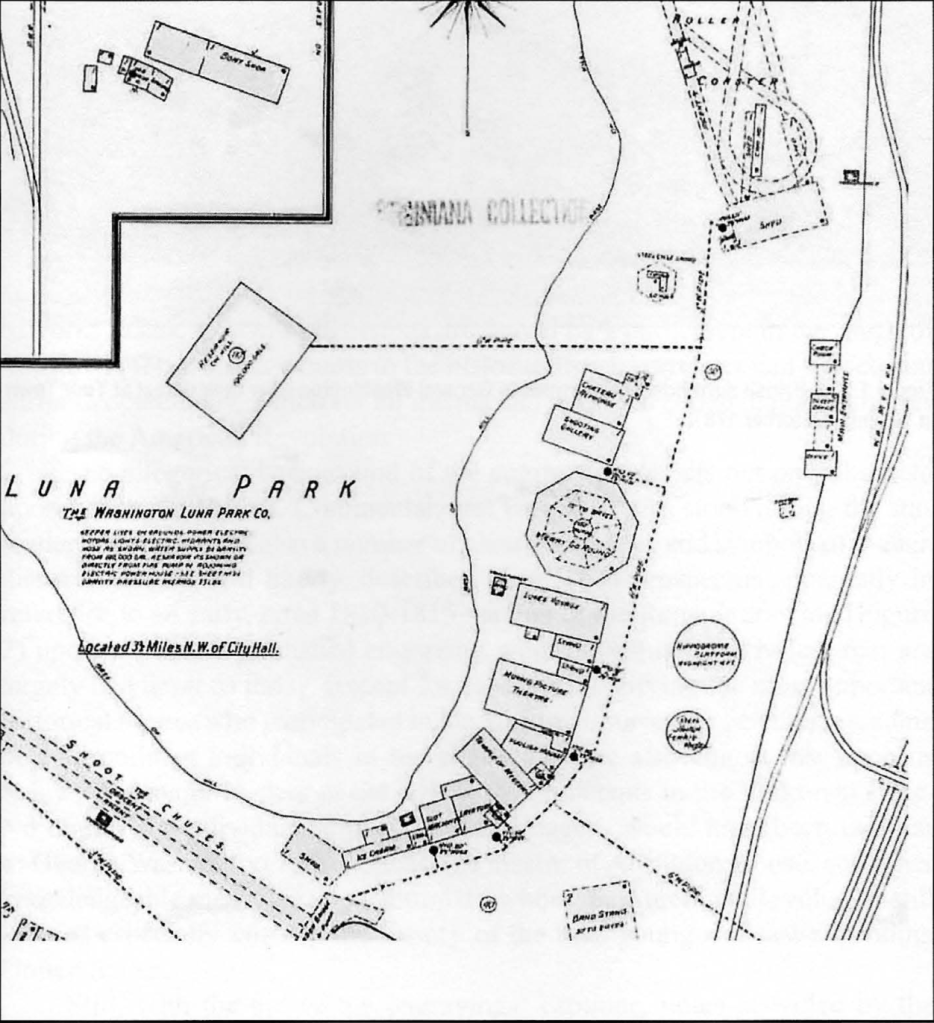
Washington Luna Park Map (Offbeat NOVA)
Map of Luna Park (Arlington Historical Society)

Attendance was steady in the opening weeks. The park organizers had high hopes after the first initial flurry of visitors at the end of May that it would be the most popular theme park of its kind in the country. Organizers continued to offer the same amusements each day, with several relatively popular “B and C list” acts to draw more paying customers into the park. The Norins high divers, a well-known family of death-defying performers, took twelve dives a day in the opening weeks. In June, famous aeronaut Roy Knabenshue made scheduled flights in and around Luna Park on a six-day stint from June 12th to the 18th. For two ascensions daily, he was paid $1,000. By the beginning of August, the park was well on its way to making its first season both successful and profitable.7 

THE EVENT

If you asked anybody who knows about the park’s limited history, they would most likely say the most sensational thing that happened in the inaugural year was the escape of elephants from the park in late August. Any mention of Washington Luna Park in papers or online articles mentioned the flight of four elephants (Tommy, Queenie, Annie, and Jennie) into Alexandria. The elephants “smashed a barn, decimated a cornfield, and trampled a graveyard” before being caught. All four elephants were rounded up a week later near Baileys Crossroads in what some call “The Pachyderm Panic of 1906.”

After reading through several articles in the Alexandria Gazette about the elephant escape in late August of 1906, I was satisfied with the direction a proposed segment on it would take. For posterity, I decided to press through and see all news and incidences before the end of the first season in September. That’s when I found out about the unfortunate story of John Wright and his alleged assault of a woman at Luna Park in September 1906. Although the incident occurred over one hundred years ago, it felt as if it was ripped from our headlines today.  

Less than two weeks after the drama of the elephant escape, a new challenge to the park’s reputation emerged on a pair of warm evenings in early September. On the night of September 6, 1906, two individuals were assaulted just outside of Luna Park’s grounds. Local D.C. resident Joseph Saddler accompanied Ms. Tassie Bywater from Rappahannock County to the park when they were both assaulted just after 10 pm that evening. According to the article on the “mysterious assault,” Saddler was shot in the neck and beaten outside the picnic grounds by an unknown assailant. The article stated that:

“There was intense excitement at the park when Saddler, with the blood spurting out of his wounds, rushed through the park gate, and in hand with Miss Bywater, whose clothes were literally covered with his blood.”9

Alexandria Gazette, September 7, 1906

The bullet penetrated into his body and lodged in his jaw. He also had visible wounds on his cheek and scalp. He later confessed that a black man came upon them while they were waiting for an Alexandria trolley car. The man began beating him on the head with a stone and fired the shot into his neck. According to Bywater, the blast was so close to them that the shot burned her, also splattering the wound’s blood all over her clothes. Although Saddler was confident in his own testimony, Ms. Bywater was unsure if “the man who did the shooting was white or black.”10

It was surmised in the news the following day that the assailant was “either a jealous lover of Miss Bywater or an angry relative,” not a black man. Just three days after the first assault reported at Luna Park, on September 9, 1906, another incident occurred nearby where the first took place between 8:30 pm and 9 pm. This time, however, the presumed aggressor would not remain unfounded. 

According to the news report in the Alexandria Gazette, Washington-area residents Mr. Forrest Gooding and Ms. Mabel Risley were the victims of a similar assault. The article stressed that the assailant was once again “a negro.” They were reportedly beaten and robbed of their jewelry and $16 nearby where Mr. Saddler was shot.11 

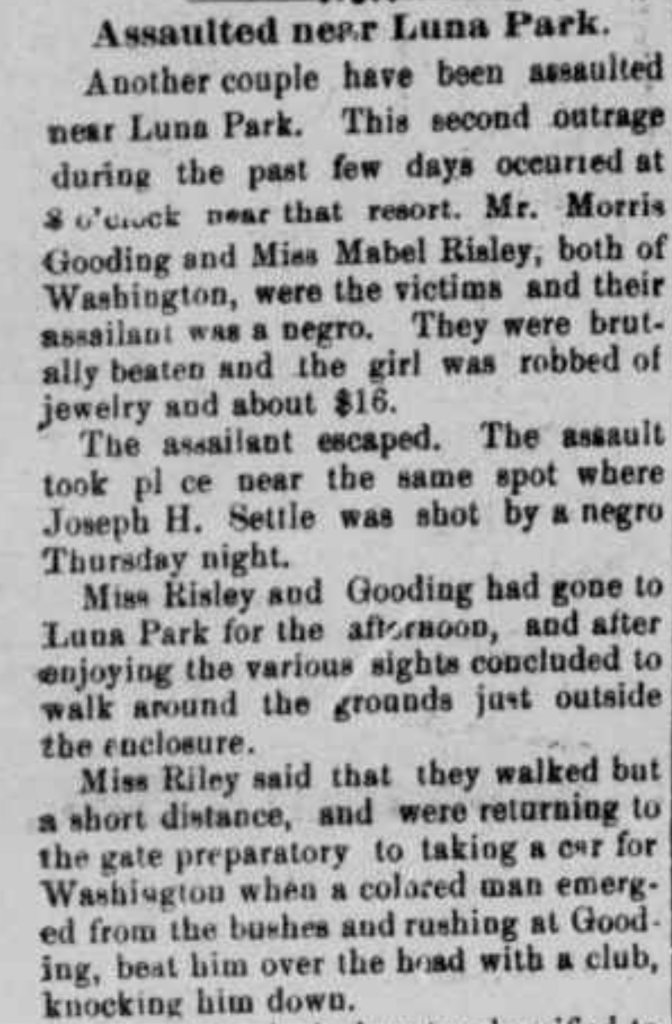
luna park assault 1906 (offbeat nova)
First mention of the assault (Alexandria Gazette, September 10, 1906)

Mr. Gooding and his companion took a stroll beyond the main gate that evening before deciding on a trolley car back to Washington. It was then that a “colored man emerged from the bushes,” and beat his head with a club. He then turned to Ms. Risley and demanded her jewelry and cash. She began to run when he pulled out a revolver and threatened to shoot her. He then grabbed her, “burying his fingers in her throat,” and “choked her until almost fainting.” Two gold rings, a pocketbook, and a watch were taken before the assailant ran off. Mr. Gooding did not witness any of the events involving his date and the assailant. Risley, who was “nineteen years old and attractive,” stayed in shock from the incident through the night. Both individuals were treated at a hospital for reported injuries.12 

Authorities at the park had a competing story about the incident. According to them, no pistol was discharged, and both individuals were approximately a quarter-mile away from the gate. It was only after they were confronted that Gooding ran towards the park to raise an alarm. One of Goodings’ ears were bleeding at the park, but nothing that would exactly deem as serious head trauma. The park stressed that they were not liable for any visitors who strayed outside the confines of the park itself.13

One newspaper, the Evening Star, included some proposed dialog between the “colored ruffian” and Gooding. When Gooding supposedly asked what the man wanted after he popped out from a cluster of bushes, he replied that he was going to kill him. He then proceeded to hit Gooding in the head near the ear with a two-foot-long club. Stunned, the assailant turned to Ms. Risley, who was told at gunpoint to give him her handbag or he would kill her. He then lunged for the bag, grabbed it, and left. There was no mention of forced trauma to the woman, despite saying so earlier in the same article.14

A black man was arrested the following day under suspicion of being the attacker. He was held in the county jail. The next day, the Luna Park managers offered up a one hundred dollar reward for the arrest of those responsible for the “murderous assaults” near the park. The police believed the person who assaulted Ms. Risley and Mr. Gooding on September 9th was the same person who attacked Tess Bywater and Joseph Settle. The assaults were committed in almost the same spot, three days apart. Although Ms. Risley denied Mr. Gooding fired a shot at the assailant, she was still in shock from her abrasions on her throat and arms. Despite her shock, she was positive she could describe the perpetrator as “a negro of medium height, wearing black clothing” and possessing a “slight mustache.” In the meantime, the individual who was arrested had yet to be interrogated.15 

The park closed for its inaugural season on September 22, 1906. Yet Luna Park stayed in the news for well over a year. The name of a verified suspect stayed out of the papers until October 8, 1906, when the Alexandria Gazette included a short article “On the Charge of Murder.” The African American individual’s name was Joseph Thomas, who also went by the alias of John Wright, found a week after the incident occurred in Washington, D.C. It was reported on the 8th that a requisition from Virginia Governor Claude Swanson for the removal of Wright to Alexandria county for a trial on charges related to the murder of another African American man, Jackson Boney. It was noted that Wright was also wanted on the charge of assaulting Risley and Gooding. At the time, Wright was being held in the Washington Jail. 

From there, things escalated quickly. What began as an assault case for Wright became a trial for his life within a few weeks.

Footnotes:

  1.  Alexandria Gazette, August 7, 1906. 
  2.  Alexandria Gazette, January 15, 1906. 
  3.  Marty Suydam, “From Trolley Park to Sewage Treatment: Luna Park,” Arlington Historical Magazine, May 2016. Accessed April 24, 2021, LINK.
  4.  Alexandria Gazette, May 16, 1906. 
  5.  Suydam, “From Trolley Park to Sewage Treatment.” 
  6.  Alexandria Gazette, December 30, 1905.
  7.  Alexandria Gazette, May 26, 1906; Alexandria Gazette, June 11, 1906. 
  8.  Alexandria Gazette, August 21-27, 1906. 
  9.  Alexandria Gazette, September 7, 1906. 
  10.  Alexandria Gazette, September 7, 1906. 
  11.  Alexandria Gazette, September 10, 1906. 
  12.  Alexandria Gazette, September 10, 1906; Evening Star, September 10, 1906.
  13.  Alexandria Gazette, September 10, 1906. 
  14.  Evening Star, September 10, 1906. 
  15.  Alexandria Gazette, September 11, 1906.