It is the middle of March. Today’s temperatures crept up to 74 degrees, and tomorrow’s will be similar. After a freezing and dreary winter filled with lots of rain, this warmup, albeit way in advance for my global warming consciousness, felt amazing.
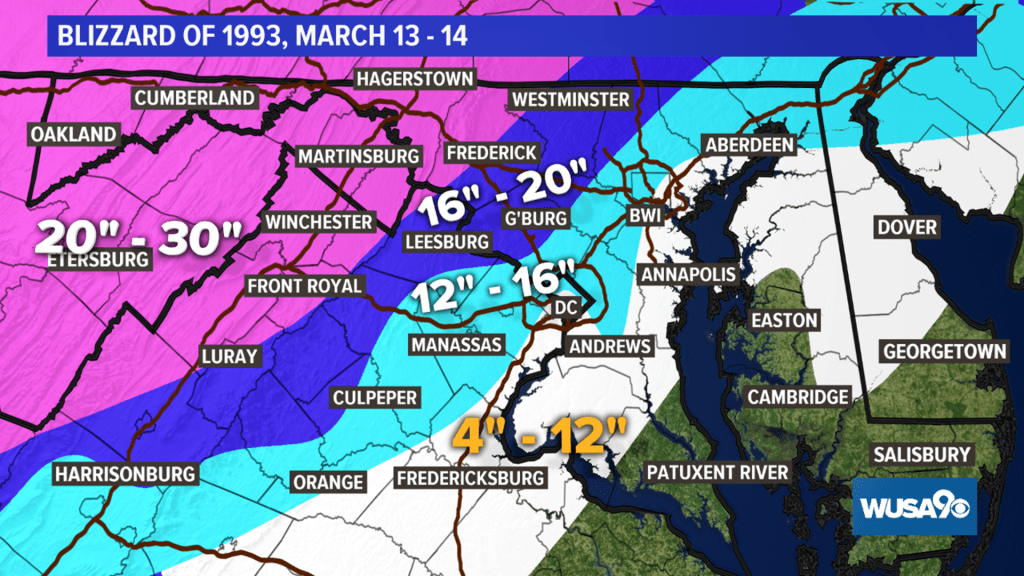
Twenty-one years ago, however, the weather in Northern Virginia was anything but warm. A massive system from Florida to Maine dropped a foot of snow in this region. The warm air and moisture from the Gulf region hit the cold air from western Canada with a shallow barometric pressure that yielded terrifying weather results. The storm caused 11 tornados in Florida and over 200 deaths after its hurricane-force winds finished ripping through the East Coast and Canada on March 14th. According to some news reports, snow drifts in Northern Virginia measured upwards of 12 feet in height. The storm left thousands of travelers and citizens without heat and electricity for days.
The Superstorm of March ’93, sometimes referred to as the “Storm of the Century” or snowicane,”did not have as significant an impact as many previous or more recent snow events in the region. The most recent event, the snowstorm of 2016, dumped over two feet of snow into the area. However, according to Accuweather, that snowstorm was not a Category 5 storm on the National Centers for Environmental Information (NCEI) scale. Accuweather’s article on the event said the 1993 blizzard was “one of the most devastating storms of the 20th century.”
Steve Marvill, a senior forecaster for Accuweather back in 1993, said in a Washington Post article that the event “had all the conditions for a powerful storm. It was as if there was a hurricane, but in the winter.”
It certainly felt like a hurricane to many who lived through it. At the Gov. Harry W. Nice Memorial Bridge near Dahlgren, VA, the wind speed topped out at 73 mph. When the dust (and snow) settled, the storm caused nearly $6 billion in damage in 1993 USD. That’s over double the $12.8 billion in today’s money. That’s enough to build four new stadiums for the Commanders. That gives them four chances to win a game, right?
If you are one of the many individuals who have since gone back into the office in the past year or months, you have undoubtedly forced yourself to talk about SOMETHING with your coworkers. Or if you are like me, you get Covid within three weeks of going back to work in a tight office stuffed to the gills with people coughing in their cubicles. Corporate cringe be damned, we are in it for the culture:
Of course, there are always the staples: the weather, the score of a sports game, and of course, the ubiquitous weekend plans. I always have the yardwork talk locked and loaded for such an occasion.
Lately, a lot of the water cooler talk (and we call it that only as a reference, because who the hell is still using a water cooler and talking near it in 2023) has been about the price of food. It’s the perfect conversation starter while you are waiting to heat up your sad, lukewarm leftovers. In recent months, going to the grocery store in Northern Virginia will net you about $50 a bag (and you better bring your own, too — we aren’t animals).
And let’s not even talk about Costco. I know some things there are necessary, but if I come out of there spending less than $300, I will chalk it up as a moral and financial victory. I need my Babybel cheese, damnit.
I was looking through some Northern Virginia history books I checked out from the library that completely blew my mind and put the current inflation going around the United States in perspective.
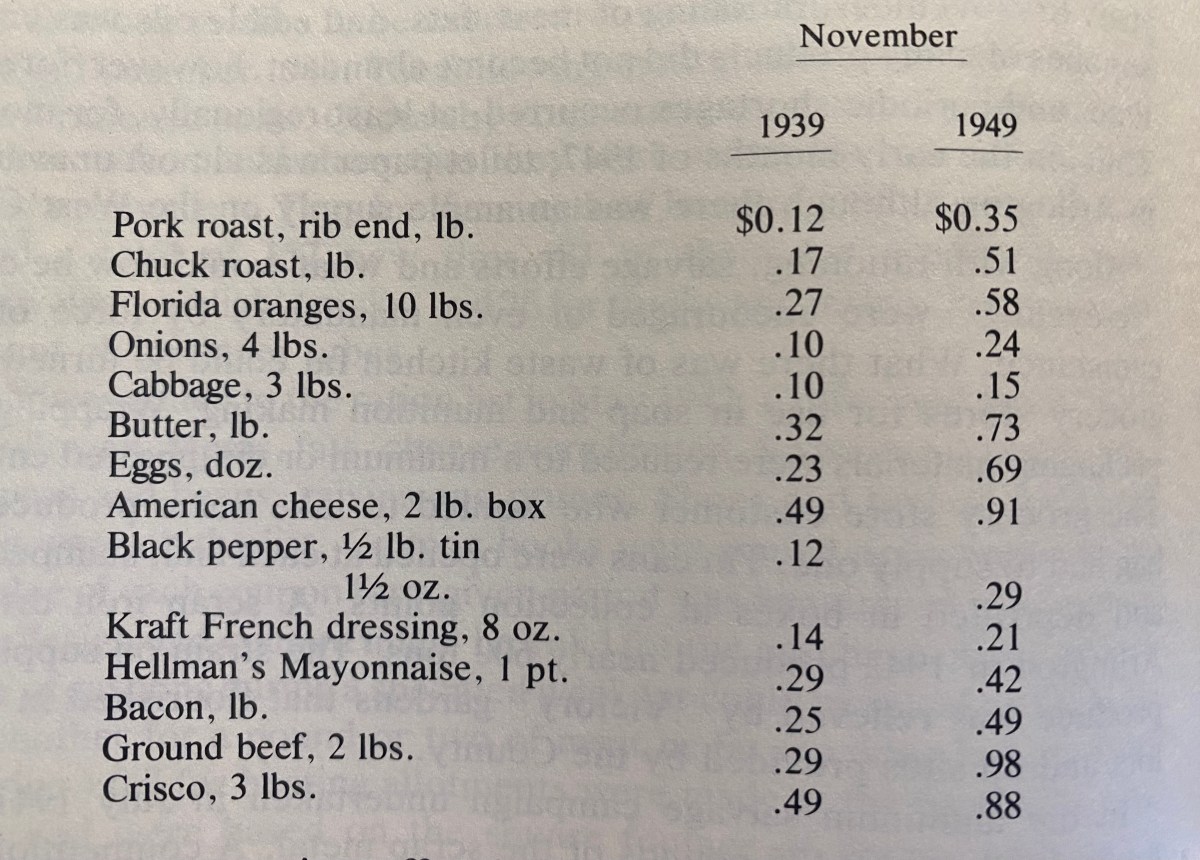
Towards the back of Arlington County, Virginia: A History, published by the Arlington Historical Society, is a chart comparing the price of common goods between 1939 and 1949 in the post-war years. While many well-known items were rationed during the war years like sugar, coffee, and meat, the hope was that prices would return to normal after V-J day. It was once patriotic to collect your used household fats. You know…for victory.
Illinois Digital Archives
The Office of Price Administration was established in 1942 as a safety net for price controls on these goods. For the most part, the Administration did its job, keeping inflation in check and prices reasonable. But as the book pointed out, “prices did rise during the decade, especially after controls were lifted.” The book included a chart from the Arlington Sun on comparative prices between 1939 and 1949. At first glance, the prices seem normal; cheap even. It’s only after you use the CPI Inflation Calculator from the U.S. Bureau of Labor that things get interesting.
If we use the calculator to adjust for inflation, the cost of some of these items would make the “egg crisis” of 2023 look like a doorbuster deal on Black Friday. Keep in mind, America was going through a recession that began in November 1948 that lasted until 1949.
Right now, the average consumer cost for a dozen eggs is $2.66. That cost, adjusted in 1939 has the same buying power as $5.00. Once prices rose after the restrictions were lifted, that same carton of eggs would cost you $8.74.
If you wanted to make a BLT sandwich, it’s going to set you back $6.21 for the bacon and $5.32 for the jar of mayonnaise. The bacon is shockingly the same as the 2023 average, which makes the 2023 inflation nearly consistent with that of 1949. As global markets continue to slide and talk of “recession” remains at the top of the news (unless you like Titanic and Russian coups), it’s always interesting to see how far the American dollar has stretched across time. At least when I make an egg salad sandwich this summer, I will have some perspective. I’ll make sure to have my “Ok, boomer” commentary locked and loaded at the office microwave because the high prices have always been something to complain about.
When I was growing up in Virginia Beach, I always heard tales of a friendly ghost at a local restaurant called Tandom’s Pine Tree Inn. The building had been around for decades—it was only natural that a ghost story go with it. Allegedly, the ghost liked to play tricks on staff. A friend’s mother, who waitressed there for time, told a story about plates being stacked one way, leaving the room, then returning to see them stacked another way. Another time, she said, she came in to open the restaurant one morning and all the chairs in the dining room were haphazardly strewn around, even though the person who had closed the night before swore they were neatly put away.
Eventually, that building was torn down to make way for progress (a Wawa, to be exact) and the stories of the friendly trickster ghost faded away. It made me wonder whether Northern Virginia had any tales of friendly ghosts—after all, cities like Alexandria had been around for much longer than Virginia Beach.
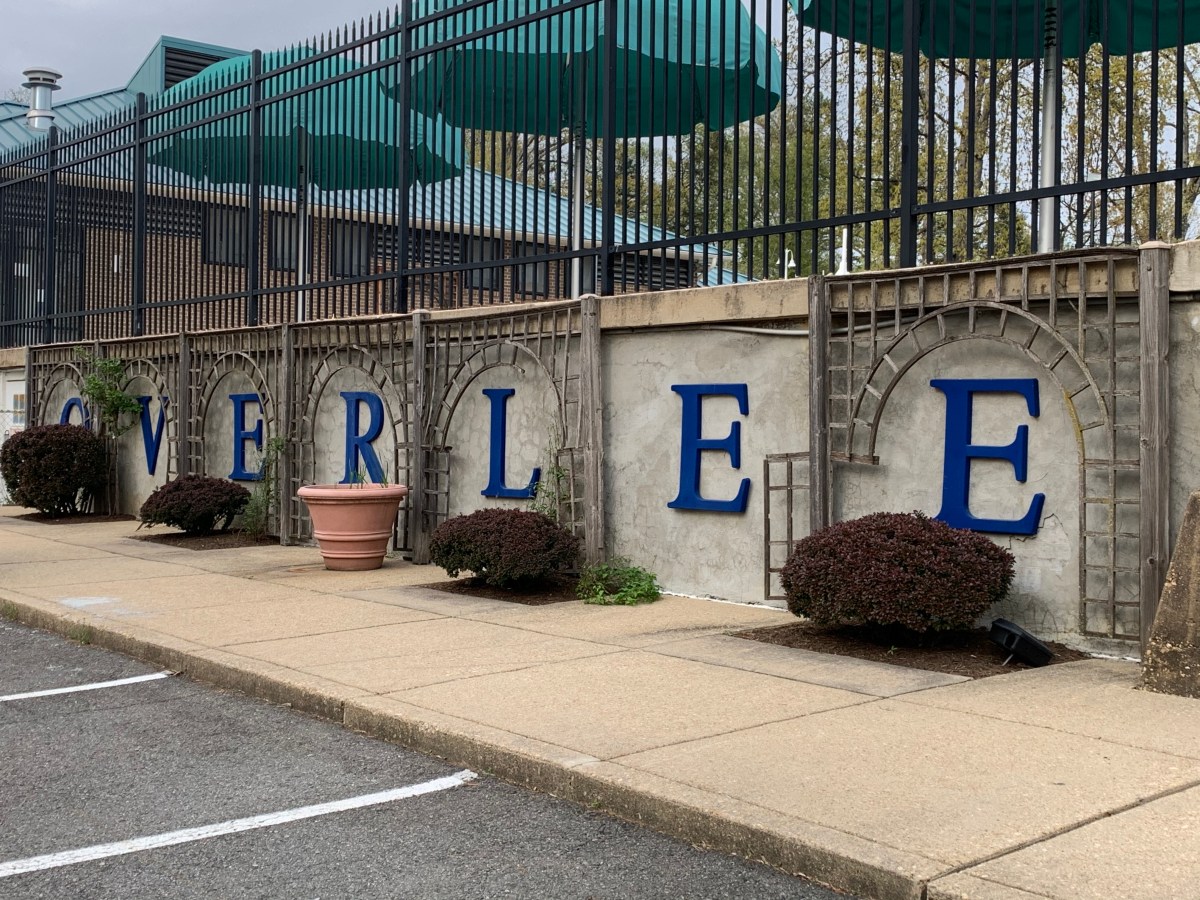
Imagine my surprise when I learned that the upscale Overlee Community Center and pool in Arlington was purported to have a friendly ghost hanging about.
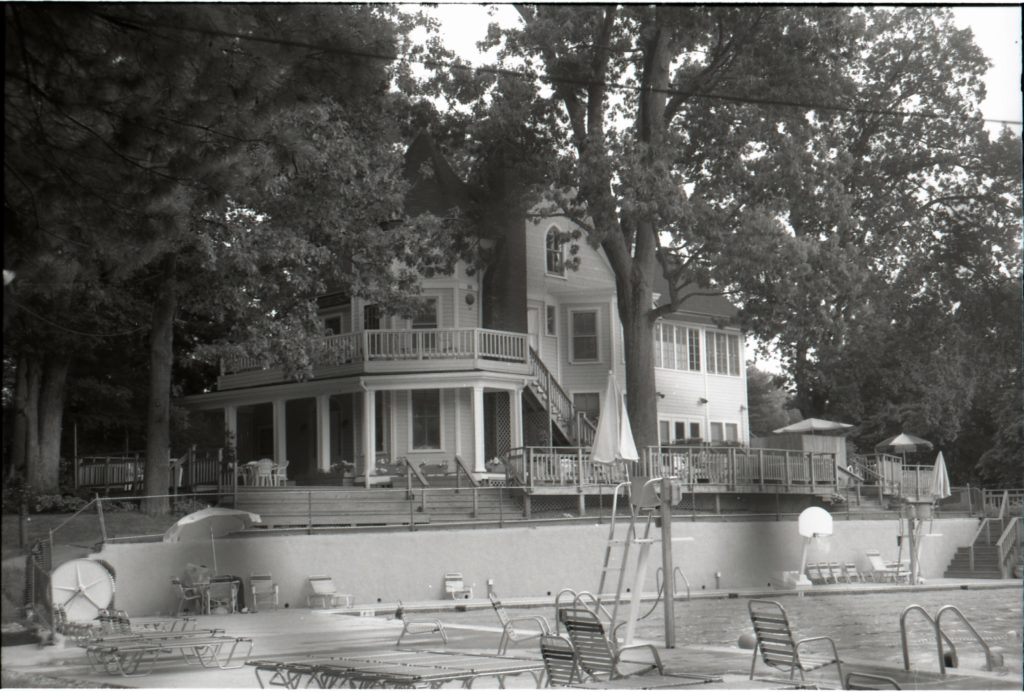
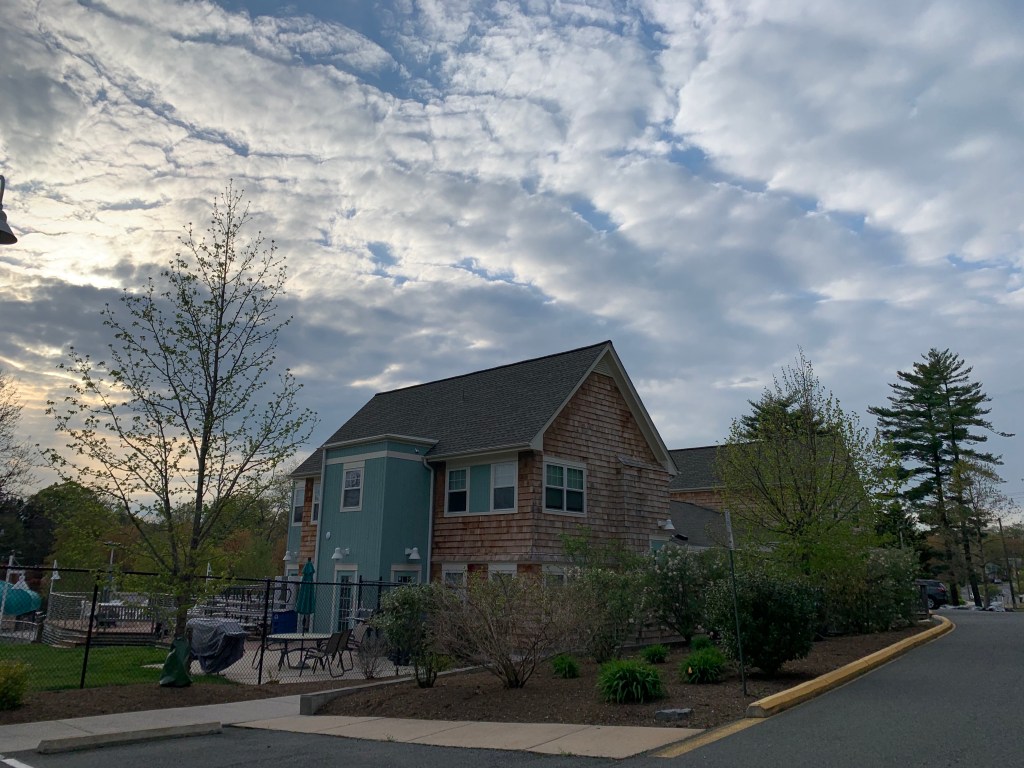
The Overlee (meaning “north of Lee Highway”)1 Community Center is a private club that was founded in 1957. It has multiple pools, park land, sports areas, and a clubhouse. The clubhouse is the item of interest in all the stories I read—though it is not the clubhouse that is standing today. The former clubhouse was a historic home, known as the Febrey-Kincheloe house, that served as the clubhouse for the association until 2012, when the pool members voted 55 to 4 to renovate the complex.2 Part of the renovations included tearing down the historic home and building a new clubhouse.
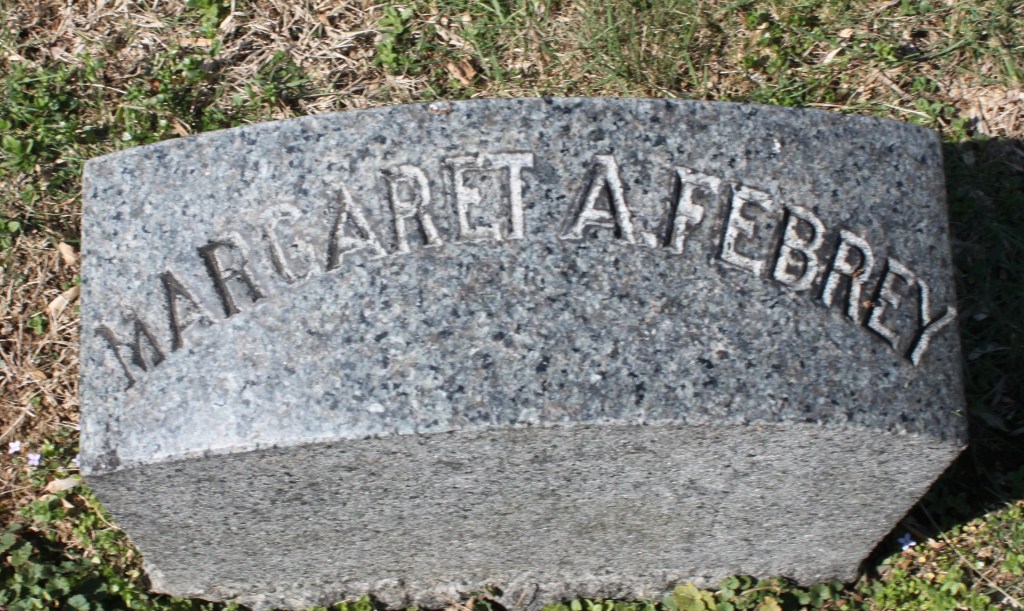
The Febrey family was the first to own the historic home. The Febreys bought a 176-acre tract of land in 1849; in 1890 Ernest Febrey built a three-bedroom home that overlooked an apple orchard and creek.3 Shortly after he built the home, his wife gave birth to a little girl, Margaret. Margaret, unfortunately, passed away on January 15, 1913, at the age of 14. She had Pott’s disease, a rare infection of the spine.4 Supposedly the family no longer used the home after Margaret died. She is buried in Oakwood Cemetery, not far from the site of her home, with her mother and infant brother.
Margaret A. Febrey Tombstone in Oakwood Cemetery, Falls Church (FindAGrave)
In 1947, a lady named Florence Kincheloe bought the property. She converted the home into what was known as the Crestwood Sanitarium, a home for retired Washington dignitaries.5 Little details exist about the Crestwood, though a publication from the Arlington Historical Society notes that “it was a burden to manage [the sanitarium] and that the population in the area was too young to need a nursing home,” so she sold the property in 1957.6 Soon after, it became the Overlee Community Center.
Febrey-Kincheloe House, 1997 (Arlington Library)
Over time, the creek and the orchard disappeared, but the house remained. However, it seems that more than just the house stuck around.
A former swim coach that lived in the Febrey-Kincheloe house in the late 70’s and early 80’s reported hearing weird noises (but never seeing anything) that reminded him of the ballroom dancing scene in Disneyland’s Haunted Mansion.7 One of the Overlee Board members mentioned “other ghost stories” that included “music and strange noises and things . . . most people believe it’s from the time it was a sanitarium.”8
Sounds like something straight out of a Stephen King novel, if you ask me.
However, there is another well-known ghost that is said to haunt the property.
Multiple people have reported seeing the ghost of a young girl wandering the grounds. Described as chatty and friendly, she was said to enjoy playing with other children at the pool.9 When the property was renovated and the original Febrey home torn down, construction workers reported seeing a girl in Victorian clothing climbing through the construction debris and walking around the site.10 Others reported talking to a young girl in “strange clothing” that they later identified as Margaret.11 One former manager recounted odd happenings, such as a lifeguard chair swiveling on its own, the sound of rocks being thrown into construction equipment, or the shuffling of feet in a breezeway.12One construction worker even quit after he sighted her in the house. He went in to find her, came out, then saw her on the steps. He turned away for a moment, and she was gone. A coworker said that the worker who sighted the girl immediately packed his stuff and left the site.13
The Overlee Community Center Clubhouse, site of the former home (Offbeat NOVA)
No one reported any malice or frightful happenings, just small, slight occurrences that suggested there was more at work than just an active imagination. Even so, there have been few sightings of Margaret since 2012. An article from Arlington Connection, dated 2013, asks, “Where are you, Margaret?”14 and recounts one story of a sighting.
Overlee Community Pool (Offbeat NOVA)
The friendly ghost of my childhood, the Pine Tree Inn ghost, disappeared after the building was razed. The stories and occurrences stopped the second the building came down (though I’d love to know if anyone’s ever encountered something weird at the WaWa). Like the Pine Tree Inn ghost, the ghost of Margaret Febrey seems to have disappeared with the destruction of her home.
The board members didn’t take any chances when the house was demolished, though. They left flowers and a note that said, “Dear Margaret, we are building you a new house. Please come visit any time.”15
And maybe, she will.
But I wouldn’t hold my breath.
Footnotes:
Zak, Dan. “Haunting at Overlee pool in Arlington shows past is still part of community’s future,” The Washington Post, June 13, 2012. Accessed April 24, 2021, LINK.
Zak, “Haunting at Overlee.”
Ibid.
Ibid.
n.a. “The Spirits at Overlee,” Rediscover Haunted Arlington. October 28, 2019. Accessed April 24, 2021. LINK.
Vogel, Sophie. “Growth of a Suburban Village: Fostoria, Overlee Knolls & Westover, 1730-1998,” Arlington Historical Society Magazine. October 1998. Accessed April 24, 2021. LINK.
Zak, “Haunting at Overlee.”
Pyzyk, Katie. “Workers Report ghost Sightings at Overlee.” ARLnow. March 16, 2012. Accessed April 24, 2021. LINK.
Zak, “Haunting at Overlee.”
n.a.“Spirits at Overlee.”
Ibid.
Zak, “Haunting at Overlee.”
“Arlington ghost: construction worker quits after Margaret Febrey sighting.” YouTube video. November 9, 2012. Accessed April 24, 2012. LINK.
McMorrow, Michael. “Where Are You, Margaret? TheArlington Connection. Connection Newspapers. September 11, 2013. Accessed April 24, 2021. LINK.
This is the last of a three-part series on the an assault case that happened in the opening year of Washington Luna Park in 1906. Read the first article HERE. Read the second article HERE.
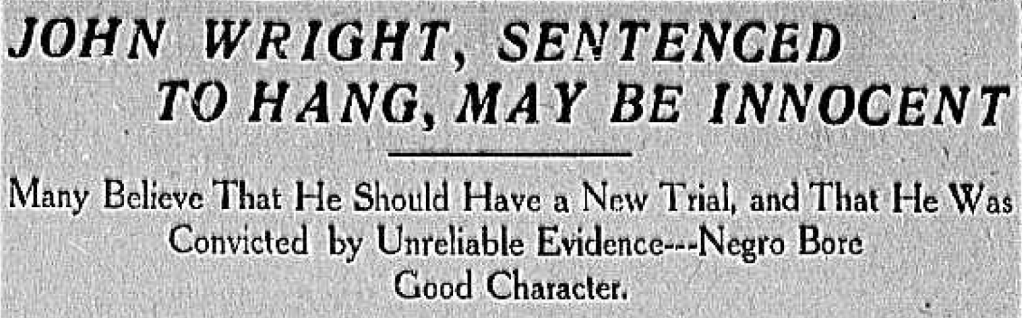
The facts continued to repeat in the newspapers. Ms. Gooding failed to identify the prisoner when she first saw him in the lineup. This was corroborated by four officers who saw her pick another man. The man she identified had been in jail since January of that year. She was also the only person to testify of the assault because Forrest Gooding had run away to the park gate for help. She also claimed to have throat bruises, but no physician was ever called to testify to that condition, and she appeared otherwise normal, if not a bit frazzled.1
“Do these facts seem to justify an impartial, unbiased mind in reaching a conclusion of guilt and fixing the punishment at death? Was not the alibi proved by a preponderance of testimony, or was it not certainly sufficient to raise in the minds of the jury a reasonable doubt of the prisoner’s guilt, and was not the failure to identify at once, at first sight, a fatal obstacle to the prosecution’s case?”2
Evening Star, November 14, 1906.
Clements fully believed in the man’s innocence. He wasn’t the only one. With the appeal put in place, the only thing to do was wait.
The answer came in the second week of December, just one week before Wright was sentenced to hang on the following Friday. On December 11, 1906, James Clements received a writ of error from the Virginia Supreme Court of Appeals. That in the least postponed the hanging from happening the following week. The writ claimed that new evidence had been found and that the verdict was circumstantial and largely due to public clamor than actual evidence. The case went under review once again because of Ms. Gooding’s inability to recognize the individual at first and Wright’s strong alibi on the night of the alleged incident. The liveryman’s testimony that Wright returned to the stable around the same time of the incident made it very difficult to connect the two. Wright was hopeful he would get a new trial.3
The case was argued before the higher court on January 10th of the following year, with no decision made after the first week in February. Throughout this, Wright continued to proclaim his innocence. A decision was finally made by the Court of Appeals in Richmond in mid-March, which affirmed the decision of the lower court on a decision of three to two.4
Richmond Times-Dispatch, March 22, 1907
The next day, the Richmond Times-Dispatch ran with the headline “Court Divided, But Wright Must Hang.” The verdict could not be reversed in a case like this unless it was found that new evidence was insufficient to warrant the finding of the jury. The decision also stated that no new trial would be granted. The article ended with a haunting and foreboding warning for trials of its kind to come in the future:
“It is further stated that the guilt of the accused is purely a question of fact, and that if the witnesses for the Commonwealth were worthy of credence, of which the jurors were the exclusive judges, there can be no question that the verdict is neither contrary to the evidence nor without evidence to support it.”5
Richmond Times-Dispatch, March 15, 1907
John Wright was a dead man walking. Wright was sentenced to hang on May 31, 1906.
Interest in the case continued to grip the local community. Clements continued to fight for Wright. He went to work and prepared another petition to the court of appeals for a rehearing. More revelations came out regarding the other crime Wright was accused of, the murder of Jackson Boney. According to one report, a woman named Anna Green, a woman of “debased character,” accused Wright of murdering Boney when she herself was with Boney on the night in question near the Long Bridge that connected Virginia to the district. The details she offered authorities was “beyond belief,” and put Wright nowhere near either incident. Her testimony would have undoubtedly spread doubt to Wright’s conviction. Yet these facts and information were summarily dismissed from appearing at the case.6
In the midst of these appeals, it was reported in the Alexandria Gazette that Forrest W. Gooding had gone missing on April 26, 1907. Mrs. Gooding noted in the article that Gooding had been in a nervous condition since the conviction of Wright and that Black individuals in the neighborhood had “threatened to kill him.” No mention in the news was ever made of his reappearance.7
A small community movement began towards the end of May 1907 to present Virginia Governor Claude A. Swanson with a request to overturn the execution by hanging. Governor Swanson put another stay in the execution until August 30th so he could fully absorb all details of the case. It was decided by Governor Swanson on that date that he would commute the sentence, and instead give Wright a life sentence in prison. With all the facts laid before him, Swanson had in his official statement “a serious doubt as to the identity and guilt of the prisoner.”8
Wrongfully accused or not, Wright escaped the gallows but was resigned to live his life as a prisoner, not a free man, for a crime he undoubtedly did not commit.
THE END
The park continued to run for nearly another decade before it met its untimely end in 1915. On April 9, 1915, a fire destroyed the roller coaster. According to the Washington Post, “the origin of the fire is thought to have been from sparks from a blaze in the woods adjoining the park.” The closest fire stations were in Washington and Alexandria, so the park’s premier attraction was a total loss, even if very little else was taken by the flames. Regardless of this fact, the park was closed and dismantled later that year.9
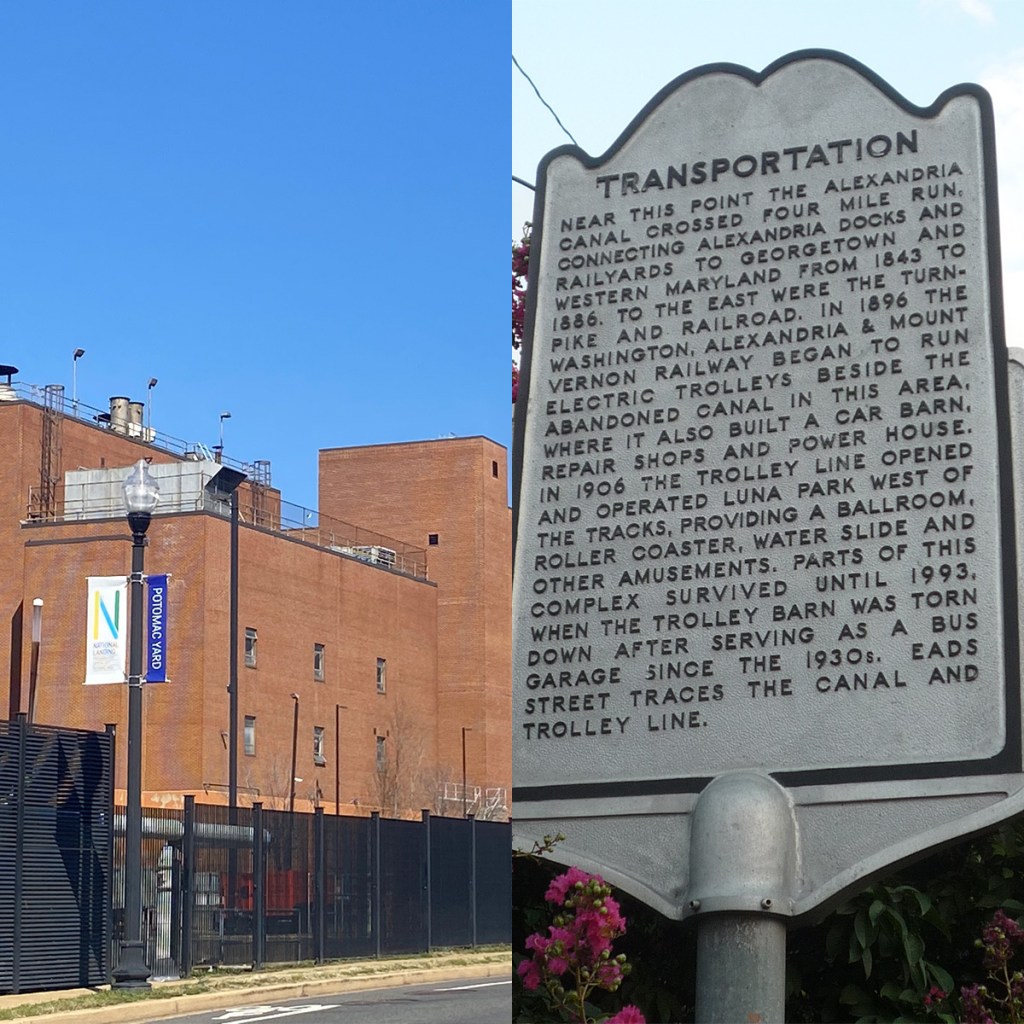
The site of Luna Park today is the Arlington County sewage treatment facility. Nearby on the corner of Glebe and South Eads is an unassuming transportation marker hidden in a tree. (Matthew Eng/Offbeat NOVA)
Today, the land on the corner of Glebe Road and South Eads St. near Four-Mile Run is occupied by the Arlington County sewage treatment facility. No evidence of the park exists. Only a small transportation marker for the Washington, Alexandria, & Mt. Vernon Railway exists behind a gate and an overgrown tree. I couldn’t help but think how close I was standing to the incident with John Wright and Mable Risley on a warm evening in the later summer of 1906.
I wanted to come out of my research on this once beautiful park with sanguine thoughts and waves of nostalgia. Instead, I have very mixed emotions about the park’s legacy. In the wake of the racially motivated violence we have witnessed in recent memory, I take pause and think about how many of these incidences have occurred in American history. Too many.
How many like John Wright were lucky enough to narrowly avoid the gallows? How many more were lynched without the benefit of a trial? There are multiple examples in the area when mob mentality won out at the turn of the century. It’s sobering to think how little some things have changed over the course of one hundred years. With so much progress, society continually lags in the pack. All you have to do is read the news. It would be at least comforting to say incidents like that of Mr. Wright were unprecedented. But the world sadly does not work that way. Not then. Not now.
Forest S. Gooding Death Notice (Ancestry)
I don’t know what happened to John Wright at this moment in time. There are prison records in Richmond, but that will take time to find out at this time. Life was easy for the Goodings, however. Census records show that the couple settled in Wheaton, Maryland, in Montgomery County, shortly after the yearlong trial and commutation process ended for Wright. By 1910, the two had two children, including a newborn son named James. When the 1920 census was collected, the Gooding’s had four children. Forest Gooding died on September 23, 1929. Mabel remained a caretaker beyond her husband’s passing, dying in 1976.
But what happened to John Wright?
Should I look up Joseph Thomas or his more common alias, John Wright? These are questions I will ask myself self in the future when it’s safe to venture out and research more intimately. Rest assured, I want to bring some sort of closure to this story. I think John would want that — a slice of freedom he was never given. His story, like those both known and unknown by the public today, matters. His life matters. Especially since the only life he got was one attached to a sentence from a broken system.
Footnotes:
Evening Star, November 14, 1906.
Evening Star, November 14, 1906.
Richmond Times-Dispatch, December 12, 1906.
Alexandria Gazette and Virginia Advertiser, March 14, 1906.
Richmond Times-Dispatch, March 15, 1907.
Richmond Times-Dispatch, March 22, 1907.
Alexandria Gazette, April 27, 1907.
Virginia Citizen, August 30, 1907.
“Luna Park – 1915,” Arlington Fire Journal & Metro D.C. Fire History, June 24, 2009. Accessed April 24, 2021, LINK.
It’s hard to think of Arlington, Virginia, as a hotbed for hate. Living near it has a remarkably price tag. According to one website, Arlington ranks as the eighth-most expensive city in the United States, with the 2020 cost of living sitting at 53% above the national average.1 As you drive through its premiere neighborhoods like Bluemont, Clarendon, and Ballston, you realize why it’s one of the most desirable locations to live in not only Northern Virginia, but the entire country. It is only a stone’s throw from DC, the houses are beautiful, and the landscaping is perfect. Where there are no houses, there are meticulously built high-rises and lush public spaces. As they say, location is everything.
But Arlington has not always been beautiful and perfect. It was know for darker things . . . other things that lived quietly inside its utopian ecosystem like a virus entering a new host.
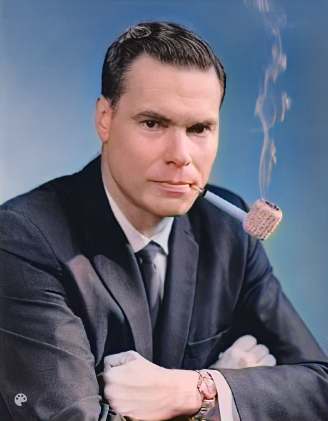
George Lincoln Rockwell (Wikimedia Commons)
Arlington was the former epicenter of the Neo-Nazi/white power movement in the United States for over two decades beginning in the early 1960s. Less than two decades after the end of the Second World War, Washington’s premiere suburb became an enclave for a reincarnation of Nazi Germany’s beliefs when George Lincoln Rockwell came into town. For seven years, Rockwell ran the American Nazi Party from his headquarters on 928 N. Randolph Street in the busy Ballston neighborhood of Arlington. He also ran a barracks for his “storm troopers” at the top of the hill in a mansion farm house called “Hatemonger Hill” by local residents.
It was from there that he drove the short distance to the Dominion Hills Shopping Center to visit the EconoWash laundromat on August 25, 1967. As Rockwell sat in his car, a disgruntled former party member fatally shot him from the roof of the building. Rockwell’s death marked a critical halt in his march towards white racialism at a time when the Civil Rights movement had reached its strongest point. It also stands as a bleak reminder of the resurgence of hatred into modern life today.2
George Lincoln Rockwell was born in Bloomington, Illinois, in 1918. He lived a privileged childhood, and was talented in many subjects. While studying philosophy at Brown University, Rockwell dropped out of school to accept a commission as an officer in the United States Navy in 1938, just three years removed from the United States’ entry into the conflict. He served as a naval aviator during the Second World War, operating in both the Atlantic and Pacific Theaters. As a lieutenant commander living in San Diego with his family during the Korean War, he became acquainted with Adolf Hitler and Nazism. He also applauded American figures like anti-Communist stalwart Senator Joseph McCarthy and General Douglas MacArthur. It was from the latter that he adopted his signature corncob pipe, an accessory he held onto until the day he died.
Later, he divorced his wife and married another woman with similar interests and sympathies of his own. By 1955, he was back stateside in Washington, D.C., publishing a periodical called U.S. Lady, a magazine made for U.S. service member’s wives that doubled as his mouthpiece for his racist ideologies. His racist attitudes and words grew more vocal and more popular in the latter half of the decade, gaining a following in and around his new home in Arlington County, Virginia. He gathered his thoughts for a new vision of racial purity. He called it the American Nazi Party. By the end of the decade, he had his first headquarters in Arlington inside a brick rambler at 6512 Williamsburg Boulevard. As author Charles S. Clark noted in his exposé on Rockwell, “through the window, neighbors could see his lit-up swastika on a red flag.” The home is now a private residence estimated in value at $758,000.3
ANP Headquarters on 928 N. Randolph Street, now high-rise luxury apartments (lindseybestebreurtje/Google Street View)
In 1960, Rockwell’s American Nazi Party moved to a new location at 928 N. Randolph Street, today the site of high-rise apartments. In front of the near-derelict building was a large sign that everyone could read from the road: “White Man…Fight! Smash the Black Revolution Now.” His numbers of followers continued to grow into the early 1960s. He eventually set-up a “stormtrooper barracks” inside a large hilltop farmhouse two miles away from his headquarters at 6150 Wilson Boulevard. Local residents came to call the location “Hatemonger Hill.”4
The American Nazi Party (ANP) spewed their racist vitriol inside the beltway and beyond. Rockwell used the party as a platform for advocating deporting Black Americans back to Africa, sterilizing Jews, and executing race traitors like President Eisenhower and Chief Justice Earl Warren. Famously, Rockwell and several of his followers drove a swastika-clad Volkswagen van from Arlington to New Orleans to protest the “Freedom Rides” like some low-rent, racist pilgrimage to Bonnaroo.5
Despite their media attention, the ANP was small. One estimate had them numbering only thirty “hardcore followers” and just over three hundred total during the Rockwell era. One of those followers was John Patler, a former United States Marine who was honorably discharged after being arrested at an ANP rally. Born John C. Patsalos, he changed his last name to Patler to sound phonetically like “Hitler.” He joined the party officially in 1960 and served as the editor and cartoonist for the organization’s magazine, Stormtrooper. He was expelled from the group in 1967 for harboring “Bolshevik leanings” after a disagreement with Rockwell over policy. Although Patler claimed he loved Rockwell “like a father,” and he to him “like a son,” Patler grew unwilling to see a world where the two were separated. Rockwell sullied on, spending most of his time atop Hatemonger Hill. Patler festered until the anger, frustration, and disappointment reached a boiling point in the summer of 1967.6
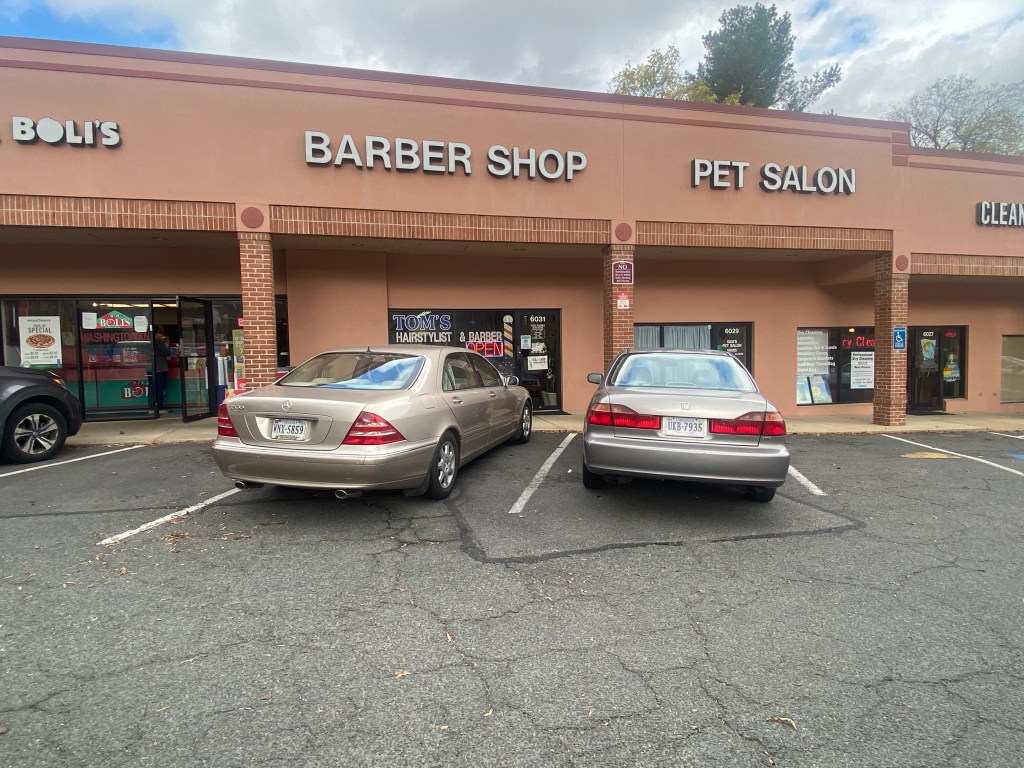
Dominion Hills Shopping Center Today. The silver sedan in the distance is where Rockwell was killed. (Matthew Eng Photo)
Around noon on Friday, August 25, 1967, Rockwell went down the hill with his laundry to visit the EconoWash, one of the many establishments in a small strip mall called the Dominion Hills Shopping Center. He was dressed in a white shirt and dark slacks. Parking his 1958 Chevrolet in front of a barber shop owned by Tom Blakeney, the two waved at one another before Rockwell exited his car and entered the laundromat. He appeared moments later, having forgotten his bleach. As he returned to his car, as Tom Blakeney remembers, he heard two shots ring out. “I thought a car had backfired,” he said. He continued:
“I saw Rockwell kind of jumping around in the front seat, and I thought he was having a seizure. I saw him point at the roof and then slump over the steering wheel.”7
Tom Blakeny, Tom’s Barber Shop Owner
Two shots traveled through the windshield. One landed into Rockwell’s heart and the other ricocheted off the seat and into the roof of the vehicle. His car knocked into another nearby vehicle. According to Charles S. Clark, Rockwell “fell and landed face-up in the parking lot, splayed beside his box of Ivory Snow and a copy of the New York Daily News.” The leader of the ANP was gone. A coroner later pronounced him dead at the scene.8
Where Rockwell died (Matthew Eng Photo/Offbeat NOVA)
Rockwell’s final gesture was for a very good reason. He was pointing at his killer, John Patler. Patler had used the vantage point from the top of the roof of the Dominion Hills Shopping Center to aim down and shoot Rockwell. Patler was a former Marine, who are as a rule expert in their marksmanship. Arlington police arrested the 29-year-old half an hour later on Washington Boulevard. A discarded raincoat and cap believed to be Patler’s was found in a nearby yard, and a German Mauser Semiautomatic pistol was recovered in the water along nearby Four Mile Run below a footbridge. He was convicted of first-degree murder in December 1967, and sentenced to twenty years in prison. He was later paroled in 1975, serving less than half of his original sentence. As for Rockwell, he was given a military burial at Culpepper National Cemetery. Although the agreement for his military burial stipulated that there be no Nazi insignias to be displayed during his burial, his followers violated these conditions. He was secretly cremated the next day.9
Today, very little evidence of the assassination exists. There are no historical markings, only businesses that have come and gone since 1967. The facade of the entire complex has changed. The one business that still exists is the barber shop, now called Tom’s Hairstylist & Barber. As of 2010, Tom Blakeney, the original owner, was still alive, retired and living in Fredericksburg, Virginia. Looking through several pictures for references, we were able to pinpoint the exact spot that Rockwell died in August 1967. Neo-Nazi sympathizers have come to the strip mall’s parking lot for years to pay homage to Rockwell.
Hatemonger Hill is now a picnic area in Upton Hill Regional Park (Renegade Tribune/Parks Rx)
Hatemonger Hill, less than a mile away, is now a picnic pavilion where families eat in between trips to the batting cages, mini-golf courses, and swimming pool. The land was demolished and annexed to Upton Hill Regional Park in 1973, as the party members soon lost their lease after Rockwell’s death.10
Unfortunately, Rockwell’s death would not the end of the city’s relationship with hate and division.
As recently as 2016, Arlington resurfaced again as a nucleus for hate when WTOP reported that alt-right talking head/inauguration punching bag Richard Spencer and the National Policy Institute, a white supremacist think tank, was based in town before moving to neighboring Old Town Alexandria a few years later.11 Charlottesville may be a few hours’ drive from Arlington, but I do not believe what transpired there was lost on residents who lived through the tumultuous years of the ANP in their city.
On August 25, 2017, a small group of Nazis showed up to the very spot where Rockwell was killed. Dressed in white shirts, black slacks, and black ties, they paid their respects to the former American Nazi Party leader. A guest at the nearby barber shop took a photo of the six individuals giving the requisite “sieg heil” salute, with one holding a large Nazi flag in the middle. The bottom of the flag touches the asphalt and the darkened motor oil stains left there over the years…well maintained machines slowly oozing out their excess and leaving an indelible mark for future generations. I can think of no better metaphor for the arrogance of the individuals in the photograph. As one Twitter user responded to the photograph with, “I count 6 losers & a flag.”
Six losers and a flag (NBC4/Aki Peritz Twitter)
I understand that journalistic integrity is built on a foundation of objectivity. That is clearly out of the window for this article. It was painful enough to expose the old wounds of such a great city once again, so close to a time when we are all near-broken and politically fragile. So if you are upset with the bias in this article because Offbeat NOVA is taking a political stance against the creeping Kudzu of fascism in the United States, we only have a few words to say. Like Rockwell, there will come a time when the hate will end, either by their own hand or the genuine good of others.
Today is election day, when the very soul of the nation is at stake. Whether you like it or not, this year is a mirror to Charlottesville in 2017. Arlington in the 1960s. Nuremberg in 1938. But like those other events, those involved will fail. Why? Because in the good words of Woody Guthrie, all you fascists are bound to lose.
Footnotes:
Kat Tretina, “10 Most Expensive Cities to Live in for 2020,” Education Loan Finance. Accessed November 1, 2020, LINK.
United Press International (UPI), “Rockwell, U.S. Nazi party leader, slain,” United Press International, August 25, 1967. Accessed November 2, 2020, LINK.
Charles S. Clark,”Close-Up Of An American Nazi,” Northern Virginia Magazine, November 28, 2010. Accessed November 2, 2020, LINK.
Clark, “Close-Up;” Mark Jones, “Nazis in Arlington: George Rockwell and the ANP,” WETA Boundary Stones, January 2, 2013. Accessed November 2, 2020, LINK.
Jones, “Nazis in Arlington.”
Frederick James Simonelli. American Fuehrer: George Lincoln Rockwell and the American Nazi Party. Champagne: University of Illinois Press, 1999.
Charles S. Clark, “Death of an Arlington Nazi,” Northern Virginia Magazine, December 30, 2010. Accessed November 2, 2020, LINK.
Clark, “Death of An Arlington Nazi;” UPI, “Slain.”
Michel E. Miller, “The shadow of assassinated American Nazi commander hangs over Charlottesville,” The Washington Post, August 21, 2017. Accessed November 2, 2020, LINK.
Mark Jones, Nazis in Arlington.”
Dick Uliano, “White nationalist, alt-right group calls Arlington home,” WTOP News, November 22, 2016. Accessed November 1, 2020, LINK.
I love everything about spies and spy movies. I love the cool gadgets, fast cars, faster women, and scarred villains that stand between our heroes and world destruction.
Of course, every well-known popular culture spy is attractive, physically perfect, and has infinite money, skills, and abilities. We think of the Adonis-like figure of Daniel Craig stepping out of the water in Casino Royale, Jason Bourne throat-chopping Russian operatives, and Ethan Hunt blowing up a helicopter with bubble gum at the end of Mission Impossible.
Of course, that’s popular culture’s version of a spy. In reality, they look like Robert Hanssen, John Anthony Walker, Jonathan Pollard, Harold James Nicholson, and perhaps the most heinous American spy working for a foreign country, Aldrich Ames.
(Matthew T. Eng)
Ames is both the polar opposite of pop culture’s rendition of a spy and the perfect amalgamation of its reality. It’s as if you are showing a picture of James Bond to your mom, who sees it and replies that you have double agent spies at home. Yes. He is the Great Value version of a name brand spy. James Bland. Ethan Hunt’s Ketchup to Heinz. THAT is Aldrich Ames.
Yet the more you look at him, the more you see the cold deadness in his eyes. The lack of remorse. They are the lifeless doll’s eyes of a shark that Quint talks about right before he is eaten by one in Jaws. He might not look it, but he is a cold-blooded assassin; one that dealt death with secrets, not force. He looks like somebody you’d see passing the checkout line of a convenience store, and wouldn’t know that he was the perpetrator of one of the worst betrayals in U.S. history — one that culminated with a nearly decade-long mole hunt that ended near a home he purchased with blood money in a quiet upper class neighborhood in Arlington, VA.
Aldrich Ames was born in River Falls, Wisconsin, in 1941. He spent his childhood traveling with his father before settling near the CIA’s Langley headquarters in McLean. He later began his full-time career there in 1962.
Ames and his wife Rosario (Paul Davison Crime)
On paper, Ames’ career and service at the CIA checks all of the boxes of somebody teetering the line between instability and the abyss. He had a lifelong struggle with alcohol and was financially ruined through a divorce between he and a fellow CIA agent. He was also placed in increasingly sensitive posts throughout his career. He met is second wife, Rosario, in Mexico City in the early 1980s. Despite several hiccups in his performance, he was nonetheless elevated to the chief of the Soviet branch of counterintelligence at the CIA. His job focused on the recruitment of foreign agents, the very people he would turn on in due time.
In 1985, he sold the names of KGB officers working for the United States to a Soviet Embassy official for the amount of $50,000. He offered up more names for intelligence officials and military officers working against them in return for money. A trend developed in his routine at work. He continued to spy over nine years from Rome in the late 1980s to headquarters in Langley from 1990 to 1994.1 Many of these agents he exposed were captured by the Soviets and KGB and imprisoned. A handful were confirmed to be executed by USSR authorities shortly after their arrest and mock trial. In all, Ames betrayed at least twelve agents working for the United States within the Soviet Union and bloc countries in the 1980s and early 1990s.
Why did he do it? In an interview after his arrest, Ames said he did it for reasons only known to him. If you asked former Director of Central Intelligence, R. James Woolsey, the “warped, murdering traitor” did it because he “wanted a bigger house and a Jaguar.”2
Aldrich Ames House, 2512 North Randolph Street, Arlington, VA (Bigwig Digs)
And that’s exactly what he got for his troubles. Unlike the spies we see in Hollywood, Ames was careless with his spending habits. According to one report of evidence put together by the FBI, Ames and his wife Rosario spent nearly $1.4 million between April 1985 and November 1993.3 By the time of his arrest the following year, he had amassed a fortune totaling $2.5 million for nearly a decade of Soviet-financed espionage. The most egregious of his expenses came on August 1, 1989, when he bought a home in the Country Club Hills section of North Arlington on 2512 North Randolph Street. According to author Peter Maas, it was the first place that the realtor showed him. It was truly a brick and mortar representation of the new wealth he felt he so duly earned for his services. As Maas stated, “the immediate surroundings said upper middle class in capital letters.”4
Ames bought the house outright and paid in cash. The seller first asked the realtor to ask for $540,000 and “negotiate down.” But Ames did not hesitate, offering the full amount up front. At first, the realtor thought they had perhaps gotten the money from drug-related activities because Rosario was from Colombia. Without taking out a mortgage on the house, he explained the unexplainable simply an inheritance. And just like that, Ames and his wife were instantly elevated amongst the doctors, lawyers, senior businessman, and government bureaucrats that lived next to him.
Most popular culture spies are mobile, and you never really see where they live. Does James Bond own a toaster oven? We’ll never know because he is too busy putting armageddon on a temporary pause. Not Ames. He had it all and didn’t care about the optics. The North Randolph Street house was a statement. Rosario quickly put in renovations to the spacious five bedroom house to the tune of $95,000. The house had a spacious library and large living room. The best part was that there was no backyard access for anyone to see their activities because of a steep grade that led up to the houses on top of a large slope. Ames felt comfortable enough to build a large deck and hot tub. He made an in law suite downstairs for Rosario’s visiting family from Colombia. Along with the house came the fancy cars, clothes, and accessories, all of which he bought at a rate that far exceeded his paycheck. Either careless or naive, Ames carried on like he would never be caught. Until he was.5
CIA Mole Hunt Team (CIA)
All of these transactions made by Ames were quickly checked by a small team of CIA agents, working closely with the FBI, ultimately finding hundreds of thousands of dollars in deposits in Swiss bank accounts. This “mole hunt” team was created in 1986 after the first Soviet asset disappearances, was led by career CIA agent Jeanne Vertefeuille along with four other agents. By 1989, a lead came about pointing to Ames as the culprit. How did they know? As a friend of Ames, Diana Worthen noticed how far he and his wife were living beyond his means. The biggest giveaway was their luxurious house. After more digging and surveillance help from the FBI in 1992, they noticed a large spike in Ames’ accounts that would always come directly after his work-related rendezvous with Soviets. As a leader in the CIA’s Soviet/East Europe Division, it happened often. The FBI took over the case from there in 1993, gaining more information for his ultimate arrest, which came in February of the following year, ironically on President’s Day.
During that holiday weekend, Ames was preparing for a trip to Moscow, no doubt to divulge more information on assets. The FBI asked his boss Dave Edgers to call and ask him to leave his house and come in to discuss something on the morning of Monday, February 21, 1994. They wanted him out of the house and separate from Rosario when they arrested him. Thankfully, Ames bought into it and told him he would be there at Langley momentarily. The FBI already knew that his typical work route meant leaving his driveway and the curve on North Randolph before turning right on North Quebec Street where he turned a left at the Nelly Custis intersection.6
Several minutes after he hung up, Ames appeared in his Jaguar sedan with a cigarette in his mouth as he left his house and headed toward Quebec street, where he was approached by FBI agents and arrested. The nine-year manhunt was finally over. He later admitted in a television interview that he was completely shocked that he had been caught.
Arrest Location of Ames, 1995 vs. Today (FBI/Google Maps)
There’s one photo in particular used by the FBI to document Ames’ arrest. You can see from the photo Ames being escorted by FBI agents into a sedan. Using several sources, I discovered that the photo was taken near the intersection of North Quebec Street and Nelly Custis Drive, a short distance from his house. It looks much quieter today. I’m sure the residents of this upper middle class neighborhood feel much safer knowing the Ames’ aren’t there, even if he spent half a decade hiding in plain disguise as a Soviet-bought imposter.
Ames was convicted of espionage in 1994 and is currently serving a life sentence without the possibility of parole in the Federal Correctional Institution in Terre Haute, Indiana. His wife Rosario received a five-year sentence for tax evasion and conspiracy to commit espionage. She was clearly a co-conspirator in her husbands activities, as it was found she had as healthy a spending habit as Aldrich. When the FBI searched their house after the arrest, they found more than 500 pairs of shoes, sixty purses, and 165 unopened boxes of pantyhose.7
There is a small silver lining to all of this. In 1995, Ames’s prosecutors presented a check in the amount of $549,000 for the victims of his crimes. The check included the price of the Randolph Street house as well as the other assets seized by the government, including his 1992 Jaguar sedan and property ranging from expensive suits to silver. According to the Washington Post, the sum only represented a fifth of the $2.7 million that Ames received for spying on behalf of Moscow.8
So where does the house stand today? According to public records, the home was last sold for $401,000 in April 1995. Today, the estimate of the household is listed at $1,184,351. Houses in the Country Club Hills neighborhood run from just under a $1 million on the low end to nearly $3 million.9 The median estimate for price in the neighborhood is just below this at $1.167 million. Take that against the median value for a house in Arlington, which is $751,000, still at the higher end in the entire country. You can see why Ames selected this particular neighborhood as his home base. According to one website, Arlington’s cost of living is 53% above the national average.10
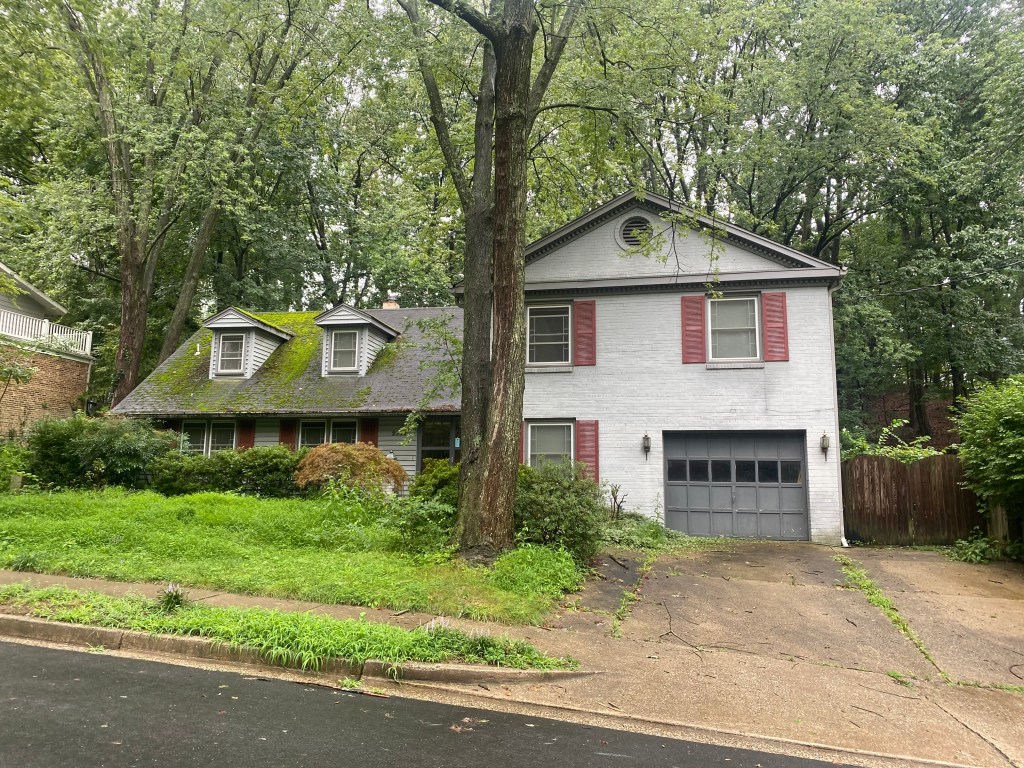
Former Residence of Aldrich Ames Today (Matthew Eng)
Looking at this house on North Randolph Street today, you would hardly guess it fits that description of domestic opulence. Driving through the neighborhood, Ames’ former residence sticks out like a sore thumb. The front yard appears overgrown and unkempt. Grass is growing between cracks in the driveway. The siding on the house is dirty and disheveled. Moss grows in sections on the roof near the second floor windows. The colors are altogether muted from its former heyday.
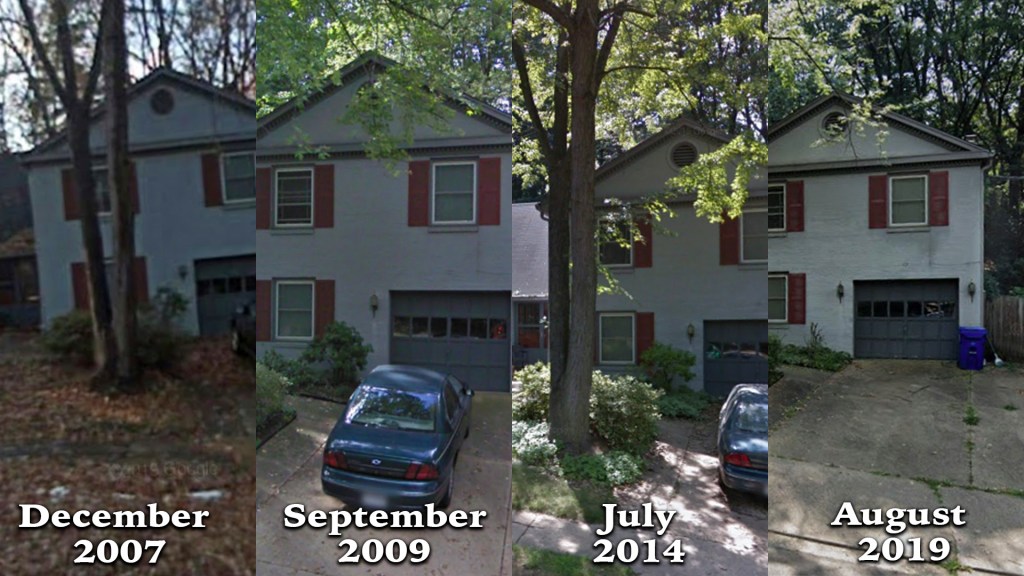
Composite of Former Ames Household Over Twelve Years (Google Maps)
It wasn’t always that way. Thanks to Google Maps, there is a record of what the house looked like on four separate occasions: December 2007, September 2009, July 2014, and August 2019. You can see the slow decline of the look and feel of the house over time. It’s hard to tell if anyone is currently occupying the house. A traitor’s house does not deserve light and love. Perhaps it should remain this way — nearly derelict and devoid of charm or character. It stands as a reminder of the cost of secrets and information and the faustian bargain one must make to achieve an unearned status of wealth and prestige.
Footnotes:
Tim Weiner, “Why I Spied; ALDRICH AMES,” The New York Times, July 31, 1994.
Weiner, “Why I Spied.”
Senate Select Committee on Intelligence, An Assessment of the Aldrich H. Ames Espionage Case and Its Implications for U.S. Intelligence, November 1, 1994. Accessed September 1, 2020, LINK.
Peter Maas, Killer Spy: The Inside Story of the FBI’s Pursuit and Capture of Aldrich Ames, America’s Deadliest Spy (New York: Warner Books, 1995), 104-105.
Maas, Killer Spy, 105.
Maas, Killer Spy, 213.
Maas, Killer Spy, 222-223.
Charles W. Hall, “Aldrich Ames’s Spying Booty Shifted To a Good Cause.” Washington Post, September 1, 1995.
Zillow, 2512 N. Randolph Street. Accessed September 4, 2020, LINK.
Education Loan Finance, “10 Most Expensive Cities to Live In for 2020,” March 2, 2020. Accessed September 4, 2020, LINK.
I’m a commuter. I pass by the same landmarks and historical places every single day, and I don’t even know it.
Well, I was a commuter, before COVID. The alarm would blare incessantly at 5 am, and I would reach over in a blind haze to hit snooze just to get a couple of precious seconds of extra sleep. By 6:45am I’d be headed to the metro for my trip to DC.
One of my favorite parts of the metro ride is crossing the bridge into the city. A few times, if I was lucky, I could catch a plane roaring right over me, headed either to some unknown destination in the clouds or coming in for a landing at National Airport. I’ve got a weird fascination with planes—I’ve got a pretty healthy flying phobia, but I love to look at them.
Sometimes my mind works in weird ways. The planes dip so low when they descend, and climb so steeply when they ascend. The pilots steer those planes through the air with an expert hand; they take off and land with an ambient dexterity, no matter how bumpy the landing. So more than once while I crossed over the Potomac, I wondered if there had ever been an accident at National Airport.
It turns out, there was a pretty notable accident at National Airport in 1982: the crash of Air Florida Flight 90.
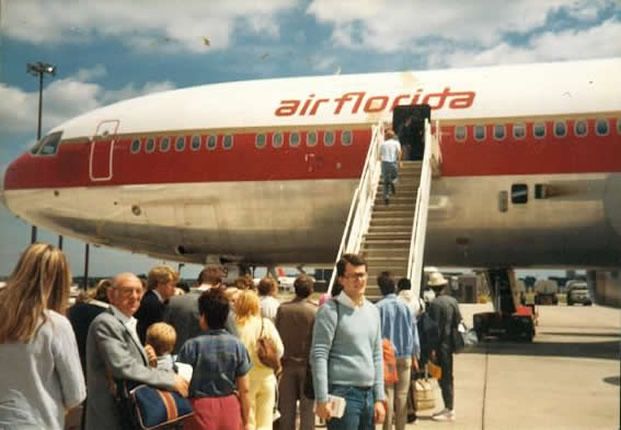
Air Florida Airlines (Aviation Explorer)
Air Florida was a carrier based out of Miami throughout the 1970’s and 1980’s. It began as an intrastate operation, but soon expanded to the east coast and, eventually, international destinations. On the afternoon of January 13, 1982, Air Florida Flight 90 was scheduled to fly from Washington D.C. to Fort Lauderdale, Florida, with a stop in Tampa. The plane was supposed to depart at 2:15 pm, but takeoff was delayed due to heavy snowfall in the area. The airport closed from approximately 1 pm to 3 pm, so Flight 90’s departure was delayed about 1 hour and 45 minutes.
During that time, American Airlines personnel were deicing the aircraft. The National Transportation Safety Board report stated that the “deicing process used was inconsistent with recommended practices” so the plane was not deiced properly. In fact, the plane had visible snow on the wings and the fuselage at the time of takeoff. The Safety Board also noted that the Captain and the first officer did not inspect the outside of the plane before leaving the gate. This oversight was the first of many from the crew that contributed to the accident.
The crew continued to make mistakes throughout the taxiing process. The report continued, “the flight crew’s failure to turn on engine anti-ice was a direct cause of the accident” and suggested the accident may have been avoided had the crew turned it on. The report also notes that the plane’s proximity to another aircraft while taxiing turned the snow on the plane to slush, which then froze in several critical areas. The instruments were not working correctly, which the first officer noted, but the captain brushed him off.
Though all of this, I can’t help but wonder what the 79 passengers aboard were thinking. They had been boarded between 2:00 and 2:30 pm. They had been stuck on the plane for close to two hours. Were they nervous to fly in these conditions, or just dreaming about the sunny weather that awaited them in Florida?
Joe Stiley, one of the survivors, was an experienced pilot. In an ABC News article following the crash, he said he knew something was not right while the plane hurtled down the runway: “You could see out one side, but not really the other side. I wanted out in the worst way.”
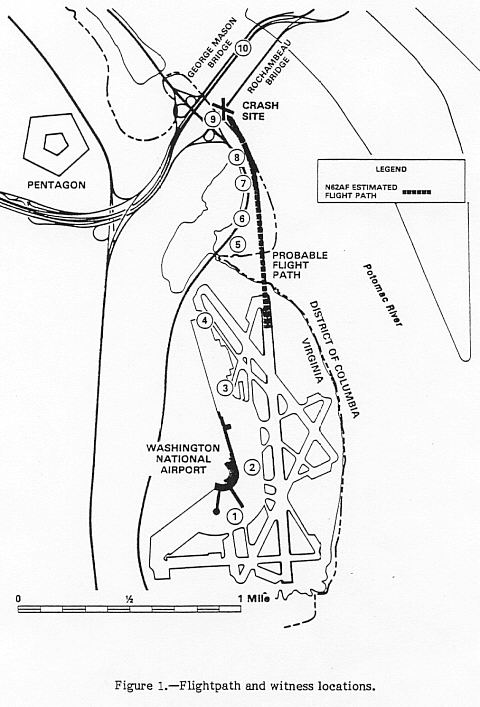
Air Florida Flight 90 Flight Map (NTSB)
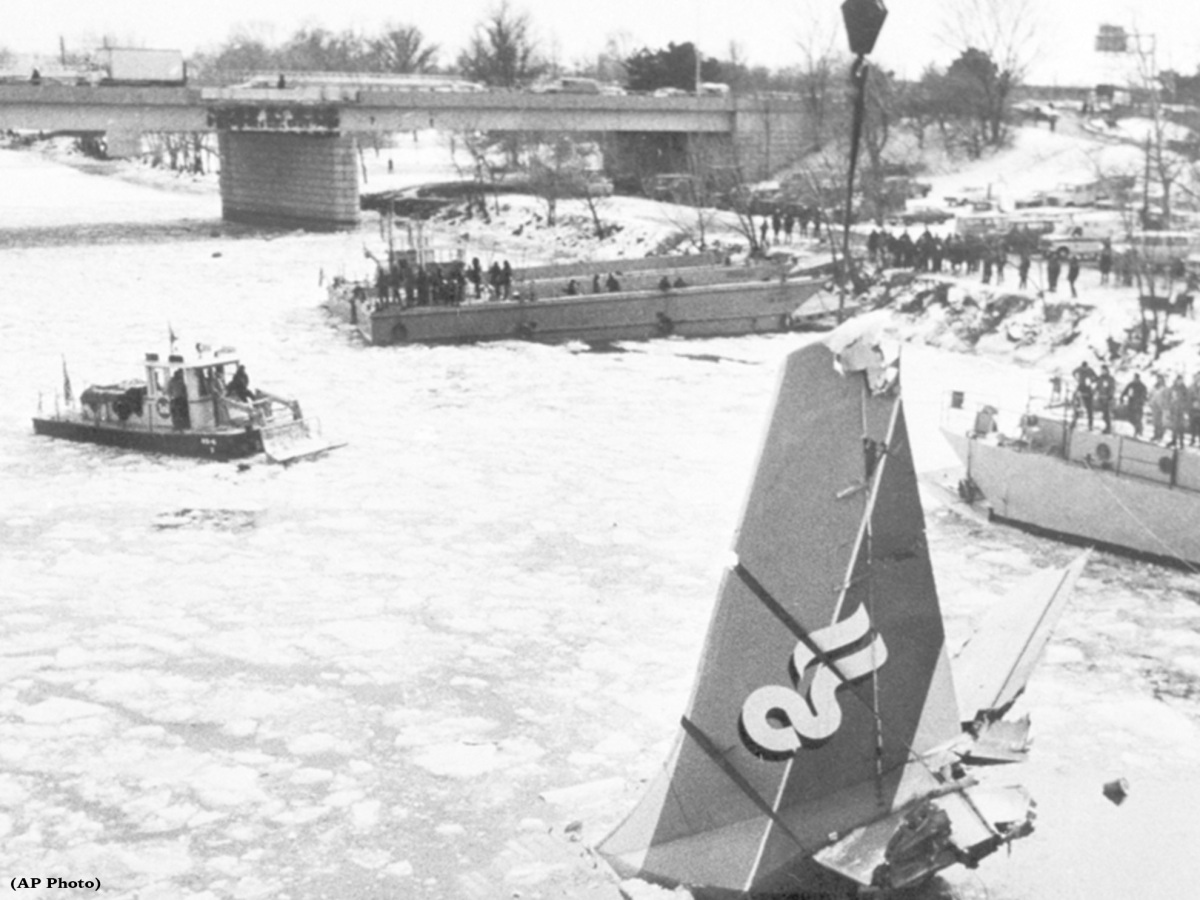
The plane took off and struggled to maintain altitude. It began to descend after reaching between 200 and 300 feet. One eyewitness, a driver on the 14th Street Bridge that day, stated that the plane’s nose was up and the tail was down. The right wing hit the bridge span first as the plane descended, leaving a trail of debris. The point of impact was only approximately 4500 feet from the end of the airport runway. The rest of the plane slammed into west side of the bridge and sank into 25 to 30 feet of water between the 14th Street Bridge and the George Mason Memorial Bridge.
The National Transportation Safety Board report later noted that the “cabin separated from the cockpit and broke into three large sections and many smaller pieces.” None of the cabin floor remained intact; most seats were extensively damaged and separated from the floor. The only part of the plane that held together was the rear of the cabin by the flight attendant’s jump seat.
Air Florida Flight 90 Survivors: Joe Stiley, Nikki Felch, Kelly Duncan, Priscilla Tirado, and Bert Hamilton
In all, there were five survivors: Joe Stiley, his coworker Nikki Felch, flight attendant Kelly Duncan, Priscilla Tirado, and Bert Hamilton. Duncan was only 22 at the time of the crash. According to a New York Times Magazine article, “After hours of delays, when the plane was finally ready to push off, she took her seat, as required, at the back of the plane . . . no one from the front of the plane survived.” In an interview after the crash, Duncan said, “My next feeling was that I was just floating through white and I felt like I was dying and I just thought I’m not really ready to die.” She, along with Stiley and Hamilton, were rescued from a lifeline thrown from a helicopter.
One bystander, Lenny Skutnik, was able to rescue Priscilla Tirado from the icy waters after the rescue helicopter’s failed attempt to tow her to shore. Tirado was 22 and traveling with her husband and 2-month old son. Both her husband and son died in the crash; Other survivors remember hearing her scream for someone to find her baby as they all flailed in the water. Felch was lifted out of the water from rescue personnel aboard the helicopter.
The temperature of the river that day was only 34 degrees Fahrenheit. For comparison, the temperature of the water the night the Titanic sank was 28 degrees. The water in the Potomac that day was only six degrees warmer.
Arland D. Williams, Jr. (Toronto Star)
Initially, there was a sixth survivor that day—46 year old Arland D. Williams Jr. Williams was “trapped in his seat in the partially submerged rear section of the plane by a jammed seat belt.” Though the helicopter’s lifeline came to him several times, he passed it to other survivors. When all the other survivors had been rescued, the helicopter went back for him. However, he was gone. The coroner determined that he had drowned; the only victim of the crash to do so.
In 1985, the 14th Street Bridge was renamed the Arland D. Williams Jr. Memorial Bridge in his honor.
To me, that bridge was always the 14th Street Bridge. I never knew that it actually had a name until now—or that it was named after an incredible man who gave his life so selflessly only a few feet from where thousands of commuters cross into DC every day. There are no markers or plaques commemorating him. I can’t even recall seeing any other name for the bridge other than 14th Street.
Though I wish there was more recognition of the bridge’s true name, I’m grateful I know it now. At least the next time I commute into the city I can reflect on his bravery instead of impending disaster.
National Transportation Safety Board, “Aircraft Accident Report: Air Florida, Inc. Boeing 737-222, N62AF, Collision with 14th Street Bridge, Near Washington National Airport, Washington, D.C., January 13, 1982,” National Transportation Safety Board Aviation Accident Report, accessed August 29, 2020, https://www.ntsb.gov/investigations/AccidentReports/Reports/AAR8208.pdf. Pages 2-3.
I have a confession to make. It’s going to be a hard one to admit to fellow music lovers. Here it goes.
I wasn’t into Nirvana until much later in life. I know…I KNOW.
I was very young when “Smell’s Like Teen Spirit” became the Seattle earworm that congested radio and television airwaves in the early 1990s. When Nevermind was released in 1991, I was only seven years old. My experience with music up until then had been whatever my dad listened to. If you wanted to mosh to some Dan Fogelberg, James Taylor, or Jackson Browne in the early 1990s, I was your guy. I knew all the words to “Somebody’s Baby” and “Run for the Roses” long before I committed the mantra-like meanderings of the band’s biggest hit inside a poorly-ventilated high school gymnasium to memory.
My first real exposure to Nirvana came just before the end the band in 1993 for the televised Unplugged in New York concert on MTV. They played it on the station so much afterwards that I had plenty of time to sneak into our room above the garage to watch it. The entire concert blew me away. What impressed me the most, though, was their drummer, Dave Grohl. I didn’t know anything about him seeing him on stage for that televised concert. Throughout the concert, Grohl played an acoustic drum kit and sang backup vocals perfectly. He even picked up an acoustic bass for one of the songs. How could he be so good at more than one instrument? I had to know more. By the time I did my research about Grohl and the rest of the band (which in the early 90s meant combing through magazines at the local bookstore), Nirvana was over. Cobain died by suicide in April 1994 and the band broke up forever shortly after. Would I ever see my newfound musical hero again? As it turns out, I would.
Grohl recording Foo Fighters (Photo by Michel Linssen/Redferns)
Unbeknownst to me, Grohl had been secretly recording his own songs while he played drums in Nirvana. Not only was he good at drums, singing, and bass, he was a hell of a guitar player. He could do it all. Six months after Cobain’s death, Grohl booked six days in a local Seattle studio to record what would become the first Foo Fighters record. Besides a few guest appearances, he recorded every instrument and sang every word.
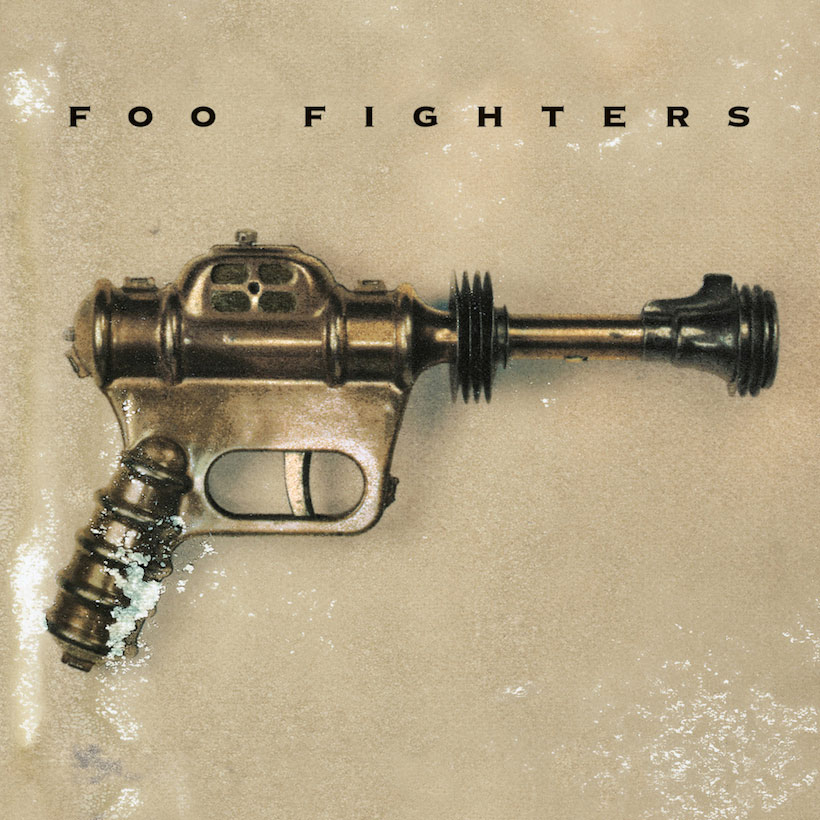
Foo Fighters was released on Roswell Records on Independence Day, 1995. When I heard about the release with my friends, all of which were now enamored with Grohl and grunge music culture, I begged my dad to go to the local music store to get it. He eventually acquiesced my request, and we went to Planet Music in Virginia Beach. I can remember bringing my SONY discman with me so I could listen to it immediately after ripping off the impossibly-hard-to remove shrink wrap encasing the compact disc.
Keep in mind, Foo Fighters would not be my first grunge music purchase at that point. I had several already in my collection by July 1995, including Pearl Jam’s Ten, Soundgarden’s Superunknown, The Smashing Pumpkins’ Siamese Dream, and of course, Nirvana’s Unplugged in New York. I had never been more excited up to the point getting a record than when I did with Foo Fighters. “This is a Call,” their first single, released on the radio a few weeks before, and I was in love with the overall sound. It sounded like Nirvana, but more polished. It was punchier and faster paced. One might say it had the existential qualities of punk rock music, a genre I would also embrace less than two years later. But for 1995, it was all about this release.
Foo Fighters (Roswell Records/1995)
The first couple of songs were fantastic off the bat. To this day, there are very few first tracks that hit harder than “This is a Call.” The next two songs, which also became singles and iconic music videos to boot, still resonate with me. It’s the middle of the album that I continue to go back to, with one song in particular. Standing up among a three song set exploring some differing styles such as eighties post-punk nostalgia (“Good Grief”) and grunge-drenched shoegaze (“Floaty”) is the two minute and forty-six second brain melt that is “Weenie Beenie.”
“Weenie Beenie” was the first song I ever heard that felt truly aggressive to me. The aggression felt good, even for a middle class kid with a b-plus average. The song starts loud and ends louder. Grohl’s characteristic scream is put on display there for the first time. The drums are open ended with plenty of hi hat filling the empty space between the drones of bass and guitar. The snare hits like hammers on your ear drums. The guitars are tuned down and turned up to a nearly uncomfortable level. In the immortal words of Nigel Tufnel, the amps “go to eleven.” It’s a sound I would identify with for the rest of my life. Just because a song sounds angry, doesn’t mean it IS about anger. Without sounding too nostalgic, the song is an emotional one. Every music lover has a genesis to their obsession. Mine happens to be “Weenie Beenie.”
My first experience with music, c. mid 1990s.
I couldn’t play a single instrument when the eponymous release came out in 1995, but it undoubtedly spurred me to pick up my first, a black and white bass guitar, for my birthday in 1996. I still own and cherish that bass to this day. Over the course of middle and high school, I made it a goal to learn all the instruments Dave Grohl could play. I can play all of them now, in varying degrees of precision (or lack thereof).
It wasn’t until I was in college at James Madison University that I found out through some old archived interview that “Weenie Beenie” was named after a northern Virginia fast food stand nearby where Grohl grew up. I had to go. But geography, my lack of vehicle, and my studies (…right) kept me from making a pilgrimage to this fast food holy grail. After a while, I simply forgot about it, even if I continued to make that album part of my rotation throughout my high school years and beyond.
It’s been twenty five years since Foo Fighters was released. What better time to FINALLY go to this iconic northern Virginia establishment than now? Once we started the Offbeat NOVA project, it was the first thing I wrote down. We had to finally go. I was not disappointed.
Weenie Beenie is located just north of the Shirlington neighborhood in Arlington. The small restaurant, offering walk-up service only (no doubt a great boon for business in the currently pandemic) sits unpretentiously in a small parking lot across from a park. The restaurant is the last remaining of a chain of restaurants created by notorious pool shark Bill Staton and his uncle Carl in 1950. According to the Arlington Public Library, Staton funded the first stand alter collecting nearly $30,000 in earnings from a profitable gambling trip in Arkansas. The namesake of the establishment became the nickname of the pool player for the rest of his life.1
The food tasted amazing (Angela H. Eng Photo)
I asked Angela to put the song on as we drove down Shirlington Road. where the restaurant was located. After twenty five years, I had finally arrived.
When I looked it up, Google said it was known for “BBQ sandwiches and hot dogs.” I wasn’t feeling a hot dog on a hot summer day, so we decided on grubbing on a pair of barbecue sandwiches and fries. As we ordered, our daughter Zelda charmed all of the waiting customers around us. It was so unbearably hot and humid that day (nearly 100 degrees), that all of us waiting for our food attempted to hang out in the small amount of shade the tiny orange eaves the restaurant provided from the direct sunlight. After about fifteen minutes, we finally received our hot bag of food. I brought it back to the car and cranked the air conditioning before eating my sandwich. The first thing I noticed was the bun. Normally a soggy afterthought to barbecue sandwiches, the bun was thick and toasted, holding all of the seasoned meat and cool coleslaw together.
I took my first bite of the barbecue sandwich as Dave growled into the chorus of the song inspired by the place I was finally eating at. The meat was warm and well seasoned, with just a hint of spice to it. It also had a tang to it reminiscent of the North Carolina-vinegar style I love so much. The coleslaw was not unlike the restaurant itself, simple and unpretentious. The sandwich reminded me of a better version of a famous drive-in restaurant I grew up eating at in Norfolk, VA, Doumars. Whereas those sandwiches were small and soggy, the one dished up at Weenie Beenie was large, crispy, and filling.
Zelda and I patiently wait for our food (Angela H. Eng Photo)
But I’m not finished. I haven’t talked about the fries yet. I don’t have a picture of the fries because we ate them too fast. Weenie Beenie serves large, wedge-cut fries with an addicting seasoned coating on them. Complimented by the sugary, umami taste of ketchup, they were crispy and perfect. By the time the song was over, we were halfway through our entire meal. It was gone completely in another two minutes. We drove away from Weenie Beenie still sticky with sweat but full and content with delicious food. It’s definitely not a meal you can have all the time, but surely worth waiting nearly thirty years for. Eating there closed a very important chapter of my life, when music was new and exciting.
I highly recommend giving this local business your patronage. When you roll up on the unassuming establishment in your car, don’t forget to crank the seventh track on the first Foo Fighters album while you do.
Footnotes
Arlington Public Library, “The Weenie Beenie,” Link.


















 Offbeat NOVA