

Categories
Civil War spottsylvania county

Offbeat Postscripts: The Minister of Pestilence

Offbeat Postcripts is a series of short posts where we cover small topics of offbeat history in Northern Virginia. 
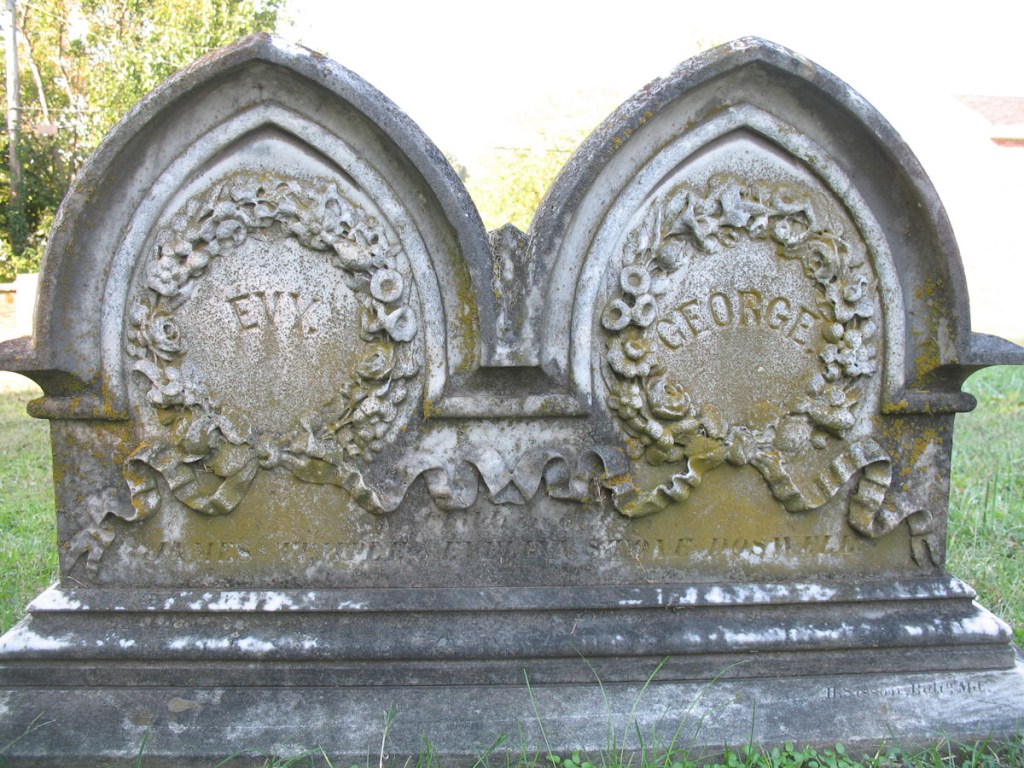
George and Evy Doswell, Fredericksburg City Cemetery (John Hennessy/FredericksburgHistory)

By Matthew T. Eng, Offbeat NOVA

In a year that seems like twenty, I catch myself thinking about what life was like before Coronavirus. At the beginning of March, I can faintly remember hearing about the first reported case of Coronavirus in Virginia from a Marine in Quantico. That particular individual was of course not “Patient Zero,” but the first of many that tested positive for the deadly virus in the months since.

I remember talking to others at work in January and February about how the virus had isolated itself in the Pacific Rim, and it would never make its way over here. Boy, was I wrong. I’m sure nervous Americans felt the same thing about the A/H1N1 “Spanish Flu” happening overseas in 1918, even if the first cases were likely in the United States. Well, no one ever said Americans were ever right, or could believe their own naivety. 

But what do you do when it’s inescapable? Movies featuring deadly worldwide viruses treat it like some invisible monster wreaking havoc over populations, leaving death and destruction in its wake. It’s the Motaba virus in Outbreak. Captain Trips in The Stand. The T-Virus in Resident Evil. And now we have Coronavirus. But it’s not Hollywood. It’s actually happening, and the reality is far different and more terrifying. 

I began to think about other epidemics in American history and their connections to Northern Virginia. Talking about the “Spanish Flu,” while tragic, is not necessarily offbeat. 

Then I found a story first written about by John Hennessy, Chief Historian of the Fredericksburg and Spotsylvania National Military Park. 

The story involves a short outbreak in Civil War-era Fredericksburg of scarlet fever, a disease that acts much like Coronavirus, and the man who performed a large number of burials for the unfortunate children who fell victim to it between 1861 and 1862. 

The worldwide pandemic of scarlet fever was among many of the deadly epidemics that occurred in Europe and North America in the early to late 19th century (one report approximates the years between 1820 and 1880). Symptoms of the streptococci bacteria in a human body include a sore threat, fever, inflammation of the lymph nodes, and, in some cases, abscesses of the throat and tonsils. Unfortunately, the majority of those who developed the sickness were young children, who would often succumb to the virus within two days of the onset of symptoms.2 

Scarlet fever came to Fredericksburg beginning in September 1861. According to Hennessy, the first known death was Wilmer Hudson, an eight-year-old son of John and Pamela Hudson. The deaths continued to increase into the winter of 1861. Countless parents had to watch their children die in large numbers. The only respite for their anguish was the ferocity of the virus, taking those affected quickly. In all, there were forty-one known victims of scarlet fever from September 1861 to February 1862. The devastation of it was so bad that NPS historian John Hennessy said it might have been “the greatest human disaster to ever befall the residents of Fredericksburg.” That was, of course, until December of 1862.3

Alfred M. Randolph (Wikimedia Commons)

Either out of grief or worry of spreading disease, the majority of children were buried the following day in cemeteries around Fredericksburg. One of the most popular spots was the Fredericksburg City Cemetery, a small plot of land on the corner of Washington Street and Amelia Street in the heart of downtown Fredericksburg. Most people know the area next to it simply as the “Confederate Cemetery,” an equal parcel of land separated by an invisible dividing line that that splits the area. At least seven of the children who died of scarlet fever were buried there. These burials were performed by one man, a young minister named Alfred Magill Randolph of St. George’s Episcopal Church, less than a half mile away from the burial site. His position at St. George’s was his first after graduating from the Virginia Theological Seminary. He quickly climbed the ladder at St. George’s, becoming a rector after he was officially ordained at the age of twenty-two in 1860.4   

When the war began in April 1861, the burials he presided over took a different tone. Sporadic fighting was occurred near Fredericksburg in Spotsylvania County, so the likelihood for Randolph to bury soldiers became a reality in the fall of 1861. The first soldier he administered a burial for was Francis Lewis of Company G., 1st North Carolina Infantry Regiment, on October 12, 1861. By the end of the month, Randolph also began burying children from the scarlet fever epidemic. 

The rector’s first burial was Sidney Cavell, a two-year old child of Charles Cavell and Emma Huckey, who died on October 27th and was buried the following day. His next two burials were by far the most heartbreaking. Two prominent figures of the Fredericksburg community, J. Temple and Evelina Doswell, lost two of their children within nine days of each other. Randolph presided over the burial of five-year-old George Doswell on November 11, 1861. He did the same for his sister, two-year-old Evy Doswell, nine days later on November 20th. The Doswells were not the only family to lose more than one child, but Rector Randolph presided over the pair.

In all, Alfred Randolph performed burial rites for seven children between October 1861 and February 1862. The last was two-year-old John Edward Haydon.5 

  • Sidney Cavell (2 years) – Buried October 28, 1861 (Death 27 October)
  • George Doswell (5 years) – Buried Nov. 11, 1861 (Death Nov 10, 1861)
  • Evy Doswell (2 Years) – Buried Nov. 20, 1861 (Death 19 November 1861)
  • Malvina Meade Hart (5 years, 7 mos.) – Buried December 7, 1861 (Death Dec 6, 1861)
  • Susan Gill Mander (2 years, 6 mos.) – Buried Dec. 11, 1861 (Death Dec. 9, 1861)
  • Anne B.H. Scott (10 years, 9 mos.) – Buried Jan 5, 1862 (Death Jan 3, 1862)
  • Thomas Wolfe (6 years) – Buried February 7, 1862 (Death Feb 5, 1862)
  • John Edward Haydon (2 Years, 2 Mos.) – Buried February 24, 1862 (Death Feb 1862)

By February, scarlet fever had dissipated in Fredericksburg and Virginia in other hotspots like the Confederate Capital in Richmond. Today, you can see many of the gravestones and pay your respects to these children in the Fredericksburg City Cemetery. 
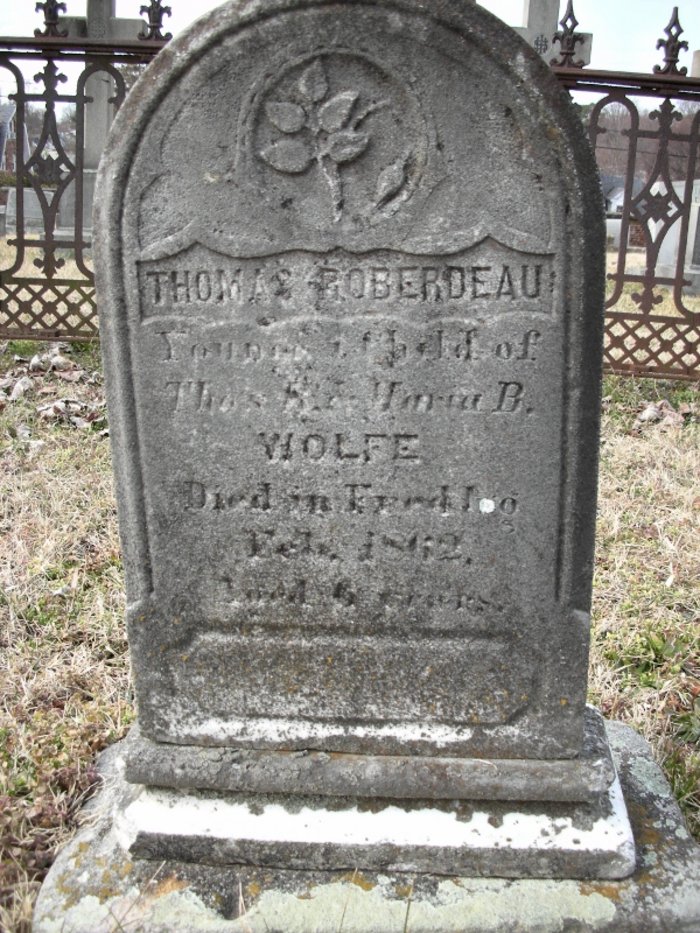
Six-Year-Old Thomas Wolfe (FindaGrave)

The woes for Fredericksburg only had a brief respite once cases and deaths began to dissipate after Alfred Randolph presided over the burial of John Edward Haydon in February 1862. By autumn of that year, Federal forces were beginning to descend in and around Fredericksburg. A major battle seemed imminent in November. With forces at their doorstep, residents were given the order to evacuate on November 21, 1862. Randolph and his young family departed his wife and day-old son for Danville, where he became a Post Chaplain for the Confederacy until the remainder of the war. He held a number of positions in Alexandria, Baltimore, and Norfolk before passing away after a long career of service to God (and unfortunately the Confederacy) in 1918. He is buried at Hollywood Cemetery in Richmond. No doubt he kept his thoughts on the turbulent winter of 1861-1862 in the back of his mind for the rest of his life, and the many poor children he buried as a result of an unforgiving disease. 

Reading about this tiny event puts our current troubles into perspective. We cannot justify any death, but the loss of those younger than us are the hardest to bear. 

Stay healthy and wear a mask. 

Footnotes:

  1. NBC Washington Staff, “US Marine in Virginia Tested Positive for Coronavirus, in State’s First Case,” March 8, 2020. Accessed October 2, 2020, LINK.
  2. Alan C. Swedlund and Ann Herring, Scarlet Fever Epidemics of the Nineteenth Century: A Case of Evolved Pathogenic Virulence. New York: Cambridge University Press, 2009), 159-177.
  3. John Hennessy, “The 1861 Scarlet Fever Epidemic,” Remembering, October 15, 2010. Accessed October 2, 2020, LINK.
  4. St. George’s Episcopal, “Alfred M. Randolph.” Accessed October 2, 2020, LINK.
  5. St. George’s Episcopal, “St. George’s Burials, 1859-1913.” Accessed October 2, 2020, LINK.
Categories
Alexandria blog Matthew Eng

Beyond a “Ruinous Condition:” Alexandria’s Historic Wilkes Street Tunnel (PART II)

(This is the second of a three-part series on Alexandria’s historic Wilkes Street Tunnel. Read PART I)

Matthew Eng, Offbeat NOVA

PART II: The Curious Case of Mollie McKinney

Naturally, the track fell into disrepair during the Reconstruction period, adding insult to the already dilapidated condition of the tunnel. At one point, there was a resolution that instructed the Committee on Streets to take steps to have the problematic east end of the tunnel walled in and filled. The resolution never gained any speed and was soon forgotten.1 

After the Panic of 1873, the railroad consolidated into the Virginia Midland Railway, one of the many times the tracks under the tunnel would change corporate hands before ultimately meeting its end as a rail tunnel over a hundred years later. The tunnel became a popular place for young boys and aspiring prepubescent vagabonds to congregate, arousing the suspicions of the citizens of tunnel town. The police reported several instances of vagrancy for these boys, who had the habit of jumping from the top of the tunnel onto the passing cards below. “This is an exceedingly dangerous practice,” said one concerned citizen, “and should be put a stop to by police before some of these bold children are crushed under cars.” Meanwhile, the tunnel continued to be as one person put it, “not only unsightly, but dangerous.” The people of tunnel town and Alexandria would soon find out how dangerous it could be on an unusually cool day in the late summer of 1882.2 

Alexandria Gazette, August 17, 1882

Twenty-two-year-old James Cliff walked with his young wife Mollie McKinney on the morning of August 16, 1882, to the Potomac Ferry Company Wharf. Mr. Cliff’s sixteen-year-old bride fancied a trip to Washington, D.C. Money was tight for the young couple. Mollie had allegedly come up with funds for a nice trip into the big city. At the time, the couple had only been married for about five months. Three months after they were married, Mr. Cliff was let go from his job as a tinsmith due to poor health, draining their cash flow considerably. Although he protested her trip that morning, he insisted on escorting his wife. Mr. Cliff suggested they take a shortcut to the ferry on King Street through the Wilkes Street tunnel. Midway through the tunnel, at its darkest and most concealed point, James slapped his wife and drew a small caliber pistol and proceeded to fire several shots at her. Mollie was hit in four places: on her right ear, on her head above the ear, in the fleshy muscle of her right arm, and her left hand. Ms. McKinney’s screams were heard by several people in the neighborhood, yet nobody seemed to detect foul play at first glance. Two young boys who happened to be walking through the tunnel at the time of the struggle had a visual on the struggle in question. Upon hearing Mollie’s cries, they approached the helpless woman before being told by Mr. Cliff to turn around and leave, who reportedly fired two shots at them. Mrs. Cliff emerged from the tunnel moments later, visibly weeping and covered in her own blood. Mr. Cliff followed close behind his wife, carrying himself cool and calm as if the recent burst of violence were merely a lover’s quarrel.3

Mr. Cliff stopped to chat with several parties in attendance nearby, admitting to them that he had in fact shot his wife. “So great was the surprise at his action,” the article stated, “that no one attempted to arrest him.” He proceeded to walk casually down Royal Street in the direction of the canal. Several women encountered the gravely wounded Mollie McKinney on the corner of Royal and Wilkes and escorted her home. After nearly passing out from blood loss, the helpful women brought her back to life until a doctor arrived to remove what projectiles he could out of her body. The doctor removed the balls from her hand and arm but waited to remove those in her ear and head until she had “calmed down.” The wounds were serious, but not fatal, thankfully.4 

Mollie was hit in four places on her body by her husband, James Cliff.

A crowd soon formed around the house of Mollie McKinney. Oddly enough, it took a great amount of time before anyone in the vicinity began to search for the husband who had walked away from the crime scene so calmly and casually. What kind of man was he, and what possessed him to make an attempt on his wife’s life? 

James Cliff had spent the better part of two months sick with consumption, which forced him out of his job, unfit and unable to work. Mollie, not one to shy for the finer things of life, asked for fine clothes, food, and companionship, which her husband answered with jealousy, physical abuse, and emotional abuse. This was all well documented by those that knew the couple. Neighbors reported that Mr. Cliff was known to “whip” his wife, but not in a manner that would suspect further efforts of deeper foul play. His friends said he was possibly insane. Yet in the realm of Gilded Age romance, Mr. Cliff and Mrs. McKinney had forgivable differences. Mollie’s habit of seeking “lively company” made Mr. Cliff insanely jealous, which was likely the prime motive for the attempted murder. Such behavior is never an excuse, however distasteful it may be to a sick husband strapped for cash at the beginning of an unhappy marriage, for murder. For all intents and purposes, he casually walked away from the city unmolested.5

After the altercation, James Cliff took the Washington Road outside the Alexandria jurisdiction where he waited until evening when he returned to the city feeling too weak from his illness to move further. He went directly to his sister’s house on Duke Street. His sister proceeded to call for the police who took him into custody. The Alexandria Gazette reporter met with Mr. Cliff in his jail cell the following morning to speak to him about what happened. When the reporter arrived, Mr. Cliff was reading the very report on the incident published that morning. He then preceded to tell his side of the story, correcting the report’s ostensible misinformation “in a very indifferent manner.”6 

Much of the offender’s account played out like the article from the previous day. Mr. Cliff insisted that it was his wife’s own idea to go to the wharf for the express purpose of borrowing money for a trip to Washington. Mr. Cliff stated that his wife had not secured money for a tryst in the big city quite yet. How she would get it was up for speculation. The tunnel route, in his eyes, was her idea. He also said that he had a very loving marriage with Mollie until he got sick. It was only after this that she “would never stay with a consumptive man, hoping God might paralyze her if she did.” He continued his tale of sorrows for several more lines, regaling the reporter with a litany of jealous notions and suspicious of infidelity. To him, whatever had happened in the previous morning, was justified. Meanwhile, down the street in their home, Mollie rested from her serious injuries, with one of the balls in her ear still lodged firmly in place. Sadly, the article summarizing the second day of the event ended on a somber note indicative of the time period:

“Mrs. Cliff, it is understood, does not want her husband punished for his crime, and is willing, like a woman, to blame herself entirely for the affair.”7

Alexandria Gazette, August 18, 1882

It was an ominous warning of things to come. If not prophetic.

Two months went by before there was a conclusion to the Cliff assault case. In the middle of October 1882, the Commonwealth set out to convict the prisoner James Cliff, who had the “intent to maim, disfigure, disable, and kill” his wife. Neither party had apparently seen each other since the incident in August, but circumstances that played out would prove that to be highly unlikely. After taking time for the selection of jury, witnesses were called, including Mollie McKinney herself. In a shocking turn of events, she refused to testify in court against her husband, giving no reply when asked about the events on the 17th of August. When she did finally speak up later on during questioning, she merely said that “she had nothing to tell” and objected to other leading questions that would have assuredly convicted Mr. Cliff. All the prosecutor could get from the witness after several attempts to get her to tell the truth was a smile. The smiling grew infectious, and soon laughter was heard in the courtroom. When asked if she had been talked to or influenced before the trial, she responded with a submissive and inaudible “yes.” She then refused to say anything else on the matter of the trial, which forced the prosecutor to send his star witness to jail for contempt of court for the evening. The trial reconvened on the follow day, October 16, 1882, with the witness in a hopefully better position for testimony. She agreed to “tell part, but not all” of her story. Whatever she said must not have been compelling as the end of the trial neared. Other witnesses were examined, playing into the hands of the defense, who asked for a plea of transitory insanity before the jury retired.8 

Sometimes, things do not go like you think they will, especially during the Victorian Era. (Alexandria Gazette, October 16, 1882)

A verdict was reached later that evening after a short deliberation. Foreman Joseph Kauffman presented a verdict of not guilty. James Cliff, now a free man, left the court room with his wife “arm in arm, as loving as if nothing has ever happened to disturb their domestic relations.” Applause could be heard audibly in the court room after the verdict was delivered. It was said that the insanity plea put up by the defense “was worked with a success in this case that even the family of the prisoner did not anticipate.” Who would? Such was the time and delicate circumstances that let a jealous man with anger issues get away with some of the worst instances of domestic abuse. It was the unfortunately product of the time period. The vehicle for that violence was eerily enough the Wilkes Street tunnel, which provided Mr. Cliff with the perfect location to strike her in a jealous rage. The Gazette later reported that Mr. Cliff met his end later on in the Wilkes Tunnel, but that could not be confirmed at present. 

If you or someone you know are being abused domestically, call the National Domestic Violence Hotline at 1-800-79907233. If you cannot speak safely, log onto thehotline.org or text LOVEIS to 22522.

Footnotes:

  1. Alexandria Gazette, November 29, 1871. 
  2. Alexandria Gazette, April 21, 1876. 
  3. Alexandria Gazette, August 17, 1882. 
  4. Ibid.
  5. Ibid.
  6. Alexandria Gazette, October 16, 1882. 
  7. Ibid.
  8. Alexandria Gazette, October 17, 1882.