
By Matthew T. Eng, Offbeat NOVA
If you are over the age of thirty, you remember going to a music store and picking up a CD to buy and bring home. For the most part, you would have very little chance to hear the entire album and assess its merit from start to finish. These were expensive purchases (remember this is the mid 1990s and CDs were still $15-20). Without buying a music review magazine like Billboard, you only had your knowledge of the songs you’ve heard to make your purchase. Even if you did have access to magazines like that, your personal taste might be different than the reviewers. It was always a coin toss.
Sometimes the coin came up on the wrong side.
For mature millennial and Gen X’ers, we’ve all been burned this way. For me, it was the Red Hot Chili Peppers. I remember going to my local music store with my father and putting down my birthday money to purchase One Hot Minute in 1995. I was so excited to hear what the album had to offer beyond the first two singles, “Warped” and “My Friends.” I wasn’t stoked on the second single, but “Warped” had a funky quality that I liked compared to the band’s grunge contemporaries. I got home and listened to it. To this day, I can safely say that “Warped” is one of the only songs I liked on that album. The Red Hot Chili Peppers are a taxing band, and that album is quite taxing. That goes double for today. Even if the album was generally well received by critics, it never stuck with me. I thought the critics were wrong. It wouldn’t be the last time.

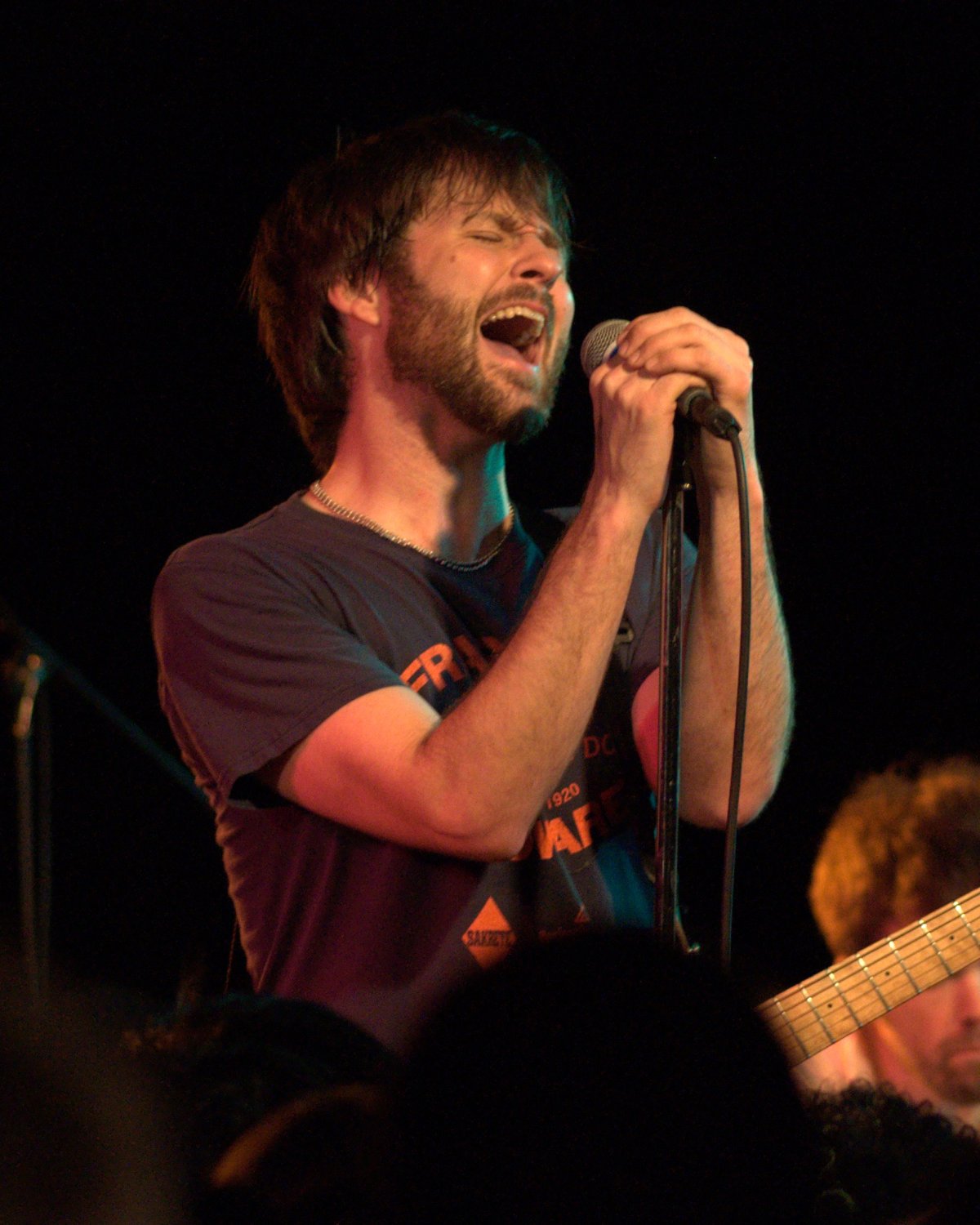
Today, reviews are instantaneous, and anyone can become a critic. In the age of the Internet, they also have the power to sway public opinion, and in some cases, ruin an artist’s career in the process. Thus was the case for Northern Virginia native Travis Morrison and his only solo album, 2004’s Travistan.
A little background first.
Born in 1972, Morrison grew up in the Washington, D.C., suburb of Fairfax. Morrison went to Lake Braddock Secondary School in Burke before leaving the area to go off to college at William and Mary. A promising music career filled in beyond that. It was at Lake Braddock that he met future bandmates Eric Axelson and Steve Cummings, who along with Morrison eventually became the influential dance punk band The Dismemberment Plan, or “The D-Plan,” to their throngs of sad, sweater and corduroy pant wearing emo boys — just like me!
As much as I enjoyed the grunge of the mid-1990s, by the time I got to the end of middle school and into high school, punk, post punk and emo/indie interested me more. The Dismemberment Plan stood at the crux of all three genres, with the syncopated drum tracks and odd vocal inflections coming together to draw on influences ranging from Gang of Four to the Talking Heads and even jazz and hip hop.
Travis Morrison famously devoted much of the lyrical content in his band’s music to Washington, D.C. Emergency & I, released in 1999, is littered with references to D.C. (For instance, “Spider in the Snow” references K Street and “The City” is entirely about Washington itself). I adored Emergency & I (and still do), with our without critical review backing my decision.
As much as he talked about D.C. in the songs he wrote for Dismemberment Plan, there certainly was no love lost for Morrison and the area south of Washington, D.C. He had this to say about Northern Virginia in a 2013 Spin interview:
Have you ever been to Virginia? Virginia is a very strange state, and it’s where we all grew up. It’s kind of the fuzzy line of the South. When I grew up, the line was right south of D.C., which is where three of us went to high school. Now that line has moved southward, so it’s somewhere north of Richmond. I know that blurry zone, that fog between the North and South, really well, because I had to go back to work there. I worked at the Huffington Post when it got bought by AOL. I found myself back deep in Virginia, and “White Collar, White Trash” came from being from Washington, but having to stay in a hotel 45 miles outside of Washington in an industrial park near the airport, near these huge, wide-open rural highways and mansions. It was horrible.
D-Day: Travis Morrison Dissects the Dismemberment Plan’s Return (Spin, October 11, 2013)
Yikes. At least we still have all the great tunes, right?
It was clear that Morrison had better things looming on the horizon and needed to branch out beyond the District. In 2004, Morrison moved to Seattle to start working on solo music after The Dismemberment played their first final show (there have been several in the years since) at Washington’s Fort Reno Park. He moved back to D.C. and recorded Travistan, a 14-song solo album that included Morrison and producer/Death Cab for Cutie member Chris Walla playing the lion’s share of instruments. I remember (ahem ahem) “downloading” the album from the comfort of my college apartment at James Madison University. I especially liked the tracks “Born in ’72” and “Get Me Off This Coin A.” The music has a similar feel to The Dismemberment Plan without sounding like a copycat. There is experimentation in songs like “Song for the Orca” where the risk/reward is rather high, but worked. The album was generally well received by most critics (Spin, Alternative Press, A.V. Club).
Most critics.

Pitchfork, the budding music review conglomerate in its early stages back in 2004, famously gave the album a coveted 0.0 rating. Travistan joined the ranks of a small but growing list of albums that the reviewers at Pitchfork felt had no merit, like Liz Phair’s self-titled 2003 album and Sonic Youth’s NYC Ghosts & Flowers. None of these albums are bad, yet each of their 0.0 ratings did much to damage the reputation of the artists. Such was the case for Travis Morrison. This stands in sharp contrast to his previous projects, which were extremely well received (Ironically, a reissue of Emergency & I received a 10.0 perfect rating years later on the same site).
In the September 2004 review of the album, now-freelance writer Chris Dahlen had very little to say that was good about Travistan. In fact, in his estimation, nothing was good. There’s very little critique here, unfortunately, and it mostly sounds like the writer had a particular bone to pick that one of his favorite bands isn’t playing anymore.
Travistan fails so bizarrely that it’s hard to guess what Morrison wanted to accomplish in the first place; the guy who led sing-alongs to sold-out crowds can’t find the words on his own album.
He went on to say that he never heard an album that was “more angry, frustrated, and even defensive about its own weaknesses.” Ouch. Double ouch. One blogger who wrote a 10-year retrospective on the historic review referred to it as a “dick punch.” The response was fairly immediate at a time when the Internet was still in its toddler phase. As a result of the review, many of his shows were cancelled and stores didn’t stock the album. The event has come up in news stories over the years. Essentially, Morrison does not want to talk about it. And why should He continued to play music, albeit in a limited capacity, and is now enjoying life with his family in Durham, NC. As late as July of this year, he posted a single picture of a guitar and practice amp on his Instagram, ending the caption with “time to play some damn shows.” Let’s hope so. The world needs you now more than ever, T-Mo.
There have been other 0.0 reviews from Pitchfork since 2004. Jet’s 2006 album Shine On particularly comes to mind. That doesn’t mean they always stay that way. Pitchfork is famous for rolling back on their reviews of albums that have been certified classics in their own time. Their recent review of Jimmy Eat World’s perfect record Clarity is a perfect example. In that same vein, the site recently released an article re-scoring some of the albums they felt they would change if they could. “These adjustments are born out of conversations we have all the time here on staff, much like the conversations you, our dear opinionated reader, have as well,” they wrote in the introduction to the list of 19 albums that got another chance (for better or worse). Included in that list is Liz Phair’s 2003 eponymous release. The new score, a 6.0, did a modest amount of damage control on the arguably “condescending and cringe” review. I would agree with the score. In a world where indie pop is very much a thing, artists like Phoebe Bridgers and Carly Rae Jepson owe their triumphant walks to the crawling of Liz Phair.
Travistan was absent from that list. When I first saw the list, I was almost certain it was going to be on there. Unfortunately, the review has remained unchanged for nearly twenty years.
In the end, I think we put too much merit on reviews without seeing it for ourselves. I had to purchase One Hit Minute to know it sucked. If I only read reviews, I would think the album was solid, instead of listening to lyrics like “Meet me at the coffee shop/we can dance like Iggy Pop.” Ugh.
Travistan deserves a second listen, especially when others of a similar ilk received better. But maybe I should follow my advice and just give my own silent credit to Morrison’s only solo debut. It’s not a fantastic record, but compared to The Dismemberment Plan, what is?
I think there is also an allegory here for Northern Virginia. As much as we write about the cool, fun, and interesting of this area, it’s hard to get beyond a review of the area as a traffic-soaked suburban dumping zone to the nation’s capitol. There’s clearly more here, just like with Travistan.
So in all seriousness, don’t take my advice. You have to form your own opinion about both. But when I scratched beneath the surface of each of these, I was pleasantly surprised with what I found.
Except for The Red Hot Chili Peppers. They still suck. You need more than just a clever name.


 Offbeat NOVA