It’s been a rollercoaster for recreational golf in Alexandria, but the journey is likely over. We’ve been tracking the story of the 17-acre property since the closure of the original stateside Topgolf location in early 2020. The 2022 launch of Rudy’s, an entertainment golf center similar to Topgolf’s, had its share of challenges. In the first year, I often drove down Van Dorn Street and saw the lot nearly empty on a Saturday or Sunday afternoon. It’s no easy task to attract business to a location that appeared neglected and abandoned for years. The empty and abandoned Ruby Tuesday restaurant on the property (still empty today) didn’t help the situation.
Over time, however, I noticed more cars in the lot. You could see several families playing mini-golf on the property, with the lot over half full with cars. Unfortunately, whatever momentum the owners gained over the last two years will likely be for nothing. Throughout the entire period dating back to 2015, developers and Fairfax County Supervisors have considered the acreage a prime location for residential and mix-use development: just what we need in Northern Virginia. Look anywhere in the area, especially on the Richmond Highway corridor nearby, and you’ll see the development of large, uncharacteristic residential/commercial combos with little regard for necessary infrastructure.
A shot of the redevelopment (Alexandria Living Magazine)
Alexandria Living published an article on January 25 of this year about the possibility of Rudy’s closure. The article noted the vote by the Fairfax County Board of Supervisors to allow a townhouse redevelopment to move forward. By March, the publication confirmed the suspicions, with the business set to close to make way for 174 new townhomes. The only positive? The Board of Supervisors amended the agreement to reduce the size of townhomes built from 275 to 174.
Via Fairfax County – Proposed Townhome Design (FFX Now)
The area around Kingstowne, where Rudy’s sits today, is already busy. I can imagine that residents’ protest and petitioning derives from the fact that the already choked area for traffic will be much worse. The opening of Chick-fil-A a few years ago in the shopping center across the street did nothing to alleviate the traffic tensions. Nearly 900 people have signed a petition to save the area “so that other kids have the same opportunity to have fun and learn how to play golf.” Unfortunately, the petition will likely unchange what is already in motion like all machinery. If you want the feeling of hitting a golf ball into a brightly colored hole for points this summer, you’ll need to travel up the road to the National Harbor location or points west in Northern Virginia.
Of course, if you would have no idea about the imminent closure if were a patron of Rudy’s, you would have no idea they were closing. There is no mention on their website or social media about the closure of their business, which I applaud. Damn the man: save the Empire.
They say when one door closes, another opens. In this case, the other door is open…for now. If you have followed the latest in the news, Red Lobster, the casual dining seafood restaurant and purveyor of cheddar bay biscuits, is considering filing for bankruptcy after the debacle of their $20 endless shrimp promotion. The offer that started last June lasted weeks before the company realized its mistake. Who knew a promotion for endless food would backfire in the United States? One individual managed to eat 108 shrimp in four hours. You can’t sit in a Golden Corral and transition from breakfast to lunch or dinner. Don’t test the intestinal fortitude of Americans. You will lose every time.
“I am become death, the destroyer of shrimp” – Oppenheimer would have loved Red Lobster
Locations around the country are closing and auctioning off items in the wake of this business blunder. Around 100 stores have closed recently, a large proportion of their 700 active locations. However, in the Northern Virginia area, the only locations closing are focused in Maryland: Gaithersburg, Columbia, Silver Spring, and Laurel. The only locations throughout Virginia currently closing (or “temporarily closing”) are further south towards Richmond, Williamsburg, and Hampton Roads. If you still want the hit of the Red Lobster, you can drive less than a mile down the roads from Rudy’s location on Van Dorn Street. Other area locations in Northern Virginia are Fredericksburg, Woodbridge, Manassas, Fairfax, and Sterling.
Insanely sexual Open Table for Red Lobster Alexandria (Open Table) – Step Red Lobster, What are you doing?
Northern Virginia remains a bastion for two things: the extremely high cost of living and Red freaking Lobster. If there is any plus side to living here, it is the notion that you can drown the sorrows of your rent check with a greasy cheddar biscuit or Sysco-delivered coconut shrimp.
If you want to follow the full saga of Topgolf saga, here are all of the articles in order of publication:
Have you ever traveled down a road and wondered if it was named after a certain person or place? That question led me down a rabbit-hole of Northern Virginia history, culminating in a search for nineteenth-century ruins and long-forgotten gravestones.
While my husband and I were driving through Springfield one day, not long after moving to Alexandria, we ended up on a long stretch of highway called Old Keene Mill Road. We noticed that the name “Keene Mill” seemed to have significance: the name showed up on a school, several shopping centers, and apartment complexes.
“I wonder if there really was a mill here,” my husband mused.
The short answer: yes. There was, in fact, a Keene’s Mill.
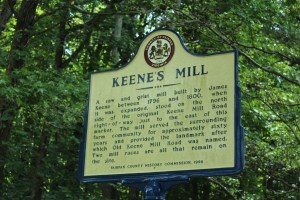
Keene Mill Historial Marker on Huntsman Rd. in Springfield (Matthew Eng Photo)
Keene’s Mill was a saw and grist mill that stood approximately at the intersection of Pohick Creek and Old Keene Mill Road. I found the historical marker for the site online; it states that the mill was built “by James Keene between 1796 and 1800, when it was expanded, stood on the north side of the original Keene Mill Road right-of-way.”1 What caught my attention was the final line on the marker: “Two mill races are all that remain on the site.”
From then on, I had two goals:
Find out more about Keene’s Mill, and
Find out what a mill race was and try to find them.
History of the Mill
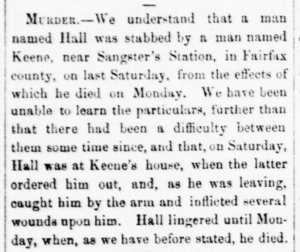
Alexandria Gazette, November 1, 1855
As I searched for information about the mill, I learned something quite shocking: William H. Keene, James Keene’s grand-nephew and owner of the mill from 1849 until 1855,2 was in jail for murder. An Alexandria Gazette article from November 1, 1855, stated that “a man named Hall was stabbed by a man named Keene . . . on last Saturday, from the effects of which he died on Monday.”3 Two days later, on November 3, the Gazette revealed that Keene was in jail. Keene did not appear again in my searches until April 4, 1856. The Gazette briefly mentioned that “Wm. H. Keene, confined in the jail of Fairfax county, for the murder of Lewis Q. Hall, escaped on Wednesday.” Further in the paper was a description:
He is about 45 years old, 5 feet 1C or 11 inches high, broad shoulders and stout made, long hair and bushy whiskers, high cheek bones, large nose turned up and spreading at the end, and depressed about the centre, small grey eyes, and very bad countenance.
Alexandria Gazette, April 4, 1856
It seems, though, that Keene’s freedom was short lived—he was caught the next day and returned to jail. His trial commenced in November, and in a Gazette article on November 15, 1856, he was found guilty of murder and sentenced to hang in January 1857.
Jack Hiller, a Northern Virginia historian, took an interest in Keene’s case in the late 1980s. He meticulously combed through archives and court records to find out exactly what had happened between William Keene and “the man named Hall.” One document he found was an inquisition, held at the house of a woman named Maria Sutherland.4 The inquisition stated that “Lewis Q. Hall came to his death by William Keene on the 27th day of October 1855 by means of a knife in the hands of said Keene.”5
Another document, a statement Lewis Q. Hall signed before his death, gave a few more details: he was accompanied by a man named John Barker, and he was looking for a woman named Maria Hall. He continued, “when I left his door yard followed by said Keene and proceeded at two steps toward his mill he threw his arm around me and inflicted the wound.” He told Barker that he had been cut. A third document, Barker’s testimony, stated that he saw Keene take out the knife and stab Hall; Keene then invited Barker for a drink and Barker accepted, but since Keene could find no liquor and Hall followed, Barker took Hall to Maria Sutherland’s home. The cut was quite bad; Barker said, “the bowels had come out through the cut.”6
Hiller puzzled over this turn of events, asking why Keene would attack Hall for no reason, or why Barker would accept the invitation for a drink, even when he knew Hall was wounded. Hiller suggested that none of them were “rational,” and it turns out he was correct. Hiller recounted several letters from Keene’s family members and acquaintances, all lending their own extra details: drinking may have been involved, “Maria Hall” was a red herring, and it was all an accident.7 One letter even said that one of the jurors had been pressured by the other jurors to give a guilty verdict.8
In light of this evidence, the governor of Virginia at the time, Henry Wise, postponed Keene’s punishment twice. Eventually, Wise commuted Keene’s punishment to ten years in prison. In 1857, Keene went to the Virginia State Prison in Richmond; he was forty-seven at the time. Keene’s fate after that is unknown; any prison records that may have existed were destroyed in the Civil War.9
Keene Mill property drawn by Jack Hiller (Jack Hiller)
The property was sold in 1857, and records indicated that by 1869 the mill was no longer standing.10 Since then, the land had changed ownership several times. Portions of it were abandoned and others developed. One account of the Old Keene Mill Road development read, “What is now Old Keene Mill Road was originally called Rolling Road No. 2. It was built by William Fitzhugh to transport his tobacco to market in Alexandria. In the 1920s, the rise of the automobile led to confusions between the two Rolling Roads. As the Keene Mills had ceased operation, Rolling Road No. 2 was renamed “Old Keene Mill Road.”11 However, I could not locate any other sources or information about it, though Hiller mentioned that Old Keene Mill Road, once two lanes, was converted to four lanes in 1979.
Currently, the land is that contains the mill races is part of the Fairfax County Park Authority.
Searching for the Mill Races
When I began my research, I had no idea what a mill race was. However, I was intrigued that such an odd part of history still had some visible traces, and I wanted to find them. I found out that mill races were man-made channels that essentially run water to and from mill wheels, so we’d be looking for ruts in the land, essentially. One other person had looked for—and found—the mill races in the winter of 2009 and provided photos, so I was convinced we’d be able to find them.12 The same person also noted that a Keene family graveyard was nearby, in a subdivision.
I’d underestimated how tough it would be to find the mill races in the summertime. Also, the day before we’d had tropical-storm-level wind and rain, so the ground was soft, wet, and extremely muddy. Nevertheless, Matt and I entered the Pohick Trail one hot afternoon. The trail ended as fast as it began. From the end of the trail on, there was a carpet of green and fallen branches with no indication of where to go. Matt forged ahead, though, and moved deeper into the woods.
“What direction should we go?” he asked.
“The guy in the article said he walked in the direction of Pohick Creek,” I answered. So we moved on. Nothing resembling what we’d seen in the photos was visible. I tried to remember that the photos were taken over a decade ago and in the dead of winter, so they’d definitely look different by now. Our feet squished in the earth and thorns ripped at our jeans. I walked into multiple spiderwebs, which reminded me I was definitely not an outdoorswoman.
I did, however, feel an appreciation for the history that had happened on this land. Somewhere nearby, Lewis Hall and William Keene had gotten into a fight. Hall had died and the course of Keene’s life had changed forever—and the mill for which the road was named would only exist another ten or so years.
We eventually came upon the creek. It was a pretty, quiet space. The water ran clear, an indication that human hands hadn’t meddled with it too much. However, the beer cans nearby suggested that we weren’t the only ones who had ventured this far into the woods. We both recalled Hiller’s hand-drawn map of the mill races, and walked up the creek trying to find one of them.
Possible section of mill race off Pohick Creek (Matthew Eng Photo)
Eventually we came upon a small rut in the earth that fed into the creek. If our map calculations are correct, this was one of the mill races. We decided to walk further down along the creek and see if we could find the other one. We found piles of hand-cut stones, and, after consulting the map and a couple of other sources, surmised that they may have been pieces of the original Old Keene road.13
We blundered around for a bit and thought we may have found the other mill race, but as we walked, we realized it was just a man-made runoff. Along the way, we found a large rusted-out car, more beer cans, and deer tracks.
Keene family plot, Fairfax County (Matthew Eng Photo)
When we emerged from the woods, a storm was threatening. There was no way we could venture back in, so we decided to review our photos when we got home. We did, however, track down the Keene graveyard. It sat right in the center of a townhome complex about a mile and a half away—a small fenced-in plot with two visible gravestones, one of which read “Addison Keene.” A couple of yards away, a kid played on a basketball court and watched us with a wary eye.
Conclusion
I met both the goals I set for myself. I did find out more about Keene’s Mill—most notably that the final Keene that owned the mill was tried for murder, found guilty, sentenced to hang, escaped from prison, and eventually had his death sentence commuted. I do have to wonder if anyone who named the road, the school, the shopping centers, and the residential complexes knew of this history. It’s a subtle reminder that roads and other places could be named after people or events with a dark past.
As for the mill races, I’m not completely sure we found one. However, having the opportunity to hike through the woods and experience something I wouldn’t have otherwise was a treat—mosquito bites and all.
Footnotes
“Keene’s Mill Historical Marker,” HMdb.org: The Historical Marker Database, last modified July 29, 2016, Link.
Hiller, Jack. “Murder at the Mill: My Search for William H. Keene,” Online PDF. According to Hiller, Keene turned the mill over to a Fairfax attorney in 1855 and gave him the power to sell it pay off legal and personal debts.
Alexandria Gazette, Nov. 1, 1855.
Hiller, “Murder,” 57. The house where Barker took Hall after the stabbing.
Hiller, “Murder,” 55.
Hiller, “Murder,” 56.
Hiller, “Murder,” 58-60.
Hiller, “Murder,” 61.
Hiller, “Murder,” 78.
Hiller, Murder,” 77.
John Pasierb, “Was There Ever a Mill on ‘Old Keene Mill’ Road?” accessed on August 1, 2020, Link.
Andy99. “Suburban Archaeology 1: On the Trail of Keene’s Mill,” March 22, 2009, Link.
(This is the second of a three-part series on Alexandria’s historic Wilkes Street Tunnel. Read PART I)
Matthew Eng, Offbeat NOVA
PART II: The Curious Case of Mollie McKinney
Naturally, the track fell into disrepair during the Reconstruction period, adding insult to the already dilapidated condition of the tunnel. At one point, there was a resolution that instructed the Committee on Streets to take steps to have the problematic east end of the tunnel walled in and filled. The resolution never gained any speed and was soon forgotten.1
After the Panic of 1873, the railroad consolidated into the Virginia Midland Railway, one of the many times the tracks under the tunnel would change corporate hands before ultimately meeting its end as a rail tunnel over a hundred years later. The tunnel became a popular place for young boys and aspiring prepubescent vagabonds to congregate, arousing the suspicions of the citizens of tunnel town. The police reported several instances of vagrancy for these boys, who had the habit of jumping from the top of the tunnel onto the passing cards below. “This is an exceedingly dangerous practice,” said one concerned citizen, “and should be put a stop to by police before some of these bold children are crushed under cars.” Meanwhile, the tunnel continued to be as one person put it, “not only unsightly, but dangerous.” The people of tunnel town and Alexandria would soon find out how dangerous it could be on an unusually cool day in the late summer of 1882.2
Alexandria Gazette, August 17, 1882
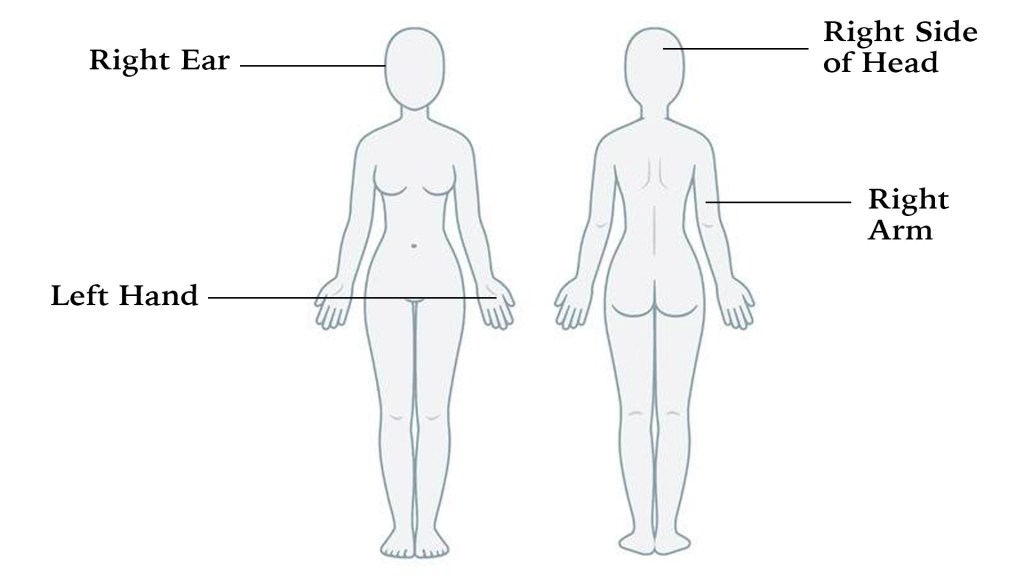
Twenty-two-year-old James Cliff walked with his young wife Mollie McKinney on the morning of August 16, 1882, to the Potomac Ferry Company Wharf. Mr. Cliff’s sixteen-year-old bride fancied a trip to Washington, D.C. Money was tight for the young couple. Mollie had allegedly come up with funds for a nice trip into the big city. At the time, the couple had only been married for about five months. Three months after they were married, Mr. Cliff was let go from his job as a tinsmith due to poor health, draining their cash flow considerably. Although he protested her trip that morning, he insisted on escorting his wife. Mr. Cliff suggested they take a shortcut to the ferry on King Street through the Wilkes Street tunnel. Midway through the tunnel, at its darkest and most concealed point, James slapped his wife and drew a small caliber pistol and proceeded to fire several shots at her. Mollie was hit in four places: on her right ear, on her head above the ear, in the fleshy muscle of her right arm, and her left hand. Ms. McKinney’s screams were heard by several people in the neighborhood, yet nobody seemed to detect foul play at first glance. Two young boys who happened to be walking through the tunnel at the time of the struggle had a visual on the struggle in question. Upon hearing Mollie’s cries, they approached the helpless woman before being told by Mr. Cliff to turn around and leave, who reportedly fired two shots at them. Mrs. Cliff emerged from the tunnel moments later, visibly weeping and covered in her own blood. Mr. Cliff followed close behind his wife, carrying himself cool and calm as if the recent burst of violence were merely a lover’s quarrel.3
Mr. Cliff stopped to chat with several parties in attendance nearby, admitting to them that he had in fact shot his wife. “So great was the surprise at his action,” the article stated, “that no one attempted to arrest him.” He proceeded to walk casually down Royal Street in the direction of the canal. Several women encountered the gravely wounded Mollie McKinney on the corner of Royal and Wilkes and escorted her home. After nearly passing out from blood loss, the helpful women brought her back to life until a doctor arrived to remove what projectiles he could out of her body. The doctor removed the balls from her hand and arm but waited to remove those in her ear and head until she had “calmed down.” The wounds were serious, but not fatal, thankfully.4
Mollie was hit in four places on her body by her husband, James Cliff.
A crowd soon formed around the house of Mollie McKinney. Oddly enough, it took a great amount of time before anyone in the vicinity began to search for the husband who had walked away from the crime scene so calmly and casually. What kind of man was he, and what possessed him to make an attempt on his wife’s life?
James Cliff had spent the better part of two months sick with consumption, which forced him out of his job, unfit and unable to work. Mollie, not one to shy for the finer things of life, asked for fine clothes, food, and companionship, which her husband answered with jealousy, physical abuse, and emotional abuse. This was all well documented by those that knew the couple. Neighbors reported that Mr. Cliff was known to “whip” his wife, but not in a manner that would suspect further efforts of deeper foul play. His friends said he was possibly insane. Yet in the realm of Gilded Age romance, Mr. Cliff and Mrs. McKinney had forgivable differences. Mollie’s habit of seeking “lively company” made Mr. Cliff insanely jealous, which was likely the prime motive for the attempted murder. Such behavior is never an excuse, however distasteful it may be to a sick husband strapped for cash at the beginning of an unhappy marriage, for murder. For all intents and purposes, he casually walked away from the city unmolested.5
After the altercation, James Cliff took the Washington Road outside the Alexandria jurisdiction where he waited until evening when he returned to the city feeling too weak from his illness to move further. He went directly to his sister’s house on Duke Street. His sister proceeded to call for the police who took him into custody. The Alexandria Gazette reporter met with Mr. Cliff in his jail cell the following morning to speak to him about what happened. When the reporter arrived, Mr. Cliff was reading the very report on the incident published that morning. He then preceded to tell his side of the story, correcting the report’s ostensible misinformation “in a very indifferent manner.”6
Much of the offender’s account played out like the article from the previous day. Mr. Cliff insisted that it was his wife’s own idea to go to the wharf for the express purpose of borrowing money for a trip to Washington. Mr. Cliff stated that his wife had not secured money for a tryst in the big city quite yet. How she would get it was up for speculation. The tunnel route, in his eyes, was her idea. He also said that he had a very loving marriage with Mollie until he got sick. It was only after this that she “would never stay with a consumptive man, hoping God might paralyze her if she did.” He continued his tale of sorrows for several more lines, regaling the reporter with a litany of jealous notions and suspicious of infidelity. To him, whatever had happened in the previous morning, was justified. Meanwhile, down the street in their home, Mollie rested from her serious injuries, with one of the balls in her ear still lodged firmly in place. Sadly, the article summarizing the second day of the event ended on a somber note indicative of the time period:
“Mrs. Cliff, it is understood, does not want her husband punished for his crime, and is willing, like a woman, to blame herself entirely for the affair.”7
Alexandria Gazette, August 18, 1882
It was an ominous warning of things to come. If not prophetic.
Two months went by before there was a conclusion to the Cliff assault case. In the middle of October 1882, the Commonwealth set out to convict the prisoner James Cliff, who had the “intent to maim, disfigure, disable, and kill” his wife. Neither party had apparently seen each other since the incident in August, but circumstances that played out would prove that to be highly unlikely. After taking time for the selection of jury, witnesses were called, including Mollie McKinney herself. In a shocking turn of events, she refused to testify in court against her husband, giving no reply when asked about the events on the 17th of August. When she did finally speak up later on during questioning, she merely said that “she had nothing to tell” and objected to other leading questions that would have assuredly convicted Mr. Cliff. All the prosecutor could get from the witness after several attempts to get her to tell the truth was a smile. The smiling grew infectious, and soon laughter was heard in the courtroom. When asked if she had been talked to or influenced before the trial, she responded with a submissive and inaudible “yes.” She then refused to say anything else on the matter of the trial, which forced the prosecutor to send his star witness to jail for contempt of court for the evening. The trial reconvened on the follow day, October 16, 1882, with the witness in a hopefully better position for testimony. She agreed to “tell part, but not all” of her story. Whatever she said must not have been compelling as the end of the trial neared. Other witnesses were examined, playing into the hands of the defense, who asked for a plea of transitory insanity before the jury retired.8
Sometimes, things do not go like you think they will, especially during the Victorian Era. (Alexandria Gazette, October 16, 1882)
A verdict was reached later that evening after a short deliberation. Foreman Joseph Kauffman presented a verdict of not guilty. James Cliff, now a free man, left the court room with his wife “arm in arm, as loving as if nothing has ever happened to disturb their domestic relations.” Applause could be heard audibly in the court room after the verdict was delivered. It was said that the insanity plea put up by the defense “was worked with a success in this case that even the family of the prisoner did not anticipate.” Who would? Such was the time and delicate circumstances that let a jealous man with anger issues get away with some of the worst instances of domestic abuse. It was the unfortunately product of the time period. The vehicle for that violence was eerily enough the Wilkes Street tunnel, which provided Mr. Cliff with the perfect location to strike her in a jealous rage. The Gazette later reported that Mr. Cliff met his end later on in the Wilkes Tunnel, but that could not be confirmed at present.
If you or someone you know are being abused domestically, call the National Domestic Violence Hotline at 1-800-79907233. If you cannot speak safely, log onto thehotline.org or text LOVEIS to 22522.
(This is the first of a three-part series on Alexandria’s historic Wilkes Street Tunnel.)
Matthew Eng, Offbeat NOVA
There is an ordinary looking tunnel one-half mile away from the heart of Old Town Alexandria’s bustling King Street waterfront. The tunnel, approximately one hundred and seventy feet long, extends between South Royal and Lee Streets, passing under Fairfax Street. Long ago, the citizens that lived in its proximity referred to the area as “tunnel town” after the aforementioned structure. Nowadays, it’s better known by the name of the street it passes through: the Wilkes Street tunnel. The street and its tunnel are named after John Wilkes, a radical English statesman who championed the cause of the American colonies against King George III.
The tunnel’s connection to the city and Northern Virginia is not unlike the structure itself, with beaming rays of light peaking at either end amidst long periods of murky gloom and blackness. After awakening some of its past ghosts, maybe this in depth look at the troubled history of the Wilkes Street tunnel will coax others out of the darkness and into the light.
PART I: Tunnel Town
To tell the story of the Wilkes Street tunnel, you have to start at the creation of the Orange and Alexandria Railroad, the first set of tracks to pass through the tunnel’s arched walls. The Orange and Alexandria Railroad Company chartered the railroad in 1848. This first incarnation ran from the Potomac River docks at the far end of Union Street in Alexandria to Gordonsville in Orange County. At its peak just before the American Civil War, the railroad extended to an expanse in the Commonwealth nearly one hundred and fifty miles from Alexandria to Lynchburg.1
Bridge on Orange & Alexandria Railroad (Library of Congress Image #LC-DIG-ppmsca-33468)
T.C. Atkinson, Chief Engineer of the railroad, put a notice in the local newspaper in February 1850 for Alexandria’s portion of railroad construction, including a tunnel “about 360 feet in length with support walls, bridge, and culvert masonry.” According to former Alexandria City Archaeologist Pamela Cressey, the local firm of Malone and Crockett won the contract and soon began work in earnest.2 George H. Smoot, then President of the Orange and Alexandria Railroad, stuck a shovel in Wilkes Street between Fairfax and Lee (then-called Water Street), which became the first work done for the tunnel. By April of the following year, the American Telegraph reported that the tunnel was proceeding “with vigor” and would soon be completed. By that time, the company had already laid the rails for the Orange and Alexandria railroad on Union street.3
On May 6, 1851, the first locomotive was placed on the track for the Orange and Alexandria Rail, traveling “from the north end of Union Street to the tunnel on Wilkes Street.”4 The news snippet reported that “the performance was good, and gave general satisfaction.” The dutiful work of Malone and Crockett, however, decreased in quality after the initial victories of the tunnel design. It deteriorated so much that they were eventually taken off the project, according to chief engineer Atkinson. It was not until October 1855 that the Gazette reported that the railroad company, now in charge of construction, planned to complete the eastern end of the tunnel overlooking the Potomac River. By early July 1854, locals hoped for a speedy conclusion to the tunnel’s initial construction, as “it should not be suffered to remain in its present condition any longer.”5
The tunnel was officially completed in 1856, over budget and over schedule. The tunnel’s original intended purpose was as a route service and major connector to the railroad carrying supplies and goods from wharfs and warehouses on the Alexandria waterfront to all points south. A nearby large depot and roundabout house was located up the track in the present-day Carlyle/Eisenhower business district. The tunnel’s sandstone vaulted walls stretched to nearly sixteen feet in height at the top of its brick arch. The western end of the tunnel featured a long ramp with brick wall sides. Architecturally, it is known as a “cut and cover” bridge, a common technique later popularized by the highly unpopular Washington Metro Area Transition Authority in Northern Virginia, Maryland, and Washington, D.C.
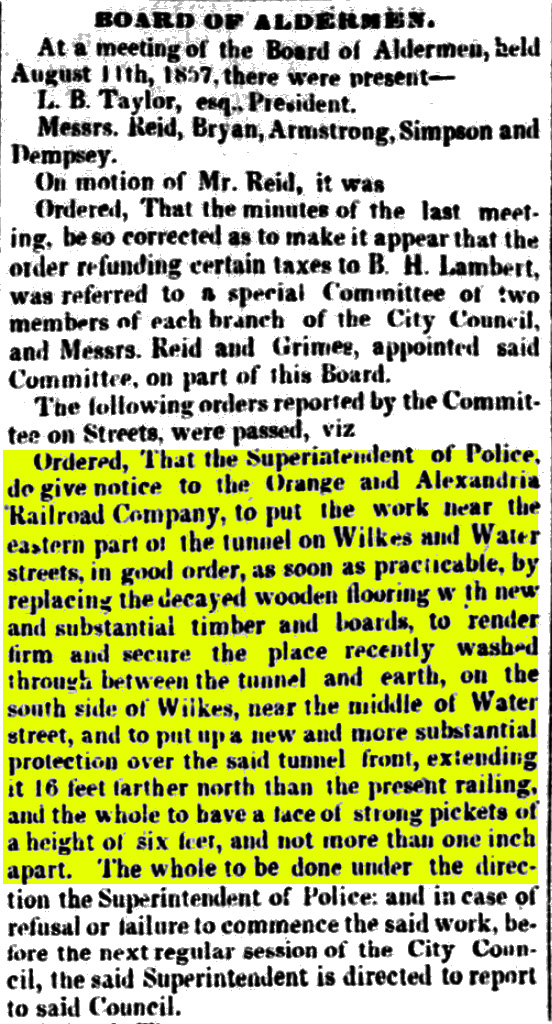
Order for the Superintendent of Police to enforce improvements on the Wilkes Street Tunnel (Alexandria Gazette, August 14, 1857)
Problems with the tunnel’s “completed” construction began almost immediately. In 1857, the Alexandria Committee on Streets reported in the Gazette about the poor condition of the tunnel, particularly the drainage and its already decaying eastern end that faced the Potomac River and Union Street.6 The tunnel’s condition became a pressing issue that continued well into the summer of 1857, coming to a head in August. The shoddy craftsmanship came up once more in a Board of Alderman meeting proceedings in the August 14, 1857, issue of the Gazette. The Superintendent of Police had given notice to the Orange and Alexandria Railroad Company to “put the work near the eastern part of the tunnel on Wilkes and Water Streets, in good order.” The work to be done included the replacement of decaying wooden flooring with new timber and better protection on the tunnel’s front. The same order was later published in the newspaper in November and April of the following year, so it is unclear when the work was actually finished, if at all.
Alexandria’s location to the proximity of Washington, D.C., made it an important political stop for many candidates seeking victory in the hotly contested election of 1860. Locals came out to support then-Presidential candidate and Alexandria native John Bell and the Constitutional Union Party in a torch-light procession and meeting on September 28, 1860, less than two months before election day. With a large sign emblazoned with an eagle declaring, “The Constitution, the Union, and the Maintenance of the Laws,” a train carrying Bell traveled through the Wilkes Tunnel on its way to the White House amongst a throng of “Tunneltown boys” carrying big bells and cheering huzzahs and other garish exultations. This is the first instance that you see a newspaper refer to the area around the Wilkes passageway as “tunnel town.” The article ended with a conclusive “assurance” that Alexandria would “speak for the Union in November next, in thunderous tones.” It was hardly thunderous. Bell was embarrassed in the election, and Alexandria voted to secede in 1861 at the start of the American Civil War.7
During the war, Alexandria was a city with Confederate sympathies that quickly fell back into the watchful eye of the Union across the river on May 24, 1861, remaining in Federal hands until the end of the conflict. During that time, the Union Army made the city a major center for troops and supplied being sent to the front lines. Wounded soldiers were brought back to local hospitals in the area, like the Lyceum and, perhaps most famous, Mansion House Hotel depicted in the short-lived PBS series Mercy Street. The Orange and Alexandria Railroad, like so many others at this time, were also taken under control by the Union Army for the war effort, which included the use of the Wilkes Tunnel.
It was not until this brief period of Federal occupation that we begin to see the dark history connected to the tunnel. The Alexandria Gazette, a paper that decidedly leaned its journalistic integrity towards the Confederacy, included several stories of odd occurrences and malfeasance by Union soldiers in the dark tunnel. After the first major battle in Manassas (Bull Run), the newspaper reported that a woman threw rocks collected in her apron at “panic-stricken” Union Zouave soldiers as they escaped through the tunnel onto awaiting gunboats along the Alexandria waterfront. It was the first “baptism of fire” for these men, but hardly the last casualty in Alexandria during the war.8
Under the heading of a “SERIOUS ACCIDENT,” the Gazette reported on the first major incident involving the tunnel in occupied Alexandria on August 26, 1862. According to the brief writeup, a soldier’s right leg was cut clean off above the ankle after lying on the railroad track at the eastern entrance to the Wilkes Tunnel the previous night. He was undoubtedly under the “influence of liquor” and, in an attempt to cross the track, fell with his leg across the rail as a locomotive passed over it, too drunk to move out of the way in time. He was later taken to a hospital and treated for his injuries. It was never reported on the condition of the soldier afterwards. It’s clear from this incident and other snippets from the paper that the Federal occupying force were adept at finding new ways of causing trouble as time dragged on and idleness set in. The newspaper also reported on the necessity to clear out Union stragglers around the city “who had thronged the streets” outside of their encampments.
Some time later in 1864, it was also reported that some “fiends” who murdered an individual put his dead body on the tracks near the western end of the tunnel. The corpse’s head was crushed as an oncoming train on the rail passed over it. It was never specified if the individuals responsible were Union soldiers or local citizens.9
Pvt. Scotten walked into this entrance and never walked out. (Matthew Eng Photo)
The most heinous and unsettling event of the war period occurred two years later in March 1864. On Friday, March 11, 1864, James Scotten of Company G, 4th Regiment, Delaware Volunteers, walked into the Wilkes Tunnel at around six o’clock in the evening and never walked out. According to the report, Scotten was approached by an individual and stabbed in the back of the neck five times. One cut severed his jugular and made a “considerable incision” in his windpipe. One cut from the autopsy report showed the instrument entering the spinal column, which ultimately killed him. Despite his windpipe being cut, one civilian near the tunnel was able to hear Scotten’s pain-stricken groans. By the time he arrived, he was dead.
Scotten was seen walking into the tunnel with another individual who became the prime suspect, John Rush of the 72d Regiment, New York Volunteers. Scotten had just received four months’ pay on the day he was murdered, with very little money found on his person at the time of his death. Rush was arrested on suspicion of murder where he awaited examination. “The victim wore new clothes and there was every reason to suppose he had enlisted in order to procure several hundred dollars bounty,” the report noted. According to Army records, Rush later mustered out of the war several months later on June 8, 1864, in New York City with the rest of his battle-hardened unit. It is safe to say he was never convicted of any wrongdoing. A perpetrator of the crime was never found, and Scotten is listed as “murdered” on Delaware Civil War veteran logs and online registers today.10
Private John Rush was mustered out of the military in June 1864, indicating he was never convicted of a crime. (Matthew Eng Image)
Life continued on for the city after these two incidents in 1862 and 1864, respectively. Complaints included in the local newspaper also continued for the sake of safety after a child fell through a set of broken blanks in the tunnel and was considerably hurt. By the time the war ended, the Gazette was back to reporting on the “ruinous condition” of the tunnel that was becoming more dangerous with each passing day.11
Footnotes
Pamela Cressey, “Wilkes Street Tunnel is Important Piece of Past,” Alexandria Gazette Packet, October 19, 1995. Accessed July 11, 2020, Link.
Ibid.
The American Telegraph, April 14, 1851.
Alexandria Gazette, May 7, 1851.
Alexandria Gazette, July 1, 1854.
Alexandria Gazette, June 1, 1857.
Alexandria Gazette, September 28, 1860.
Alexandria Gazette, March 31, 1922.
Alexandria Gazette, March 10, 1909.
Alexandria Gazette, March 12, 1864.
Alexandria Gazette, September 24, 1864; Alexandria Gazette, January 10, 1865.









 Offbeat NOVA