

(This is the first of a three-part series on Alexandria’s historic Wilkes Street Tunnel.)
Matthew Eng, Offbeat NOVA
There is an ordinary looking tunnel one-half mile away from the heart of Old Town Alexandria’s bustling King Street waterfront. The tunnel, approximately one hundred and seventy feet long, extends between South Royal and Lee Streets, passing under Fairfax Street. Long ago, the citizens that lived in its proximity referred to the area as “tunnel town” after the aforementioned structure. Nowadays, it’s better known by the name of the street it passes through: the Wilkes Street tunnel. The street and its tunnel are named after John Wilkes, a radical English statesman who championed the cause of the American colonies against King George III.
The tunnel’s connection to the city and Northern Virginia is not unlike the structure itself, with beaming rays of light peaking at either end amidst long periods of murky gloom and blackness. After awakening some of its past ghosts, maybe this in depth look at the troubled history of the Wilkes Street tunnel will coax others out of the darkness and into the light.
PART I: Tunnel Town
To tell the story of the Wilkes Street tunnel, you have to start at the creation of the Orange and Alexandria Railroad, the first set of tracks to pass through the tunnel’s arched walls. The Orange and Alexandria Railroad Company chartered the railroad in 1848. This first incarnation ran from the Potomac River docks at the far end of Union Street in Alexandria to Gordonsville in Orange County. At its peak just before the American Civil War, the railroad extended to an expanse in the Commonwealth nearly one hundred and fifty miles from Alexandria to Lynchburg.1

T.C. Atkinson, Chief Engineer of the railroad, put a notice in the local newspaper in February 1850 for Alexandria’s portion of railroad construction, including a tunnel “about 360 feet in length with support walls, bridge, and culvert masonry.” According to former Alexandria City Archaeologist Pamela Cressey, the local firm of Malone and Crockett won the contract and soon began work in earnest.2 George H. Smoot, then President of the Orange and Alexandria Railroad, stuck a shovel in Wilkes Street between Fairfax and Lee (then-called Water Street), which became the first work done for the tunnel. By April of the following year, the American Telegraph reported that the tunnel was proceeding “with vigor” and would soon be completed. By that time, the company had already laid the rails for the Orange and Alexandria railroad on Union street.3
On May 6, 1851, the first locomotive was placed on the track for the Orange and Alexandria Rail, traveling “from the north end of Union Street to the tunnel on Wilkes Street.”4 The news snippet reported that “the performance was good, and gave general satisfaction.” The dutiful work of Malone and Crockett, however, decreased in quality after the initial victories of the tunnel design. It deteriorated so much that they were eventually taken off the project, according to chief engineer Atkinson. It was not until October 1855 that the Gazette reported that the railroad company, now in charge of construction, planned to complete the eastern end of the tunnel overlooking the Potomac River. By early July 1854, locals hoped for a speedy conclusion to the tunnel’s initial construction, as “it should not be suffered to remain in its present condition any longer.”5
The tunnel was officially completed in 1856, over budget and over schedule. The tunnel’s original intended purpose was as a route service and major connector to the railroad carrying supplies and goods from wharfs and warehouses on the Alexandria waterfront to all points south. A nearby large depot and roundabout house was located up the track in the present-day Carlyle/Eisenhower business district. The tunnel’s sandstone vaulted walls stretched to nearly sixteen feet in height at the top of its brick arch. The western end of the tunnel featured a long ramp with brick wall sides. Architecturally, it is known as a “cut and cover” bridge, a common technique later popularized by the highly unpopular Washington Metro Area Transition Authority in Northern Virginia, Maryland, and Washington, D.C.
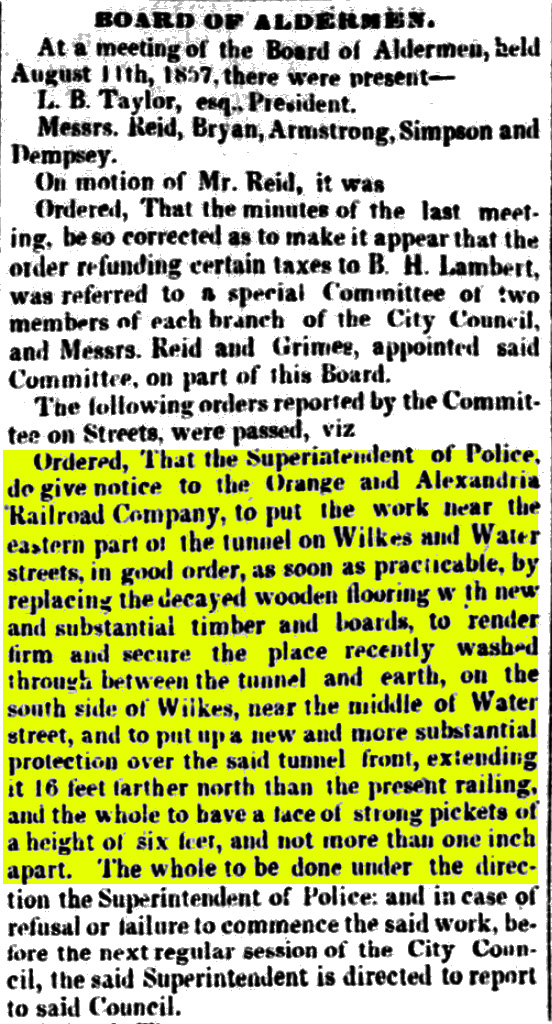
Problems with the tunnel’s “completed” construction began almost immediately. In 1857, the Alexandria Committee on Streets reported in the Gazette about the poor condition of the tunnel, particularly the drainage and its already decaying eastern end that faced the Potomac River and Union Street.6 The tunnel’s condition became a pressing issue that continued well into the summer of 1857, coming to a head in August. The shoddy craftsmanship came up once more in a Board of Alderman meeting proceedings in the August 14, 1857, issue of the Gazette. The Superintendent of Police had given notice to the Orange and Alexandria Railroad Company to “put the work near the eastern part of the tunnel on Wilkes and Water Streets, in good order.” The work to be done included the replacement of decaying wooden flooring with new timber and better protection on the tunnel’s front. The same order was later published in the newspaper in November and April of the following year, so it is unclear when the work was actually finished, if at all.
Alexandria’s location to the proximity of Washington, D.C., made it an important political stop for many candidates seeking victory in the hotly contested election of 1860. Locals came out to support then-Presidential candidate and Alexandria native John Bell and the Constitutional Union Party in a torch-light procession and meeting on September 28, 1860, less than two months before election day. With a large sign emblazoned with an eagle declaring, “The Constitution, the Union, and the Maintenance of the Laws,” a train carrying Bell traveled through the Wilkes Tunnel on its way to the White House amongst a throng of “Tunneltown boys” carrying big bells and cheering huzzahs and other garish exultations. This is the first instance that you see a newspaper refer to the area around the Wilkes passageway as “tunnel town.” The article ended with a conclusive “assurance” that Alexandria would “speak for the Union in November next, in thunderous tones.” It was hardly thunderous. Bell was embarrassed in the election, and Alexandria voted to secede in 1861 at the start of the American Civil War.7
During the war, Alexandria was a city with Confederate sympathies that quickly fell back into the watchful eye of the Union across the river on May 24, 1861, remaining in Federal hands until the end of the conflict. During that time, the Union Army made the city a major center for troops and supplied being sent to the front lines. Wounded soldiers were brought back to local hospitals in the area, like the Lyceum and, perhaps most famous, Mansion House Hotel depicted in the short-lived PBS series Mercy Street. The Orange and Alexandria Railroad, like so many others at this time, were also taken under control by the Union Army for the war effort, which included the use of the Wilkes Tunnel.
It was not until this brief period of Federal occupation that we begin to see the dark history connected to the tunnel. The Alexandria Gazette, a paper that decidedly leaned its journalistic integrity towards the Confederacy, included several stories of odd occurrences and malfeasance by Union soldiers in the dark tunnel. After the first major battle in Manassas (Bull Run), the newspaper reported that a woman threw rocks collected in her apron at “panic-stricken” Union Zouave soldiers as they escaped through the tunnel onto awaiting gunboats along the Alexandria waterfront. It was the first “baptism of fire” for these men, but hardly the last casualty in Alexandria during the war.8
Under the heading of a “SERIOUS ACCIDENT,” the Gazette reported on the first major incident involving the tunnel in occupied Alexandria on August 26, 1862. According to the brief writeup, a soldier’s right leg was cut clean off above the ankle after lying on the railroad track at the eastern entrance to the Wilkes Tunnel the previous night. He was undoubtedly under the “influence of liquor” and, in an attempt to cross the track, fell with his leg across the rail as a locomotive passed over it, too drunk to move out of the way in time. He was later taken to a hospital and treated for his injuries. It was never reported on the condition of the soldier afterwards. It’s clear from this incident and other snippets from the paper that the Federal occupying force were adept at finding new ways of causing trouble as time dragged on and idleness set in. The newspaper also reported on the necessity to clear out Union stragglers around the city “who had thronged the streets” outside of their encampments.
Some time later in 1864, it was also reported that some “fiends” who murdered an individual put his dead body on the tracks near the western end of the tunnel. The corpse’s head was crushed as an oncoming train on the rail passed over it. It was never specified if the individuals responsible were Union soldiers or local citizens.9

The most heinous and unsettling event of the war period occurred two years later in March 1864. On Friday, March 11, 1864, James Scotten of Company G, 4th Regiment, Delaware Volunteers, walked into the Wilkes Tunnel at around six o’clock in the evening and never walked out. According to the report, Scotten was approached by an individual and stabbed in the back of the neck five times. One cut severed his jugular and made a “considerable incision” in his windpipe. One cut from the autopsy report showed the instrument entering the spinal column, which ultimately killed him. Despite his windpipe being cut, one civilian near the tunnel was able to hear Scotten’s pain-stricken groans. By the time he arrived, he was dead.
Scotten was seen walking into the tunnel with another individual who became the prime suspect, John Rush of the 72d Regiment, New York Volunteers. Scotten had just received four months’ pay on the day he was murdered, with very little money found on his person at the time of his death. Rush was arrested on suspicion of murder where he awaited examination. “The victim wore new clothes and there was every reason to suppose he had enlisted in order to procure several hundred dollars bounty,” the report noted. According to Army records, Rush later mustered out of the war several months later on June 8, 1864, in New York City with the rest of his battle-hardened unit. It is safe to say he was never convicted of any wrongdoing. A perpetrator of the crime was never found, and Scotten is listed as “murdered” on Delaware Civil War veteran logs and online registers today.10

Life continued on for the city after these two incidents in 1862 and 1864, respectively. Complaints included in the local newspaper also continued for the sake of safety after a child fell through a set of broken blanks in the tunnel and was considerably hurt. By the time the war ended, the Gazette was back to reporting on the “ruinous condition” of the tunnel that was becoming more dangerous with each passing day.11
Footnotes
- Pamela Cressey, “Wilkes Street Tunnel is Important Piece of Past,” Alexandria Gazette Packet, October 19, 1995. Accessed July 11, 2020, Link.
- Ibid.
- The American Telegraph, April 14, 1851.
- Alexandria Gazette, May 7, 1851.
- Alexandria Gazette, July 1, 1854.
- Alexandria Gazette, June 1, 1857.
- Alexandria Gazette, September 28, 1860.
- Alexandria Gazette, March 31, 1922.
- Alexandria Gazette, March 10, 1909.
- Alexandria Gazette, March 12, 1864.
- Alexandria Gazette, September 24, 1864; Alexandria Gazette, January 10, 1865.

 Offbeat NOVA
2 replies on “Beyond a “Ruinous Condition:” Alexandria’s Historic Wilkes Street Tunnel (PART I)”
[…] (This is the second of a three-part series on Alexandria’s historic Wilkes Street Tunnel. Read PART I) […]
LikeLike
[…] is the last edition of a three-part series on Alexandria’s historic Wilkes Street Tunnel. Read PART I | Read PART […]
LikeLike